Introduction
Think about the last app you actually enjoyed using.
It probably felt easy.
It showed you things you cared about.
It remembered your preferences.
It did not waste your time.
That feeling is not accidental.
It is the result of deliberate personalization.
And in 2026, customers expect that same feeling from every business app they use. Not just from big brands with large budgets. From every business they interact with regularly.
That expectation is reshaping how companies invest in mobile.
A few years ago, launching an app felt like enough. Businesses built something simple and customers downloaded it and that was considered a win.
That is no longer the case.
Customers now open an app and immediately judge whether it feels relevant to them.
If it shows generic content, they ignore it.
If notifications feel random, they turn them off.
If the experience feels the same for everyone, they stop returning.
The bar has moved. And personalization is what clears it.
Here is what this looks like in real situations.
‘A gym app that shows a member their own class schedule and tracks their attendance feels more useful than one that shows the same homepage to every user.’
‘A retail app that recommends products based on what someone actually bought before feels smarter than one pushing the same promotions to everyone.’
‘A service business that sends a timely follow up based on the last visit feels more attentive than one sending bulk messages on a fixed schedule.’
These are not complex ideas.
They are simple improvements that change how customers feel about a brand.
This shift is also connected to something bigger.
Businesses that invest in personalized mobile experiences gain direct access to customer behavior.
They understand what works and what does not.
They make faster decisions based on real usage data instead of assumptions.
That kind of insight is hard to get from a website alone. It is nearly impossible to build through third party platforms. But it becomes very accessible when a business owns its own mobile app and uses it well.
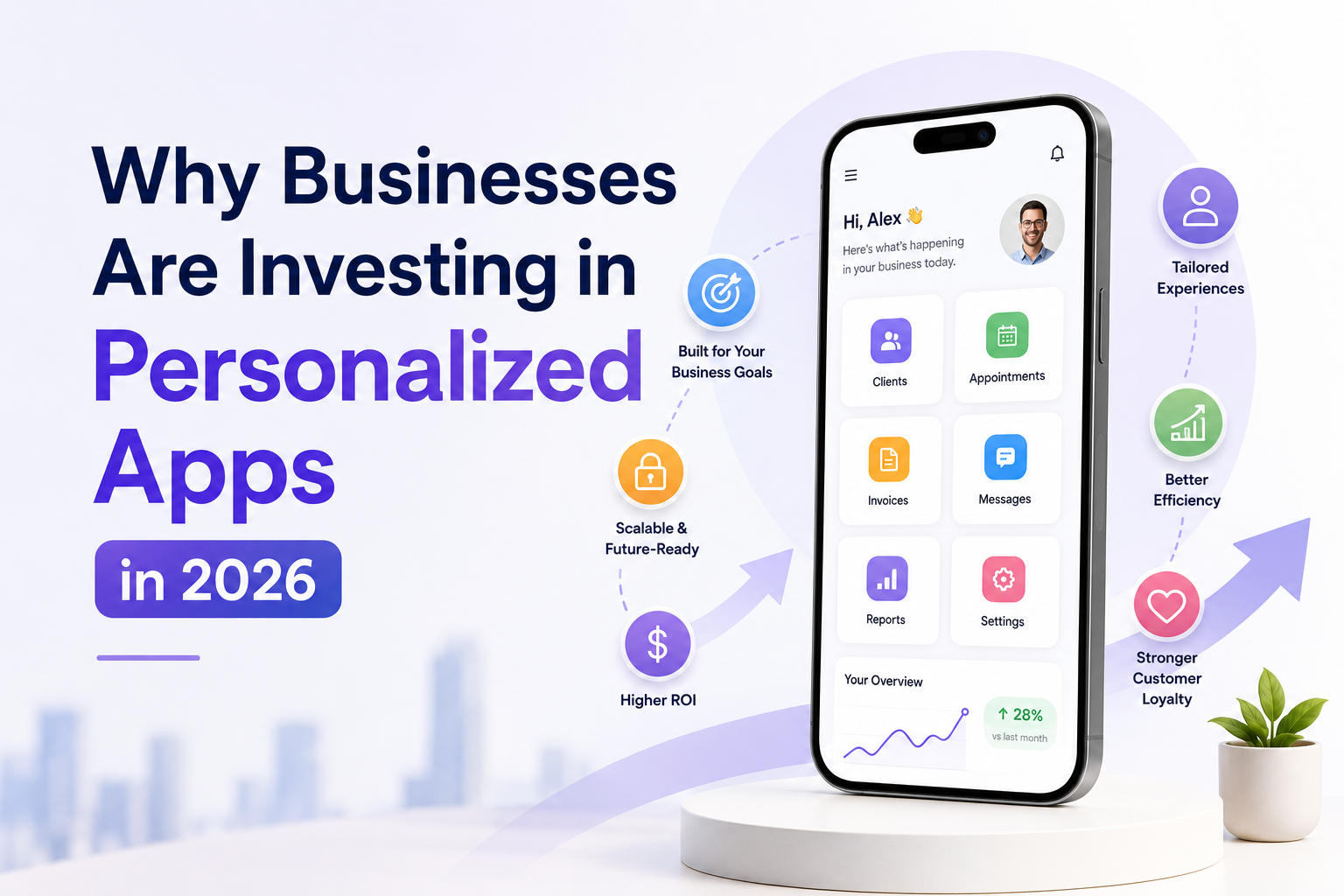
At Boolean Inc., we see more businesses prioritizing personalization in 2026 because they understand that generic experiences no longer drive the loyalty they once did.
Customers have more choices. Their attention is harder to hold. And a personalized app experience is one of the clearest ways to earn it.
In this blog, we will walk through what customers actually expect from mobile apps today. We will explore how personalization works in practice.
What Customers Actually Demand From Brands On Their Devices
Customers do not open an app just to look around.
They open it because they want something to feel easier.
That is the starting point.
In 2026, people expect a personalized mobile app experience that saves time and feels relevant from the first tap. They want the app to understand their habits without making them work for it. They want fewer steps, better suggestions and quicker access to what matters to them.
What users expect now
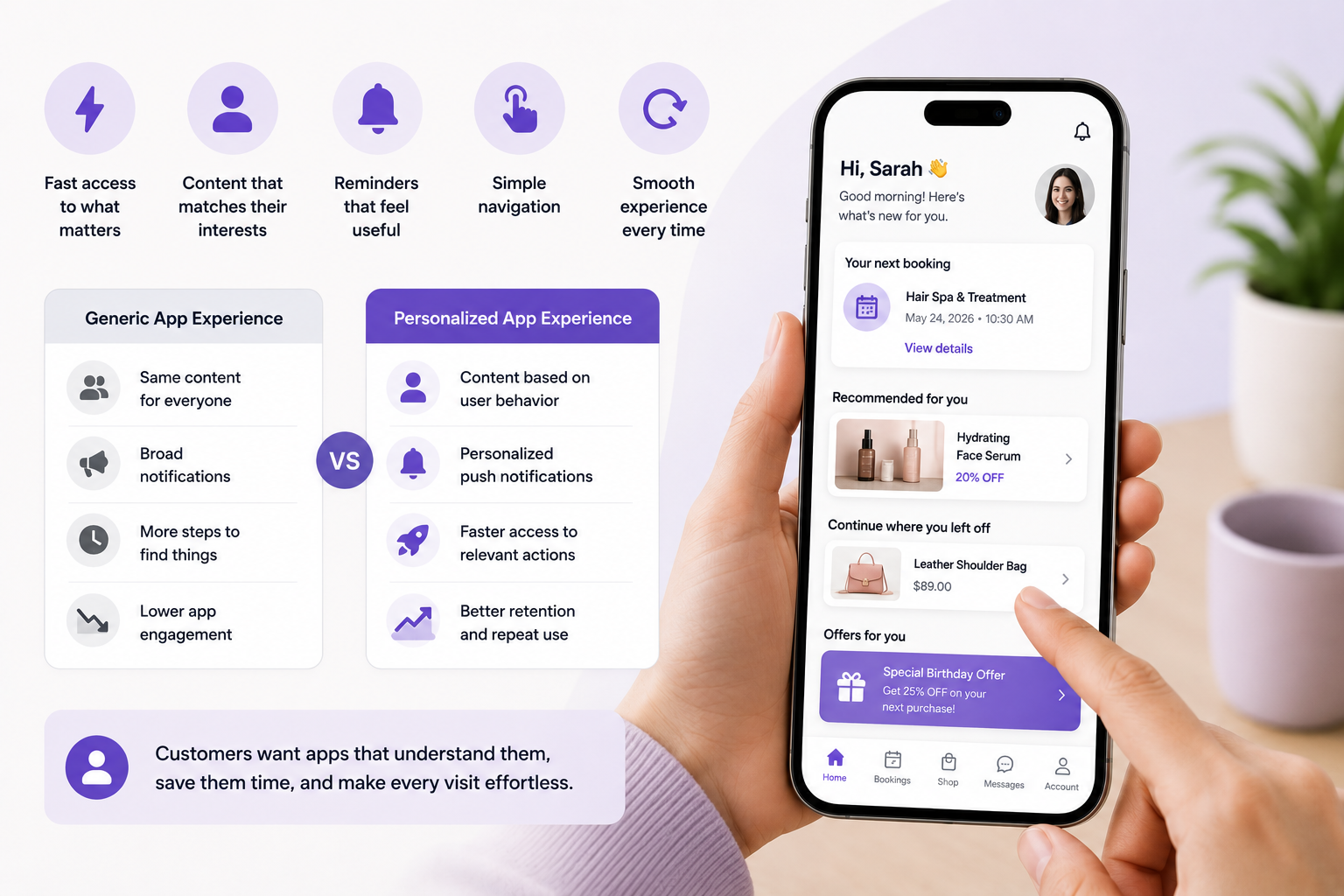
Most customers want five things from a business app:
- fast access to the things they use most
- content that matches their interests
- reminders that feel useful not random
- simple navigation without extra steps
- a smooth experience across every visit
This is why mobile app personalization matters so much now. It helps the app feel familiar. And familiar apps get used more often.
Generic experiences feel easier to ignore
If every user sees the same homepage and the same offer and the same message, the app quickly starts to feel flat.
People notice that.
A returning customer does not want to search from the beginning every time. They want the app to remember what they viewed before, what they booked before and what they may need next.
That is what creates a stronger personalized customer experience.
| Generic app experience | Personalized app experience |
| Same content for everyone | Content based on user behavior |
| Broad notifications | Personalized push notifications |
| More steps to find things | Faster access to relevant actions |
| Lower app engagement | Better retention and repeat use |
Relevance is now part of convenience
This is the part many businesses miss.
Personalization is not only about marketing.
It is also about convenience.
A customer should be able to open the app and quickly see what matters to them. That could be their last order, their next booking, recommended services and saved preferences.
When that happens, the app feels helpful instead of crowded.
This is one reason more businesses are focusing on service app experiences. They want mobile journeys that reflect how customers actually behave instead of forcing everyone through the same path.
Customers also expect brands to remember them
Not in a creepy way.
In a useful way.
They expect a retail app to remember size and style preferences. They expect a clinic app to show upcoming visits. They expect a service app to make repeat bookings easier.
These small touches improve the app user journey and make customer engagement feel more natural.
That is also why first-party data is becoming more valuable. Businesses need better visibility into customer behavior if they want to create personalized experiences that actually work.
The takeaway is simple
Customers are not asking for more features.
They are asking for better experiences.
And better experiences usually come from relevance, timing and simplicity.
That is exactly why businesses are investing more in personalized apps in 2026.
Why Owning Customer Data Makes Personalization Work
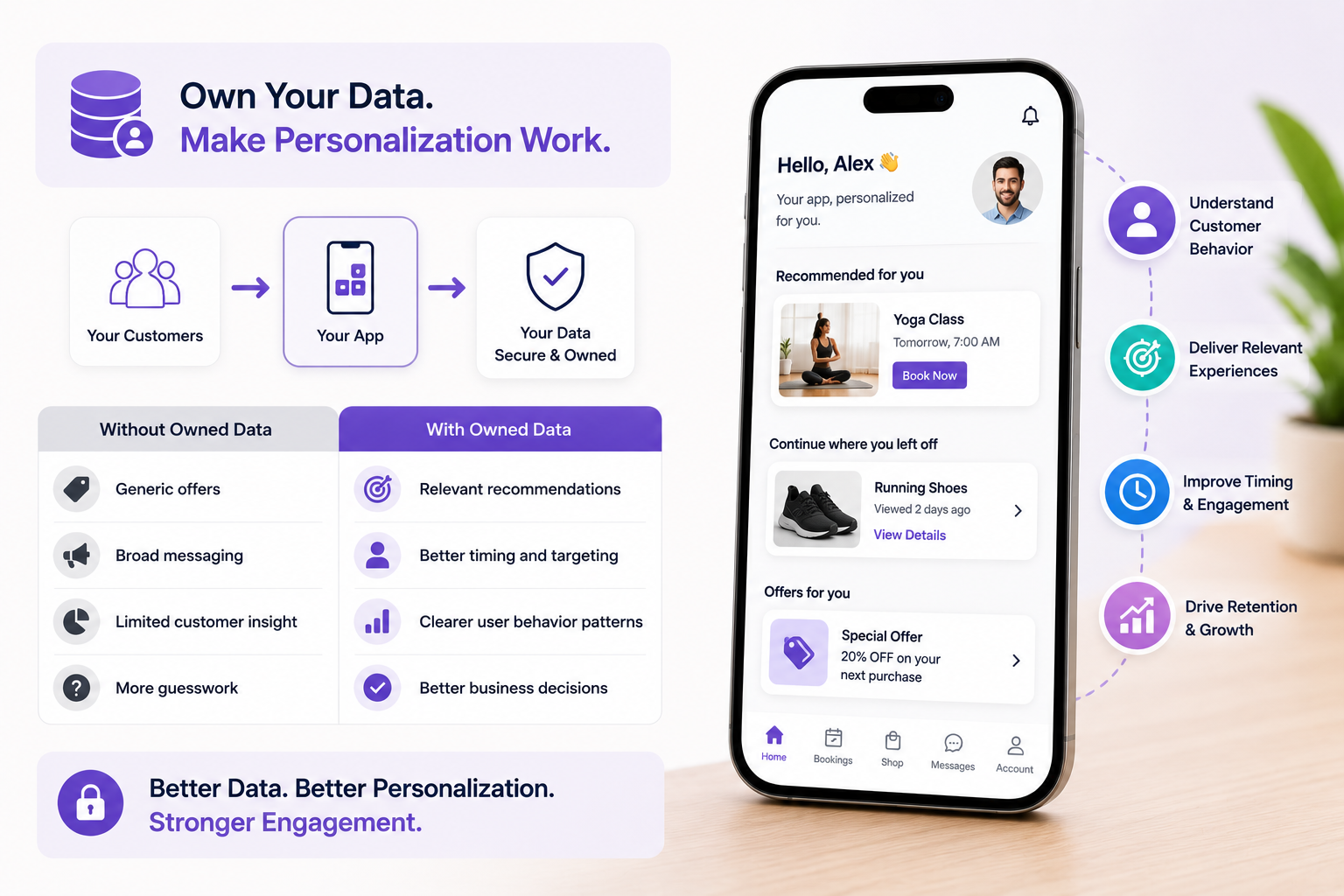
Personalization sounds simple on the surface.
Show better recommendations.
Send smarter reminders.
Make the app feel more relevant.
But none of that works well without good data.
Not borrowed data.
Not partial data.
No information is trapped inside third-party tools.
Useful personalization starts with first-party data collected through your own app.
Why this matters
A business can only personalize well when it can clearly see what customers actually do.
That includes:
- past purchases
- booking history
- viewed services or products
- preferred times or locations
- app usage patterns
- response to notifications and offers
When this information sits in one place, the app becomes more useful over time.
It can highlight the right action faster.
It can reduce unnecessary steps.
It can make the customer journey feel more natural.
The difference is easy to see
| Without owned data | With owned data |
| Generic offers | Relevant recommendations |
| Broad messaging | Better timing and targeting |
| Limited customer insight | Clearer user behavior patterns |
| More guesswork | Better business decisions |
This is one reason businesses are investing more in custom mobile apps instead of relying only on websites or outside platforms.
A custom app gives them a better chance to understand usage patterns and improve the personalized app experience over time.
At Boolean Inc., this is often where the biggest shift happens. Once a business starts using its own mobile app to collect and organize customer information, personalization becomes more practical and much easier to improve.
Personalization gets stronger with better visibility
A business does not need to know everything.
It only needs enough useful context to make the app more helpful.
For example:
- showing recently used services first
- sending reminders based on real activity
- highlighting relevant offers instead of broad discounts
- making repeat actions easier to complete
These small adjustments improve mobile customer engagement and support better customerretention.
That is also why more companies are focusing on owning customer data through their own mobile apps. Better visibility leads to better personalization. And better personalization usually leads to more repeat use.
The real value is not just marketing
This is important.
Owned data does not only help with promotions.
It helps the whole app experience.
It improves navigation.
It improves timing.
It improves app content.
It improves how the business responds to customer behavior.
That is what makes personalized mobile app experiences more effective in 2026.
Not louder messaging. Better understanding.
How Businesses Are Using App Behavior to Improve Decisions
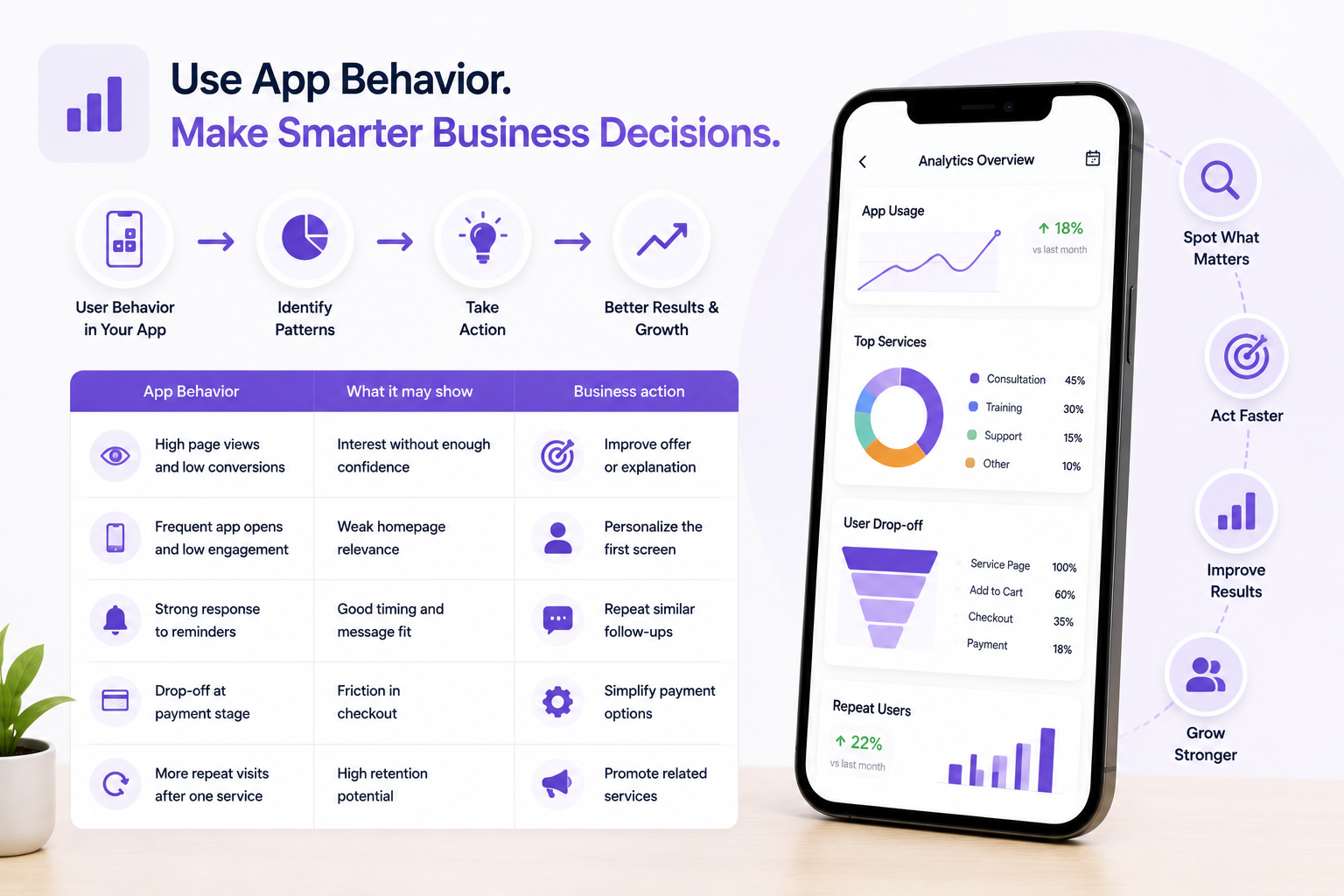
Personalization does not end with the customer screen.
It also changes how businesses make decisions behind the scenes.
When a mobile app shows how people browse, book and return and drop off, patterns become easier to spot. Those patterns help teams make better choices without waiting too long or relying on assumptions.
That is one of the biggest reasons personalized mobile app experiences are getting more investment in 2026.
App behavior reveals what is working
A mobile app can show useful signals such as:
- which services get the most attention
- where users leave the journey
- which notifications lead to action
- how often people return to the app
- what customers do before making a booking or purchase
This kind of visibility helps businesses understand what to improve.
Not based on guesswork. Based on actual use.
A simple example
If one service page gets many views but very few bookings, the issue may be pricing or clarity. If users open the app often but stop before checkout, the payment step may need work. If repeat users respond well to one type of reminder, that message style may be worth using more often.
These are small signals.
But small signals often lead to better business decisions.
| App behavior | What it may show | Business action |
| High page views and low conversions | Interest without enough confidence | Improve offer or explanation |
| Frequent app opens and low engagement | Weak homepage relevance | Personalize the first screen |
| Strong response to reminders | Good timing and message fit | Repeat similar follow-ups |
| Drop-off at payment stage | Friction in checkout | Simplify payment options |
| More repeat visits after one service | High retention potential | Promote related services |
Faster insight leads to faster action
This matters because delays cost opportunities.
If a business sees a useful pattern early, it can act while the issue is still small. If the signal comes too late, the chance to improve may already be gone.
That is why personalized apps often work well alongside real time business data. The app does not only serve the customer. It also gives the business a clearer view of what is happening right now.
Better insight also improves internal planning
App behavior can support decisions around:
- marketing timing
- service availability
- pricing strategy
- follow up communication
- feature updates
- customer retention efforts
This is where personalization becomes more than a front-end feature. It starts shaping the wider business strategy.
That is also why more businesses are exploring AI driven mobile insights to understand user behavior faster and improve the app experience over time.
The result is more confidence
When the business can see what customers actually use, decision-making becomes clearer.
Less guessing.
Less delay.
Less waste.
And a much better chance of improving the app in ways that matter.
How Personalization Becomes Part of Daily Business Operations
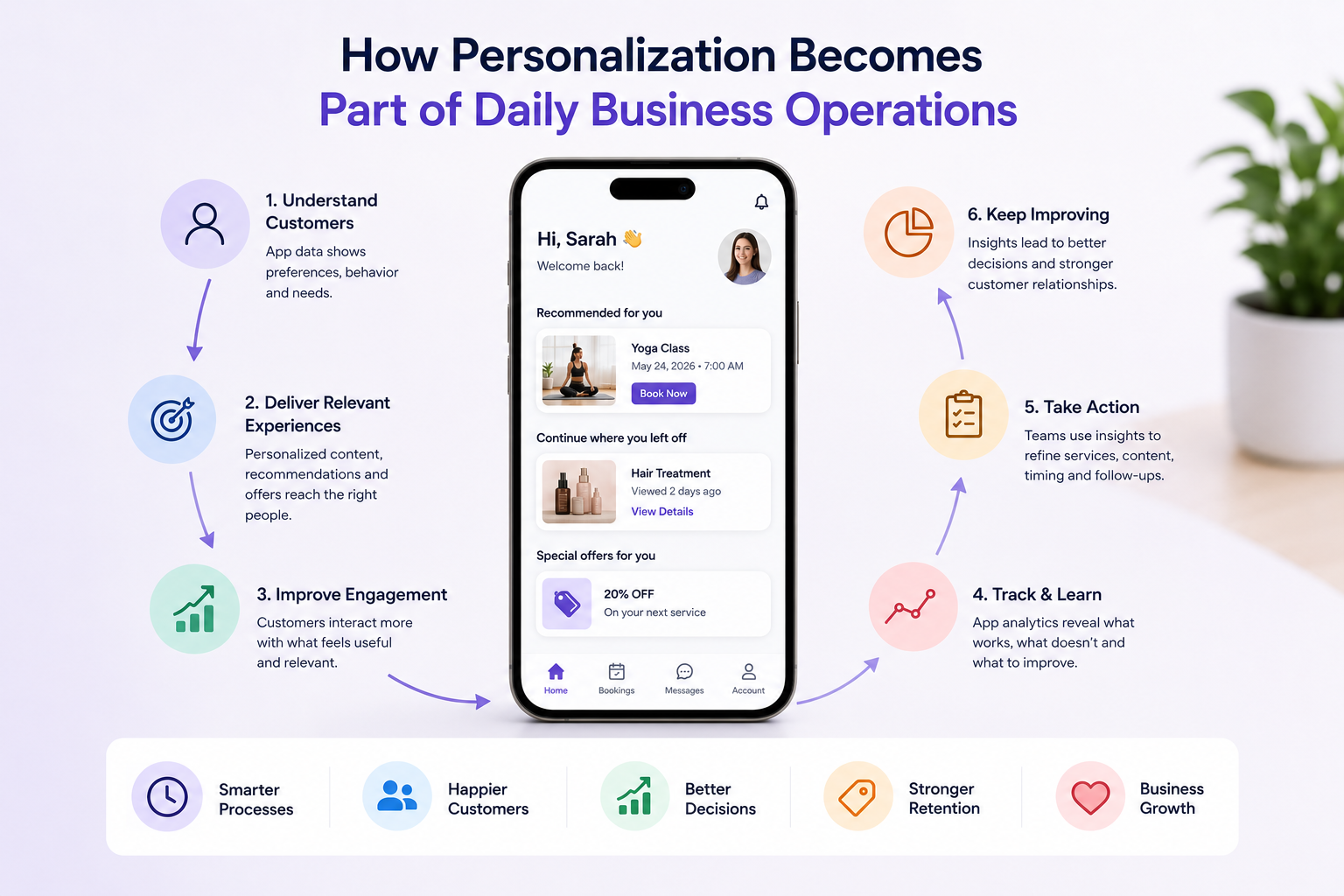
Personalization is often treated like a marketing layer.
In reality, it works best when it becomes part of daily operations.
That means the app is not only showing different content to different users. It is also helping the business deliver services, follow ups and reminders in a way that feels more relevant and more timely.
Personalization works best when it is built into the workflow
A business does not need dramatic changes to make this work.
Often, the greatest improvements come from simple adjustments to existing processes.
For example:
- booking reminders sent based on actual appointment timing
- service suggestions shown after a completed visit
- repeat actions placed first on the app screen
- support options adjusted based on recent activity
- follow ups triggered after a purchase or appointment
These are operational choices.
But they improve the customer experience at the same time.
Why this matters for growing businesses
As the customer base grows, it becomes harder to keep every interaction personal through manual effort alone.
A mobile app helps create that consistency at scale.
| Manual process | Personalized app-based process |
| Same reminder sent to everyone | Reminder based on real booking time |
| Generic homepage for all users | App screen shaped by recent activity |
| Broad follow up message | Relevant message after a specific action |
| Staff manually track repeat needs | App remembers and highlights them |
This is one reason more companies are turning business workflows into app features. Once personalization is built into the operational flow, it becomes easier to maintain and improve.
It also reduces friction inside the business
Personalized mobile app experiences do not only help users.
They also help teams.
When the app handles timing and reminders and next-step prompts more intelligently, staff spend less time doing repetitive work. That can improve service consistency without adding pressure behind the scenes.
In many cases, this connects directly with automating daily operations. The app becomes more helpful to the customer and more efficient for the business at the same time.
Personalization feels stronger when the experience is connected
A customer does not think in terms of features.
The customer notices whether the app feels smooth.
That feeling usually comes from connected moments.
The app remembers the last action.
It makes the next step easier.
It removes repeated effort.
It feels familiar without becoming repetitive.
That is what good personalization looks like in practice.
Not more noise.
Better flow.
At Boolean Inc., this is where many businesses start seeing real value. Once personalization is connected to daily operations, the app stops feeling like an extra digital tool and starts becoming part of how the business actually runs.
Why Generic Tools Are No Longer Enough for Personalized Growth
Generic tools can help a business get started.
But they usually reach a limit.
That limit becomes clear when the business wants more control over the customer journey and more flexibility in how the app experience works. At that point, personalization starts to feel restricted.
The problem with one-size-fits-all tools
Templates and ready-made platforms are built to serve many businesses at once.
That makes them convenient in the beginning.
It also makes them harder to shape around real customer behavior later.
Common limits include:
- fixed user journeys
- limited personalization options
- shallow customer data
- weak control over features
- dependence on outside systems
These tools often do the basics well. But they rarely help a business create a mobile experience that feels truly relevant and connected.
Why this matters more in 2026
As customer expectations rise, generic app experiences become easier to ignore.
Businesses need room to improve onboarding, recommendations and reminders and repeat actions. That usually requires a level of flexibility that off-the-shelf systems struggle to provide.
| Generic tool approach | Custom app approach |
| Same structure for many brands | Built around one business model |
| Limited personalization | Easier to tailor the user journey |
| Data spread across systems | Better first-party data control |
| Slower to adapt over time | Easier to improve as needs change |
This is one reason more businesses are comparing custom apps and SaaS tools more seriously now. The decision is no longer just about cost. It is about long-term growth and experience quality.
Personalization also needs independence
Businesses that rely heavily on websites, social platforms and third-party tools often struggle to create consistent app experiences. Important customer signals sit in too many places. Messaging depends on outside channels. Ownership stays limited.
That is why some companies are also focusing on reducing third party dependency as part of their mobile strategy. A stronger app experience becomes easier to build when the business controls more of the data and more of the journey.
Better personalization needs a better foundation
The goal is not to reject every simple tool.
The goal is to recognize when those tools stop matching the direction of the business.
Once personalization becomes part of retention and growth and customer experience, the app needs a stronger foundation. One that can evolve as user behavior changes and business priorities shift.
That is usually when the investment starts making more sense.
Conclusion
Personalization is no longer a nice extra.
It is becoming a basic expectation.
In 2026, businesses are investing in personalized mobile app experiences because generic interactions do not hold attention for long. A better app experience now depends on relevance and timing and smoother repeat actions.
That is what keeps people engaged.
That is what supports retention.
And that is what helps a brand feel easier to use.
The shift is not only about design or messaging. It is about building a mobile experience that fits how customers actually behave and how the business wants to grow. That often means moving beyond one-size-fits-all tools and creating stronger control over data, workflows and user journeys.
At Boolean Inc., we see this as one of the clearest mobile trends shaping business growth in 2026. The companies investing now are not only improving app engagement. They are building stronger long-term relationships through experiences that feel more useful and more personal.
The businesses that move early will have more room to learn and improve.
And that usually becomes an advantage over time.
FAQs
1. Why are businesses focusing on personalized mobile app experiences in 2026?
Because personalization improves customer engagement and makes mobile apps more useful for repeat interactions.
2. How does personalization help a business app perform better?
It makes the app more relevant by showing the right content and actions based on user behavior.
3. Do small businesses also need personalized mobile apps?
Yes, even simple personalization can improve customer retention and make the app feel more convenient.
4. Is a custom app better than a generic platform for personalization?
In many cases, yes, because custom apps offer more flexibility and better control over customer data and features.
5. What kind of personalization works best in a mobile app?
Useful personalization, such as timely reminders, relevant recommendations and easier repeat actions usually works best.