
Introduction
Business leaders are changing how they invest in technology.
For a long time, the default choice was traditional software.
Buy the system.
Install it.
Train the team.
Use it for years.
That model worked when most business activity stayed at a desk.
It does not fit as well now.
Customers move on mobile.
Teams work across locations.
Decisions happen faster.
Service expectations keep rising.
That is why mobile app investment is getting more attention in 2026.
This shift is not about following a trend.
It is about choosing tools that match how modern business actually works.
Traditional software can still handle internal tasks. But many business leaders now want something more flexible. Something easier to use. Something that improves customer experience, supports real-time communication and keeps daily operations moving.
That is where mobile apps stand out.
A desktop system may hold information.
A mobile app helps people act on it quickly.
A traditional platform may support the office.
A business mobile app can support the office, the field and the customer at the same time.
That difference matters.
It is one reason more companies are rethinking the old software model and looking at mobile as a smarter long term investment. Some are already seeing it as part of a wider competitive advantage.
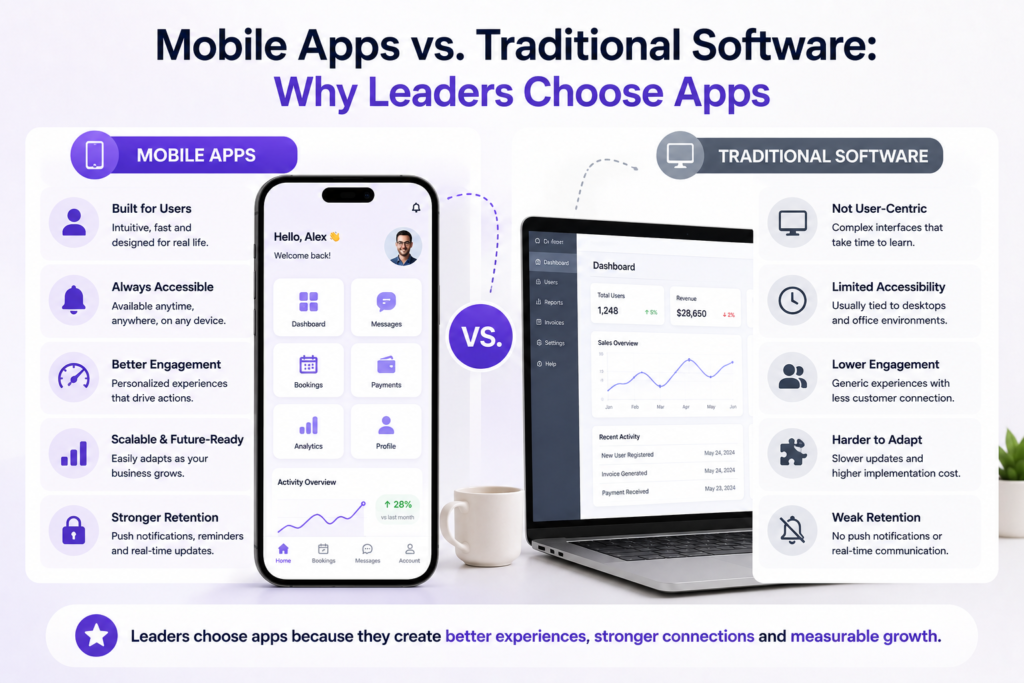
In this blog, we will look at why business leaders are choosing mobile apps over traditional software and what this shift means for growth, customer experience and operational efficiency.
What Traditional Software Gets Wrong in a Mobile-First World
Traditional software was built for a different pace of business.
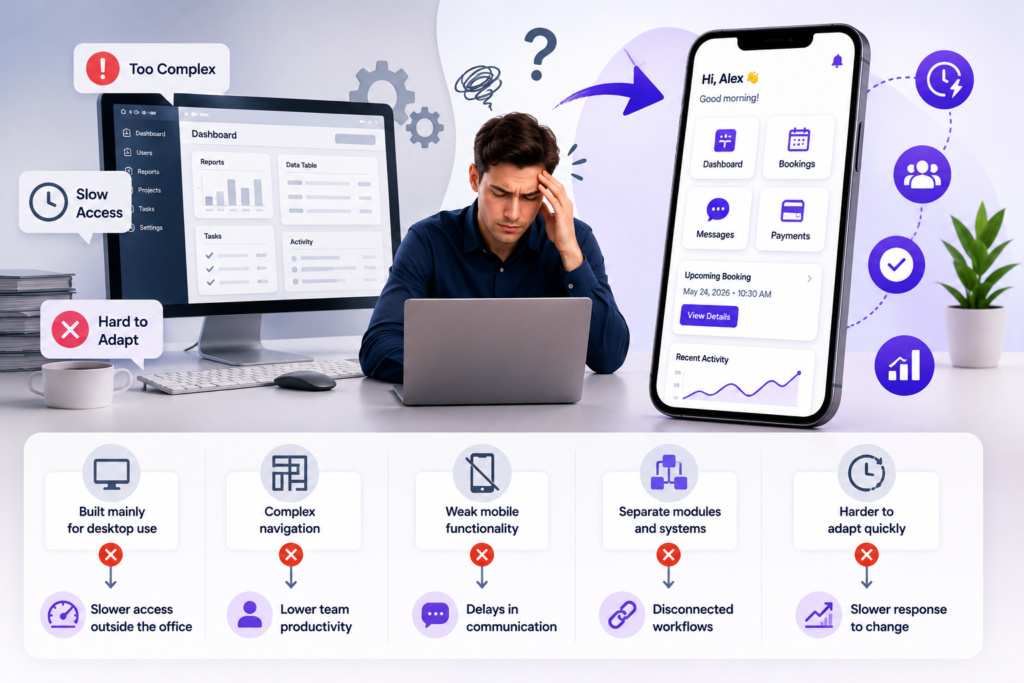
It was designed for fixed workstations and office-based teams and processes that moved in a straight line. That worked well when most work happened in one place and customers were willing to wait.
That is not how business works now.
The world moved to mobile but many systems did not
Today, work happens everywhere.
A manager checks updates while traveling.
A sales team works in the field.
A client books a service outside office hours.
A customer expects a quick answer on a phone not in a long email thread.
Traditional software often struggles in these situations because it was never designed around mobility or speed. It usually depends on desktop access, separate systems and slower workflows.
That creates friction.
The user experience often feels heavy
Many traditional business tools are powerful.
But they are not always easy.
They can involve:
- too many steps for simple tasks
- outdated interfaces
- poor mobile access
- separate logins for different functions
- slow updates across teams
This becomes a problem when the business needs faster decisions and smoother customer interaction.
| Traditional software limitation | Business impact |
| Built mainly for desktop use | Slower access outside the office |
| Complex navigation | Lower team productivity |
| Weak mobile functionality | Delays in communication and action |
| Separate modules and systems | Disconnected workflows |
| Harder to adapt quickly | Slower response to change |
It often supports the process not the moment
This is one of the biggest gaps.
Traditional software usually focuses on process structure.
Mobile apps focus on action.
That difference matters because modern business runs on moments. A customer wants to book now. A team member needs an update now. A manager wants to check performance now. A support issue needs attention now.
When technology slows those moments down it starts feeling like a barrier instead of a tool.
Customers feel the difference too
A lot of traditional software was never built with customer experience in mind.
It may help the business operate internally but it does not always help the customer move smoothly through the journey. That is why many companies are shifting toward tools that improve both internal efficiency and external experience at the same time.
This is especially clear when businesses begin turning services into mobile app experiences. The service becomes easier to access, manage and repeat. Traditional software rarely creates that kind of direct and usable customer journey.
The issue is not that traditional software is useless
It still has value.
The issue is fit.
If the business needs speed and flexibility, mobile accessibility and better customer engagement then older systems often start to feel too rigid. That is why leaders are questioning whether the old model still supports the kind of business they want to build.
Why Mobile Apps Deliver More Value Across the Whole Business
Business leaders are not choosing mobile apps just because they look modern.
They are choosing them because the value reaches more parts of the business.
Traditional software often helps one department do one set of tasks. A mobile app can support customers, staff and managers at the same time. That wider impact is a big reason mobile app investment is growing.
Value is not limited to one team
A mobile app can improve:
- customer communication
- booking or ordering
- staff coordination
- payment updates
- reporting access
- service follow-ups
- daily workflow speed
That means one investment can support both front-end experience and back-end operations.
Mobile apps create faster access
Speed matters in business.
A team member should not need to return to a desk just to check an update. A manager should not wait for a report to know what is happening. A customer should not go through five steps for something simple.
Mobile apps reduce that friction.
They make information easier to reach and actions easier to complete.
| Business need | Traditional software | Mobile app |
| Quick access to updates | Often tied to desktop systems | Available on the go |
| Customer interaction | Usually indirect or delayed | Direct and immediate |
| Team coordination | Slower across systems | Faster in one place |
| Daily tasks | More manual steps | Simpler and quicker actions |
| Business visibility | Often delayed | More real-time access |
Better value also means better adoption
This is important.
A system only helps if people actually use it.
Many traditional tools are powerful on paper but underused in real life because they feel too complex or too slow. Mobile apps usually have a lower barrier. People already understand how to use apps. That familiarity helps teams and customers engage with the system more naturally.
That leads to better usage and better return on investment.
Mobile apps also support better decision-making
When business information is easier to access leaders can respond faster.
Sales trends, booking activity and client behavior become easier to track in real time. That helps managers act earlier instead of waiting for weekly summaries or internal updates. It is one reason more companies are focusing on real time business data through mobile platforms.
The value grows over time
A mobile app does not only solve one problem.
It can keep expanding as the business grows.
A company might start with scheduling and communication. Later, it can add payments and loyalty features, internal workflow tools and customer insights. That flexibility gives business leaders more room to grow without replacing the whole system again.
That is why mobile apps often feel like a stronger long-term business technology investment than traditional software.
They are easier to build around real business needs.
And they keep delivering value in more than one direction.
How Mobile Apps Support Faster Growth Without Adding Complexity
Growth sounds exciting until the systems behind the business start falling behind.
That is where many companies struggle.
More customers should mean more opportunities. But it often brings more manual work, more disconnected tools and more pressure on teams to keep everything moving.
That is why leaders are paying closer attention to mobile apps.
They support growth without making the business harder to manage.
Growth usually exposes weak systems
A process that feels manageable with twenty clients can break at two hundred.
A team that can handle bookings manually for one location may struggle badly across five. A desktop tool that worked for a small office may slow everything down once staff need updates from multiple places.
Growth does not create these weaknesses.
It reveals them.
Mobile apps help the business scale more cleanly
A well built app can support repeat tasks without increasing the same level of effort every time.
That can include:
- booking and scheduling
- customer updates
- order tracking
- staff communication
- service follow-ups
- routine approvals
- daily reporting access
Instead of adding more layers of admin the app helps simplify the flow.
| As the business grows | Without mobile app support | With mobile app support |
| More customer requests | More manual handling | More self-service and automation |
| More staff coordination | More delays and confusion | Faster shared access |
| More locations | More disconnected systems | Better centralized visibility |
| More service activity | More admin pressure | Smoother workflow management |
Simplicity matters during growth
Leaders do not just want scale.
They want manageable scale.
A system that adds complexity every time the business expands becomes expensive in ways that are easy to miss. Staff spend more time switching tools. Managers spend more time solving process problems. Customer experience starts to vary from one channel or location to another.
This is one reason more businesses are investing in consistent mobile experiences. The app becomes a stable layer as the business expands.
Mobile apps also reduce tool overload
Growth often leads businesses to patch problems with more software.
One tool for scheduling.
One for support.
One for reporting.
One for follow-ups.
That stack gets heavy fast.
A mobile app can bring many of those functions into one place or at least make them easier to access through one simple experience. That does not only reduce complexity for the team. It also creates a cleaner journey for the customer.
Growth is easier when the system fits the business
This is where mobile apps tend to outperform traditional software.
They can be shaped around how the business actually works instead of forcing the business to adapt to rigid software logic.
That is why more leaders are paying attention to turning workflows into mobile app features. When the app reflects real operations, the business grows with less friction.
What Business Leaders Actually Look for When Choosing Technology
Technology decisions are rarely about features alone.
Most leaders are not asking which tool looks more advanced. They are asking a more practical question.
Will this help the business move faster without creating more problems?
That changes how mobile apps and traditional software are judged.
The decision is usually tied to outcomes
A business leader may not care about technical terms.
They care about results.
That usually means looking at things like:
- how quickly teams can use the system
- how easily customers can interact with it
- how well it fits current workflows
- how much visibility it gives across the business
- how hard it will be to improve later
- how much control the business keeps over data and experience
If a system scores well in those areas, it becomes easier to justify.
If it creates delays or confusion or extra dependence on outside platforms, then it starts to feel risky.
Ease of use matters more than many businesses admit
This is one of the biggest reasons some traditional systems struggle.
They may be powerful. But if the team avoids using them or only uses a small part of what they offer, then the value drops fast.
Leaders notice that.
A tool that looks strong in a sales demo but feels heavy in day-to-day work usually becomes a poor investment. A mobile app often performs better here because the format feels more familiar and more direct.
People already know how to use apps.
That lowers friction from the start.
| What leaders compare | Why it matters |
| Ease of use | Faster adoption across teams |
| Flexibility | Better fit for changing business needs |
| Speed of access | Quicker action and fewer delays |
| Customer experience impact | Stronger retention and satisfaction |
| Data visibility | Better decisions across departments |
| Long-term control | Less dependency on outside systems |
Flexibility has become a major priority
Business needs do not stay still for long.
New services get added. Customer behavior changes. Teams expand. Operations spread across more channels or more locations.
That is why leaders tend to value systems that can adapt without forcing a full reset every two years.
A mobile app often gives more room for that kind of change. It can start with a few key functions and grow over time. Traditional software can do that too in some cases but it is often slower and more rigid.
This is especially important for businesses that are building stronger direct relationships with customers. Many of them are already thinking beyond one tool or one channel and moving toward private app ecosystems that give them more control over the full experience.
Customer impact is now part of the technology decision
This shift is worth noticing.
In the past a software decision could stay mostly internal. It affected reporting, admin or finance and customers never really saw it.
That is no longer true.
Now the technology a business chooses often shapes:
- how fast someone can book
- how easy it is to get support
- how smooth repeat orders feel
- how consistent the brand feels across channels
- how personal the experience becomes over time
So when leaders compare mobile apps and traditional software, they are not only comparing internal systems. They are also comparing customer experience outcomes.
That is a very different kind of decision.
Control matters more than ever
Another thing leaders look for is ownership.
Who controls the data?
Who controls the customer journey?
Who controls the future updates?
A tool may solve a short-term need but still create long-term dependence. That is one reason many businesses are rethinking platforms that keep too much control outside the company. Leaders want systems that help them grow without locking them into someone else’s rules.
That concern is part of why mobile apps are gaining ground. They give businesses more direct contact with customers and more freedom to shape the experience over time.
The strongest investments usually do three things
In simple terms, leaders tend to back technology that:
- solves a real business problem
- gets used consistently by teams or customers
- keeps creating value as the business grows
That is where mobile apps often stand out.
They are easier to access. Easier to expand. And easier to connect to the parts of the business that matter most every day.
Real Reasons Mobile Apps Are Winning Over Traditional Software
The shift toward mobile apps is not happening because leaders suddenly dislike traditional software.
It is happening because mobile apps solve more of the problems businesses face today.
That is the real story.
Mobile fits the way people already work
Work no longer stays in one place.
Customers move between channels. Teams work from different locations. Managers need updates while away from the office. Decisions often need to happen before the day ends not after a report arrives.
Mobile apps fit that pace naturally.
Traditional software often needs more steps and more setup before someone can act. A mobile app makes access easier and that usually leads to quicker action.
A better customer experience is a major factor
Many software tools were built to support internal operations.
That matters.
But leaders are now under pressure to choose systems that improve the customer side too.
A mobile app can support booking and ordering and communication, follow-ups and account access in one place. That creates a smoother experience across the whole journey. Traditional software may support part of that process but it rarely becomes the direct customer-facing layer in the same way.
That is one reason businesses looking at personalized app experiences often choose mobile-first investment over older systems.
Mobile apps give businesses more direct control
Control is becoming a bigger issue in technology decisions.
Leaders want more ownership over customer relationships and communication and data. They do not want too much of the business experience sitting inside outside tools, they cannot shape properly.
Mobile apps help here.
They create a direct channel between the business and the user. That matters for engagement and retention and also for long-term independence.
This is why some leaders now see app investment as part of reducing reliance on outside platforms.
The value shows up in more than one place
A mobile app does not just help one department.
It can improve:
- customer support
- team coordination
- service access
- sales flow
- repeat engagement
- business visibility
That wider impact makes it easier to justify the investment. Leaders are not only paying for software. They are paying for a better business system.
| Why leaders choose mobile apps | Why it matters |
| Easier access for teams and customers | Faster action and better usage |
| Better fit for daily workflows | Less friction across operations |
| Stronger customer experience | More loyalty and repeat use |
| More direct communication | Better engagement and retention |
| More control over data and journey | Stronger long-term value |
Mobile apps keep making sense as the business changes
This is another reason they keep winning.
A mobile app can start with a few useful functions and expand over time. It can support new services, new customer needs and new workflows without forcing the whole business to start over.
That kind of flexibility matters to leaders because they are not only solving today’s problems. They are making a choice about what the business can build on next.
That is why mobile app investment keeps moving higher on the list while traditional software feels less central in many growth decisions.
Conclusion
Business leaders are not moving away from traditional software without reason.
They are moving toward something that fits the pace and shape of modern business more naturally.
Mobile apps give businesses direct access to customers. They support teams across locations. They make daily workflows faster and simpler. They create experiences that feel connected and consistent. And they keep delivering value as the business grows.
That is a different kind of return compared to most traditional software.
Traditional tools can still play a role. But when leaders weigh flexibility and customer impact and long-term control, mobile apps increasingly come out ahead.
The businesses making this shift now are not just upgrading their technology.
They are building a stronger foundation for growth.
One that travels with the customer.
One that supports the team wherever they work.
One that keeps improving as the business changes.
That is why mobile app investment is no longer a question of whether it makes sense.
For most growing businesses it is becoming a question of when to start and how to do it well.
If you are still weighing the options consider what your business needs most right now. Faster decisions. Better customer experience. Stronger team coordination. More control over data and communication.
A well built mobile app can support all of these at once.
And that kind of value is hard to find in a single traditional system.
Boolean Inc. helps business leaders move beyond the limits of traditional software by building custom mobile apps designed for modern growth and operational speed.
FAQs
1. Why are business leaders switching from traditional software to mobile apps?
Leaders choose apps because they offer better mobility for teams, faster access for customers, and a more flexible way to manage daily operations.
2. Can a mobile app replace all my traditional business software?
While some desktop tools are still needed for heavy admin, mobile apps now handle most customer-facing and field-team tasks more efficiently.
3. Is investing in a mobile app more expensive than buying traditional software?
Initial custom development can vary, but apps often provide a higher ROI by improving customer retention and reducing manual staff work.
4. How do mobile apps improve business growth compared to older systems?
Apps scale better because they allow customers to serve themselves and help teams coordinate across different locations in real time.
5. What is the biggest advantage of choosing a mobile app over a desktop tool?
The biggest advantage is speed; apps allow customers and employees to take action instantly from anywhere, rather than waiting to be at a desk.