Introduction
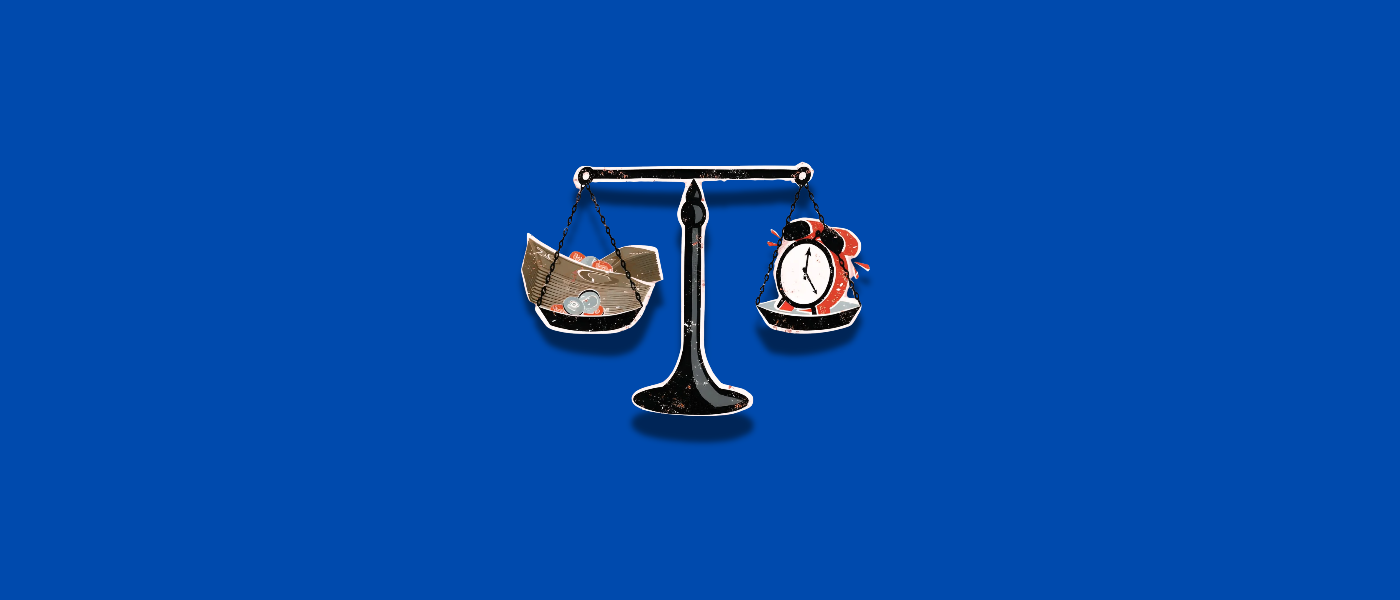
At some point, every company owner has to deal with this problem. Should you invest in a custom mobile app? Or is a ready-made SaaS tool the smarter choice?
Both options promise to make your life easier. Both claim to help your business grow. But they work in very different ways.
SaaS tools are quick to set up and easy on the budget. Custom mobile apps take more time and money upfront. Yet they offer something SaaS cannot match. Complete control over your business operations.
So which path leads to real long-term growth?
The answer depends on your goals. It depends on your budget. And it depends on where you see your business five years from now.
Many companies start with SaaS tools because they seem convenient. Later they realize those tools have limits. They hit walls. They struggle to scale. That is when the search for better solutions begins.
This blog will walk you through everything you need to know. You will learn what custom apps and SaaS tools actually are.
You will see how they compare side by side. And by the end you will know exactly which option fits your business best.
If you have ever wondered about the real hidden costs of not having a custom mobile app for your business then keep reading. This guide is for you.
What Is a Custom Mobile App?
Let me break this down in simple terms.
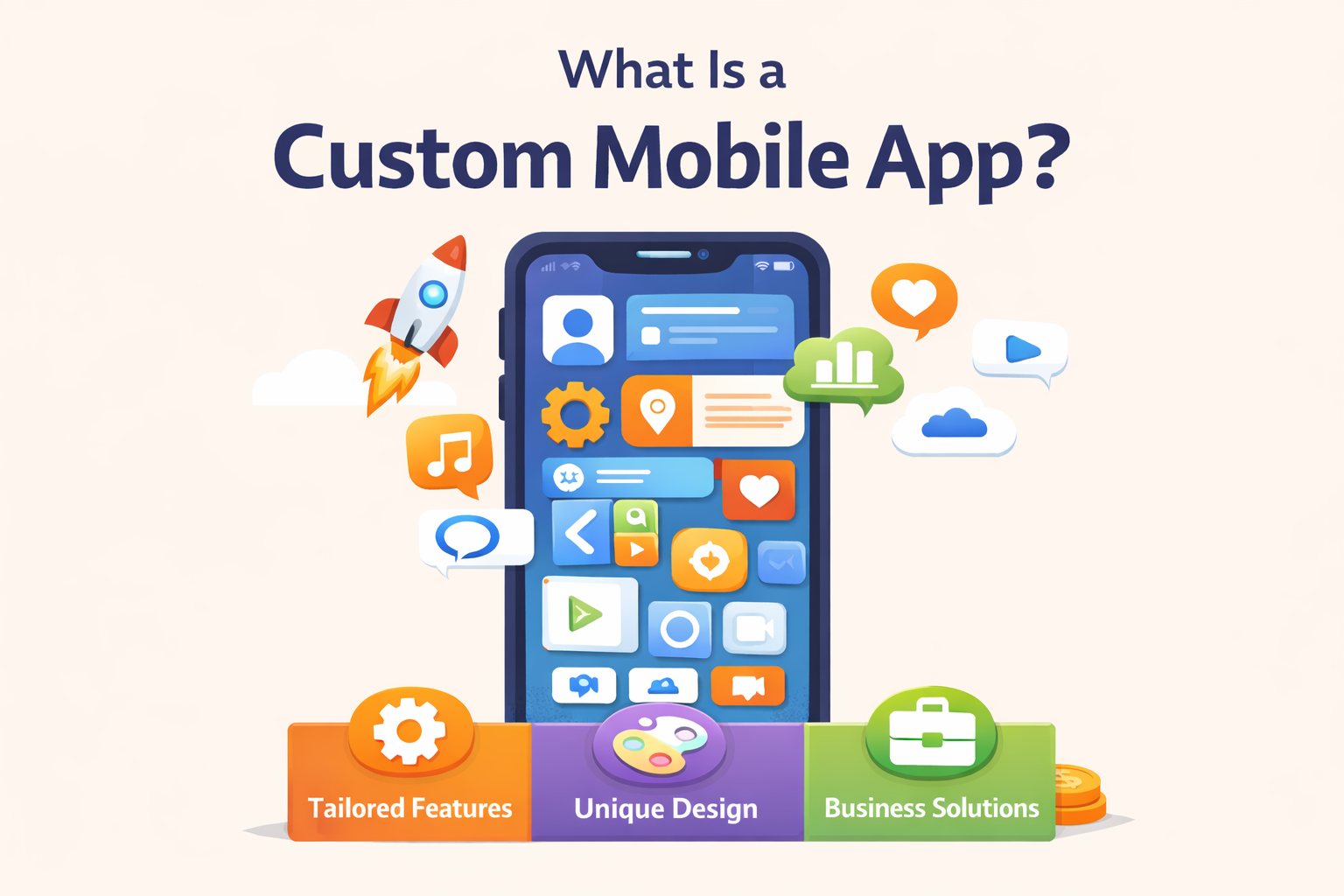
A custom mobile app is software created just for your business. Nobody else gets the same thing. It is yours from the ground up.
Picture this. You walk into a store and buy shoes off the shelf. They fit okay but not great. Now imagine getting shoes made exactly for your feet. That is the difference we are talking about here.
Generic apps try to serve everyone. Custom apps serve only you.
So, what do you actually get with a custom solution?
- Your workflows come first – The app works the way your team already operates
- Features you actually need – No clutter and no useless buttons
- Complete brand experience – Your logo, your colors, your vibe
- Total ownership – The code belongs to you and nobody can take it away
Some businesses want better customer connections. Others need their internal teams to work faster. A few simply want something their competitors do not have. Custom apps solve all these problems.
And here is the real magic. These apps grow alongside your business. Need a new feature next year? Add it. Want to expand to new markets? The app adapts.
Curious about which features actually matter? This guide on the top mobile app features every business should have breaks it all down.
Yes, custom mobile app development takes time and money upfront. But businesses playing the long game often find it worth every penny.
What Are SaaS Tools?
Now let us flip the coin.
SaaS stands for Software as a Service. Sounds technical, right? It is actually pretty simple.
A SaaS tool is software you rent instead of owning. You pay a monthly or yearly fee. In return you get access to a ready-made product that lives on the internet. No installation needed. Just log in and start using it.
Think Netflix. You do not buy movies. You subscribe and watch whatever is available. SaaS works the same way but for business software.
Chances are you already use a few SaaS tools without realizing it.
Here are some common examples:
- Email platforms – Gmail or Outlook for business
- Project management – Trello, Asana, or Monday
- Accounting software – QuickBooks or FreshBooks
- Customer management – HubSpot or Salesforce
- Communication tools – Slack or Zoom
- File storage – Google Drive or Dropbox
These tools are popular for good reasons. They are affordable to start. Setup takes minutes not months. And someone else handles all the technical headaches like updates and security.
Small businesses love SaaS because there is no high upfront cost. You test the waters without drowning in expenses. If something does not work you cancel and move on. Simple as that.
Another big plus? Access from anywhere. Your team can work from home or from a coffee shop across the world. All they need is an internet connection.
Sounds perfect, right?
Well, not always.
The catch is simple. You are using the same tool as thousands of other businesses. The features are fixed. The design is fixed. You work around the software instead of the software working around you.
Here is where things get tricky for growing companies.
What happens when you need a feature that does not exist? You wait and hope the SaaS company adds it someday.
What if they raise prices next year? You either pay up or pack up. What if they shut down completely? Your data and your workflows disappear with them.
You are essentially building your business on rented land. The landlord makes the rules. And those rules can change anytime.
For some businesses, that trade-off makes sense. Especially in the early days when budgets are tight. For others, it becomes a serious roadblock down the line. Growth stalls. Frustration builds. The search for alternatives begins.
This is exactly why understanding enterprise software solutions matters, even if you are not an enterprise yet. What you decide now will determine your business direction in the future.
Before choosing either path, it helps to understand off-the-shelf vs custom software and what works best for your business.
Custom Mobile Apps vs SaaS Tools: Key Differences
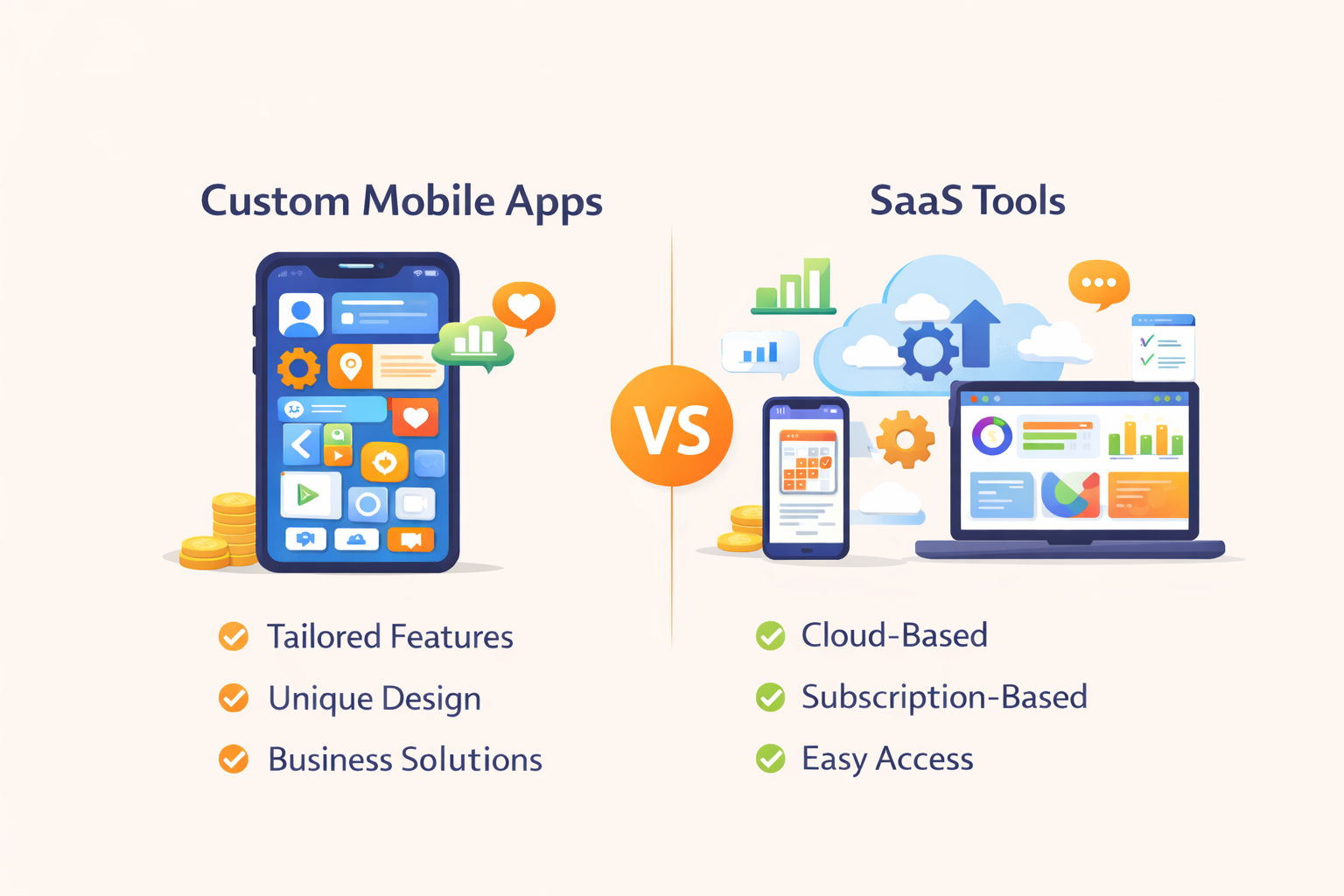
Alright. You now possess complete knowledge of both available choices. We will compare the two options directly to determine their actual performance differences.
The two options appear to resolve identical issues to their users. The two options show fundamental differences when users examine their contents more closely.
Here is a quick comparison to make things crystal clear:
| Factor | Custom Mobile Apps | SaaS Tools |
| Cost Upfront | Higher initial investment | Low monthly subscription |
| Long-Term Cost | Lower over time | Adds up year after year |
| Customization | 100% tailored to your needs | Limited to what the platform offers |
| Scalability | Grows with your business | Restricted by plan tiers |
| Ownership | You own everything | You own nothing |
| Setup Time | Weeks to months | Minutes to hours |
| Data Control | Full control | Stored on third-party servers |
| Unique Features | Build anything you want | Use what is available |
| Branding | Fully customized | Generic look and feel |
| Dependency | Zero dependency on others | Fully dependent on the provider |
Now, let us break down the big ones.
Cost
This is where most people get stuck.
SaaS looks cheaper. And in the beginning, it is. You pay fifty bucks a month and everything works. No big deal.
But fast forward three years. That fifty becomes six hundred a year. Add more users and extra features and suddenly you are spending thousands. The meter never stops running.
Custom apps flip that script. Yes, the upfront number is bigger. It stings a little. But once the app is built, you are not paying rent to anyone. The long-term math almost always favors custom solutions.
Want to plan this out properly? Here is a helpful guide on how to create an app development budget without nasty surprises.
Customization
This one is huge.
SaaS tools give you a box. You fit inside it or you do not. Need a feature they do not offer? Too bad. Want to change how something works? Not happening.
Custom apps have no box. You dream it up and it gets built. Every screen. Every button. Every workflow. It all matches how your business actually runs.
For businesses with unique processes, this is a game changer.
Scalability
Your business will not stay the same size forever. At least that is the plan, right?
SaaS tools scale to a point. Then they hit a ceiling. You upgrade to a pricier plan. Hit another ceiling. Upgrade again. Eventually, you max out what the platform can do.
Custom mobile apps scale differently. Need to handle more users? Done. Want to expand into new markets? The app adapts. There are no artificial limits holding you back.
Scalability matters more than most people realize early on. This deep dive into mobile app scalability and key factors for long-term success explains why.
Data and Security
Here is something most people overlook completely.
With SaaS, your business data sits on someone else’s servers. You trust them to keep it safe. You trust them not to use it in ways you did not agree to. That is a lot of trust.
Custom apps keep everything under your roof. You decide where data is stored. You set the security rules. You control who sees what. Period.
For businesses handling sensitive customer information, this alone can tip the scales.
Dependency
SaaS creates a relationship you cannot easily walk away from.
Your workflows live inside their platform. Your data is trapped in their system. If they change pricing or shut down a feature, you have zero say. You just deal with it.
Custom apps give you freedom. Real freedom. No third party decides your fate. You call every shot.
The differences are clear. But which one actually drives long-term growth? That is exactly what the next section covers.
Which One Supports Long-Term Business Growth?
This is the million-dollar question. And the honest answer might surprise you.
Both options can work in the short run. But long-term growth is a different game entirely. It demands tools that bend and stretch with your business. Not tools that box you in.
Let us look at this from multiple angles.
Revenue Growth
Growing revenue means reaching more customers. Serving them better. Keeping them coming back.
SaaS tools help you manage existing operations. They keep things ticking. But they rarely help you stand out. Your competitor down the street uses the exact same tool. Same features. Same limitations. Same experience.
Custom mobile apps change that equation. You create something nobody else has. Your customers get an experience built just for them. That builds loyalty. Loyalty drives repeat business. Repeat business drives revenue.
And the numbers back this up. Businesses with their own mobile apps consistently report higher customer retention rates. Higher engagement, too. People spend more time inside an app they enjoy using.
Wondering how to actually track those results? This guide on how to measure ROI for your business app walks you through it step by step.
Operational Efficiency
Here is something people do not talk about enough.
SaaS tools were built for the masses. That means your team bends its workflow to match the software. Sometimes that works fine. Other times it creates friction. Extra steps. Workarounds. Wasted hours.
Custom apps eliminate that friction entirely. The software matches your process. Not the other way around. Your team works faster because nothing feels forced.
Think about it this way. Would you rather teach your entire team to work differently? Or build something that already fits how they operate?
The answer is obvious.
Businesses that streamline operations grow faster. Period. Fewer bottlenecks mean quicker decisions. Quicker decisions mean happier customers. It is a chain reaction that starts with having the right tools.
Curious how this plays out in the real world? See how businesses can transform operations with custom mobile apps.
Scaling Without Breaking
Growth sounds exciting until your tools cannot keep up.
Imagine your business doubles in size next year. Your SaaS tool suddenly needs fifty more user licenses. The cost doubles, too. Maybe triples. And even then, the platform might not handle the load smoothly.
Custom apps are built to scale from day one. At least the good ones are. You plan for growth before writing a single line of code. More users? No problem. New locations? Easy. Additional services? Just add them.
The foundation is solid because it was built with your future in mind.
This is exactly what building scalable mobile apps for rapidly growing businesses is all about.
Customer Experience
Let us be real. Customers today expect a lot.
They want fast apps. Smooth navigation. Personalized experiences. And they will leave if they do not get them.
SaaS tools give your customers a generic experience. Nothing memorable. Nothing sticky. Just functional enough to get the job done.
Custom apps let you create moments that matter. Push notifications tailored to individual users. Personalized dashboards. Loyalty programs are baked right into the app. Features your customers did not even know they wanted.
That kind of experience keeps people around for years. Not months. Years.
And there is another angle here. More and more users prefer apps over websites. The convenience factor is massive. If you are still debating that one, check out why businesses should choose apps over websites.
Starting Smart
Now here is the thing. You do not have to build everything at once.
A lot of businesses get scared by the idea of custom app creation. They picture a huge project that takes forever and costs a fortune. But it does not have to be that way.
You can start small. Build a basic version with just the core features. Test it. Learn from real users. Then improve and expand over time.
This approach is called an MVP. It saves money and reduces risk while still moving you toward long-term growth.
Want the full breakdown? Read this comprehensive guide to MVP in mobile app development.
The Bottom Line
SaaS tools keep your business running. Custom mobile apps help your business grow.
Running and growing are two very different things. One maintains the status quo. The other pushes you forward.
For short-term convenience, SaaS wins. For long-term business growth, custom apps take the crown almost every time.
How to Choose the Right Option for Your Business
So now you have all the information. But making the actual decision still feels hard right?
That is completely normal. Every business is different. What works for a startup with five employees will not work for a company with five hundred. Context matters more than anything.
Let me make this easier for you.
Ask Yourself These Questions First
Before spending a single dollar, sit down and answer these honestly:
- Where will my business be in three years? If growth is the goal, then your tools need to grow too
- Do I have unique processes? If yes, then generic software will slow you down
- How important is customer experience? If it is everything, then a custom app makes sense
- What is my budget right now? Be honest about what you can afford today
- Am I okay with renting forever? If not, then ownership should be a priority
These questions alone will point you in the right direction. No fancy analysis needed. Just honest answers.
When SaaS Makes Sense
Look. SaaS is not the villain here. It has a real place in the business world.
SaaS tools work great when:
- You are just getting started and testing your business idea
- Your budget is extremely tight right now
- Your needs are basic and straightforward
- You do not require unique features or deep customization
- Speed matters more than anything else at the moment
A brand new business does not always need a custom app on day one. Sometimes you just need something that works. SaaS fills that gap beautifully.
The key is knowing when you have outgrown it. And being ready to make the switch before it starts holding you back.
When Custom Apps Make Sense
Custom mobile apps make sense when the stakes are higher. When growth is not just a dream but a plan.
Go custom when:
- Your business processes are unique and complex
- You need full control over features and data
- Customer experience is a top priority
- You want a competitive advantage that others cannot copy
- Long-term cost savings matter more than short-term convenience
- You are scaling fast and need technology that keeps up
If you checked three or more of those boxes, then custom is probably your answer.
The Hybrid Approach
Here is something most blogs will not tell you.
You do not always have to pick one or the other. Many smart businesses use both.
They keep SaaS tools for basic stuff. Email. Accounting. Project management. The things that do not need customization.
Then they build custom apps for the things that actually matter. Customer-facing experiences. Core business operations. Revenue-driving workflows.
This way you save money where it does not matter. And invest where it does.
It is a balanced approach that works surprisingly well. Especially for mid-sized businesses that are growing but not ready to replace every single tool overnight.
Think Long-Term, Not Just Right Now
This is the biggest mistake people make.
They choose what feels easiest today. They ignore what tomorrow looks like. Then they wake up two years later, stuck with a tool that cannot keep up. Switching costs pile up. Time gets wasted. Growth stalls.
Do not fall into that trap.
The best decision is the one that serves you now and still makes sense three years from now. Five years from now. Maybe even ten.
Short-term thinking saves money today. Long-term thinking builds empires.
A Simple Decision Framework
Still unsure? Use this quick framework:
| Your Situation | Best Choice |
| Just launched with a tiny budget | Start with SaaS |
| Growing fast and hitting tool limitations | Move to custom apps |
| Unique business model with special needs | Custom apps from the start |
| Basic operations with no special requirements | SaaS is fine |
| Customer experience is your main advantage | Custom apps all the way |
| Need a mix of both efficiency and flexibility | Hybrid approach |
There is no one perfect answer for everyone. But there is a perfect answer for you. It just takes a little clarity about where you are now and where you want to go.
Conclusion
So here we are. The big question has been answered. Or at least you now have everything you need to answer it for yourself.
Let me sum it all up quickly.
SaaS tools are easy. They are fast. They get the job done when your business is small and your needs are simple. Nobody is arguing that.
But easy does not always mean better.
Custom mobile apps take more effort upfront. They cost more at the start. They require planning and patience. Yet they deliver something SaaS never can. A solution that is truly yours. One that grows when you grow. Bends when you bend. And never holds you hostage.
Here is what it really comes down to:
- Choose SaaS if you need a quick fix and your business is still finding its feet
- Choose custom if growth is your mission and you want technology that fuels it
- Choose both if you want the best of both worlds without overcommitting in either direction
The businesses that win in the long term are not the ones that pick the cheapest option. They are the ones that pick the smartest option. The one that still makes sense years from now when everything around them has changed.
Technology should never be the thing that limits your potential. It should be the thing that unlocks it.
Ready to Take the Next Step?
If you have been considering creating a custom mobile app for your company, now is the time to move. Waiting just strengthens the distance between you and your rivals.
At Boolean Inc. we help businesses turn ideas into powerful mobile applications. No cookie-cutter solutions. No guesswork. Just apps built around your goals and designed for long-term success.
Whether you are starting fresh or outgrowing your current tools we would love to hear your story.
Let us build something that grows with you.
FAQs
- What is the main difference between custom mobile apps and SaaS tools?
Think of it this way. Custom apps are like getting a house built just for you. Everything fits perfectly. SaaS tools are like renting an apartment. It works fine but you cannot knock down walls or paint the kitchen purple.
- Are SaaS tools cheaper than custom apps?
At first glance, SaaS wins. Twenty bucks a month sounds better than thousands upfront. But add up those payments for five years. Suddenly, that custom app does not look so expensive after all.
- Can a small business benefit from a custom mobile app?
Of course. You do not need to be Amazon to have your own app. Start small with just the basics. A simple booking system. A loyalty program. Whatever helps your customers most. Build from there as you grow.
- Is it possible to use both SaaS tools and a custom app together?
Plenty of smart businesses do exactly that. They use QuickBooks for accounting because why reinvent the wheel? But they build a custom app for the stuff that makes them special. Best of both worlds.
- How long does it take to build a custom mobile app?
No sugarcoating here. A basic app takes about six to eight weeks. Something fancy with lots of moving parts? Three to four months. The good news is you can launch a simple version first and add features later.