
Introduction
Most businesses do not struggle because they lack data.
They struggle because they see it too late.
A product starts selling faster than expected.
Customer complaints begin rising.
Inventory drops.
A service slows down.
The signs are there.
But the response comes late.
That is where mobile apps make a real difference.
They give businesses access to real-time business data right when things are happening. Not hours later. Not next week. Right now.
That means faster decisions.
Better timing.
Fewer surprises.
Think of a store owner checking live sales data on a phone during the day. If one item suddenly spikes in demand, they can restock faster or promote similar products before the moment passes.
Simple move. Big impact.
This is why more businesses are moving away from spreadsheets and long email chains. They want live business insights. They want mobile dashboards. They want clear updates they can act on immediately.
For many companies, this starts after digitizing business processes and then building mobile tools around daily operations.
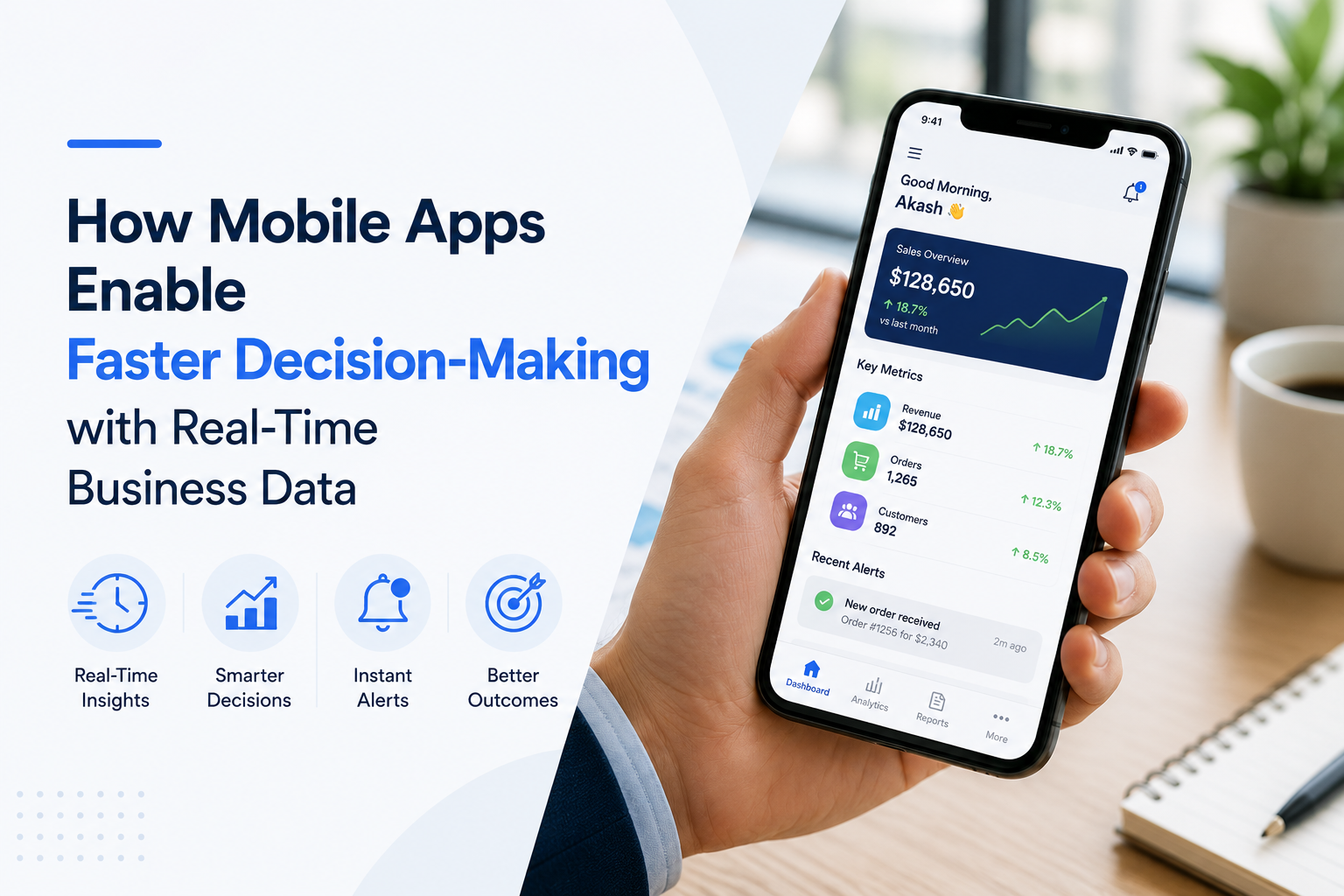
In this blog, you will see how mobile apps help businesses track activity in real time and make smarter decisions without delay.
What Real-Time Business Data Actually Means for Modern Companies
Real-time business data means seeing what is happening in your business as it happens.
Not at the end of the day.
Not in next week’s report.
Not after someone updates a spreadsheet.
Right now.
That sounds simple. Yet it changes a lot.
When data moves fast, decisions move fast too.
What counts as real-time data
For most businesses, this includes:
- Live sales numbers
- Current inventory levels
- New orders and cancellations
- Customer bookings
- Payment status
- Support requests
- Staff activity across locations
- Product or service demand trends
A simple way to understand it
| Old way | Real-time way |
| Check reports later | See updates instantly |
| React after the problem grows | Act while the issue is small |
| Guess what customers want | Spot trends as they happen |
| Wait for staff updates | View one live dashboard |
Why this matters in real life
Imagine a salon.
Three stylists get fully booked for the weekend by Friday afternoon. If the owner sees this on Monday, it is too late. If they see it live, they can open extra slots or add another staff member for Saturday.
Same business.
Same demand.
Better timing.
That is the difference.
Where many businesses get stuck
A lot of companies still manage data like this:
- Orders come through WhatsApp
- Payments are checked in a separate tool
- Stock is updated manually
- Customer notes sit in email threads
- Reports are made at the end of the day
The information exists. It is just scattered.
That is why many businesses now own customer data through custom mobile apps. When everything sits in one place, it becomes much easier to track and act on.
Signs your business needs real-time visibility
You likely need it if:
- You often run out of stock without warning
- Customers complain before your team notices a problem
- Sales reports arrive too late to be useful
- Different teams give different answers
- You make decisions based on guesswork
Real-time data is not just about speed.
It is about clarity.
And clarity helps businesses stay calm when things move quickly.
How Mobile Apps Turn Everyday Activities Into Actionable Insights
Here’s the big idea.
Your business already creates useful data every day.
The problem is that most of it gets lost in messages, spreadsheets and different tools that never connect properly.
A mobile app fixes that.
It takes everyday actions and turns them into clear business insights you can actually use.
It starts with simple activity
Think about what happens in one normal day:
- A customer books a service
- Another customer cancels
- One product starts selling faster
- Support requests increase
- A payment fails
- A repeat customer places a larger order than usual
Each of these actions tells you something important.
On their own, they look small. Together, they show patterns.
That is where mobile apps become powerful.
Mobile apps capture what manual systems miss
When your business runs through calls, emails and chat apps, information gets scattered.
One team member knows about a complaint. Another knows stock is low. Someone else sees fewer bookings this week.
But nobody sees the full picture at the same time.
A mobile app brings these signals into one place.
So instead of asking what is happening, you can see it instantly.
For example:
| Everyday activity | What it tells you | What you can do next |
| More people are viewing one service | Demand is rising | Promote it or increase availability |
| Customers abandon checkout | There is friction in the buying process | Simplify payment or review pricing |
| Repeat orders are dropping | Loyalty may be weakening | Send offers or improve follow-up |
| Support tickets increase after purchase | Something is going wrong after sale | Fix delivery or service quality |
| One location gets more bookings | Local demand is stronger there | Shift staff or inventory quickly |
This is what actionable insight looks like.
Not more data.
Better visibility.
You stop guessing and start seeing patterns
Many business owners still make decisions based on instinct.
Instinct matters. Experience matters too.
But real-time business data helps you confirm what is actually happening before you act.
A retailer can spot which items are moving fastest before stock runs out.
A clinic can see which appointment slots are underused and adjust scheduling.
A service business can identify where customers drop off before booking and improve that step.
These are not huge changes.
But small, informed decisions made quickly often beat big, delayed decisions.
That is one reason many businesses are now turning business workflows into mobile app features. They want daily activity to lead directly to smarter action.
Insights become useful when they arrive on time
Timing changes everything.
A report at the end of the week may tell you what went wrong.
A mobile app can show you while it is happening.
That means:
- You catch problems earlier
- You respond faster
- You reduce wasted time
- You protect sales before they slip away
This is especially useful in fast-moving businesses where conditions can change during the day.
A restaurant can track order spikes in real time.
A multi-service business can see which team is overloaded.
A local store can monitor what is selling now instead of checking later when the opportunity is already gone.
Good apps do more than show numbers
The best business apps do not drown you in reports.
They show the few things that matter most.
Usually, that includes:
- Sales performance
- Booking activity
- Inventory movement
- Customer behavior
- Payment status
- Support trends
That is enough to make faster business decisions without creating confusion.
And when those insights sit on your phone, they are always close.
Not buried in a laptop.
Not waiting in an inbox.
Right there when you need them.
The real benefit is simple
Mobile apps turn business activity into visibility.
Visibility leads to clarity.
And clarity helps you act with confidence.
That is how faster decision-making starts.
From Guesswork to Strategy: Using Live Data to Make Smarter Business Moves
Seeing data is helpful.
Using it well is what actually changes a business.
That is the shift mobile apps make possible.
They do not just show live numbers. They help business owners turn those numbers into better next steps.
Live data helps you act earlier
Most poor decisions are not caused by bad intentions.
They happen because the business reacts too late.
By the time sales drop enough to notice, the problem is already bigger. By the time customers complain in large numbers, the issue has already damaged trust. By the time stock problems show up in reports, sales opportunities are gone.
Real-time mobile data shortens that delay.
You see changes while they are small.
And small problems are always easier to fix.
Strategy becomes clearer when patterns appear fast
This is where mobile apps become especially useful.
They help you answer questions like:
- Which product or service is getting the most attention today
- Which location is underperforming this week
- Which customers are ordering again and again
- Which part of the buying journey causes drop-offs
- Which time of day brings the most demand
Once you can see those patterns clearly, decisions stop feeling random.
Here is a simple example:
| What the app shows | Smart move |
| One service is getting more bookings than usual | Add more slots or promote related services |
| Checkout drop-offs are rising | Review pricing or simplify payment |
| One branch is selling faster than others | Shift stock or staff quickly |
| Repeat purchases are slowing down | Send timely offers or follow-up messages |
That is strategy in action.
Not complicated.
Just timely decisions based on what is actually happening.
Better data reduces emotional decisions
This matters more than people think.
Many business decisions get made under pressure.
A few slow days happen and panic starts. One customer complains and the team assumes everything is broken. One product gets attention and suddenly, all focus shifts toward it.
Live business data brings balance.
It helps you step back and see the full picture before reacting.
That leads to better planning around pricing, staffing, promotions and customer communication.
For many businesses, this also connects naturally with automating daily operations. When your app shows what is happening and your systems respond faster, decision-making becomes much smoother.
Faster decisions also improve customer experience
This part is easy to miss.
Better internal decisions usually create better customer experiences outside.
If you spot rising demand early, customers do not face delays.
If you notice support requests increasing, you can fix the issue before frustration spreads.
If you identify popular services in real time, you can make them easier to access through the app.
That is one reason many companies are now moving from WhatsApp and email. They want one place where customer activity and business decisions connect properly.
The real win is consistency
One smart decision helps.
A hundred smart decisions made quickly over time help much more.
That is what real-time mobile data gives you.
Not one big breakthrough.
A steady flow of better calls made with more confidence.
And that is often what separates a business that keeps guessing from one that keeps growing.
Conclusion
Fast decisions come from clear information.
And clear information is much easier to get when your business runs through a mobile app.
Instead of waiting for reports or chasing updates across different tools, you can see what is happening in real time and respond while it still matters.
That means fewer delays.
Better planning.
Smarter actions.
And stronger customer experiences.
Businesses that use real-time mobile data do not need to rely on guesswork as much. They spot trends earlier. They fix issues faster. They make decisions with more confidence.
That is a real advantage.
As more companies build private business ecosystems around their own apps and data, real-time visibility will only become more important.
The businesses that move early will be better prepared.
The ones who wait will spend more time catching up.
Boolean Inc. helps businesses turn complex data into simple mobile dashboards that make faster, smarter decision-making possible every day.
FAQs
1. How do mobile apps help with business decision-making?
They provide instant access to live sales, inventory, and customer activity so you can act on facts rather than guesses.
2. Is real-time data only for large corporations?
No, businesses of all sizes use mobile apps to monitor daily KPIs and respond to market shifts immediately.
3. What kind of business data can I track on a mobile app?
You can track everything from live order volume and stock levels to customer support trends and staff performance.
4. Can mobile apps reduce business errors?
Yes, by providing accurate, live information, apps help prevent overstocking, missed appointments, and communication gaps.
5. Why is real-time data better than weekly reports?
Weekly reports show what already happened, but real-time data allows you to fix problems and grab opportunities while they are still active.