Introduction
Running a business used to mean trusting your gut. Reading the room. Making calls based on experience and hoping they’d pan out.
Those days aren’t completely gone. But they’re changing fast.
Mobile apps are no longer just a place where customers tap, scroll, and buy. They have quietly become one of the best places to understand what people want in real time.
That matters because a better understanding leads to better business decisions.
When you develop an appropriate application experience, you can use your observation skills to detect user behavior patterns and customer engagement patterns and purchasing patterns without needing to make assumptions.
The AI-powered mobile application insights transform routine user activities into practical knowledge that users can implement in their daily tasks.
Think clearer dashboards, faster answers and fewer moments. We think this is working.
Using real-time and mobile app analytics, teams may now see what’s happening now rather than waiting for end-of-month reports.
Which screen is causing users to leave? Which proposal receives the most clicks? Which clients are more likely to come back? Your app can use predictive analytics and intelligent suggestions to emphasize what needs attention next.
For businesses working with experienced partners like Boolean Inc., this is where the real value shows up. AI is not there to make things complicated.
It is there to make decision-making simpler, quicker, and more confident.
What Are AI-Driven Insights and Why Do They Matter for Your Business?
Let’s cut through the noise for a minute.
AI-driven insights sound fancy. They sound expensive. They sound like something only tech giants with unlimited budgets can actually use.
None of that is true.
At its core, this is simple. Your mobile app watches how people behave. Artificial intelligence finds the patterns in that behavior. Then it tells you what those patterns mean for your bottom line.
That’s it. No magic. No mystery.
Traditional analytics show you what happened yesterday. Someone opened your app at 2pm. They looked at five different products. Added one to their cart. Then disappeared without checking out.
Okay cool. You’ve got that data point. Along with ten thousand others just like it.
Now what? What do you actually do with that information?
This is where most businesses get stuck. They’re drowning in data but starving for actual answers.
AI analytics don’t just hand you numbers and wish you luck. They connect dots you’d never connect on your own. They spot trends hiding in plain sight. And they serve up recommendations you can actually act on.
Here’s a real scenario. Your mobile application sees decent traffic every Saturday and Sunday. Revenue looks stable. No obvious red flags. Your team thinks everything’s running smoothly.
But AI powered analytics notice something your team missed. Weekend visitors spend an average of eight minutes browsing. They view lots of pages. Engagement looks great on paper. Except they almost never buy anything.
Tuesday and Wednesday visitors? Totally different story. They’re in and out in three minutes flat. But their conversion rate is double what weekends pull.
Why does this matter? Because you’ve been dumping marketing budget into weekend campaigns, thinking more traffic equals more sales. You’ve been bleeding money on the wrong days.
One insight like that pays for itself immediately.
So what separates AI insights from the reports you’re already getting?
Standard analytics are like a rearview mirror. Useful for seeing where you’ve been. Not great for avoiding what’s coming.
Machine learning looks forward. It anticipates. It warns you before things go sideways.
- Speed matters more than you think: Processing thousands of user interactions while they’re happening changes everything. You’re not reading last month’s news. You’re responding right now.
- Depth is where the gold hides: Surface numbers tell you someone left your app. AI digs into why. Was it a confusing checkout flow? A slow loading screen? A missing payment option? Behavioral data reveals the actual problem.
- Prediction beats reaction every time: Waiting for customers to leave before you figure out they’re unhappy? That’s expensive. Business intelligence that flags at-risk users before they bounce? That’s profitable.
- Personalization isn’t optional anymore: Your app has different types of users with completely different needs. AI understands those segments individually. What delights one group might annoy another. The technology knows which is which.
Think about reading a thousand page manual versus having an expert summarize exactly the parts that apply to your specific situation. That’s the difference we’re talking about.
Why should this be on your radar right this second?
Your competitors aren’t taking coffee breaks. Customer patience isn’t getting longer. And making important decisions based on hunches costs more every quarter you keep doing it.
Data-driven decision making isn’t a luxury anymore. It’s table stakes.
Mobile app analytics enhanced by AI deliver three things every business needs yesterday:
You stop throwing money into black holes. That email campaign nobody opened. That fancy feature nobody uses. That customer complaint keeps happening because you never traced it to the root cause.
Real-time insights catch the leaks fast so you can plug them instead of watching money drain.
You catch opportunities while they’re still opportunities. New customer behaviors are emerging. Unexpected ways people use your product. Perfect timing for a new launch or promotion.
Predictive analytics surfaces these moments before they pass you by. Before your competition notices.
You lead with confidence instead of crossing your fingers. Making choices that affect your whole business feels terrible when you’re basically guessing and hoping.
Actionable insights don’t remove every risk but they remove a lot of the blindness. You’re still the one deciding. You just have actual evidence backing you up now.
The companies crushing it in your industry aren’t luckier than you. They’re not necessarily smarter either. They’re just better informed.
They know what customers want sometimes before those customers even realize it. They see problems forming and fix them before anyone complains. They test ideas using data instead of burning cash on expensive failures.
That’s not some superpower. It’s AI technology that exists right now and actually works.
Here’s the thing nobody talks about enough
Your mobile application is already generating user data. Every single day. Every single hour. Whether you’re paying attention or not.
The majority of that data is just sitting there. Ignored and collected. It’s like owning a gold mine in your backyard and never bothering to excavate.
What a waste!
That inactive heap of data is transformed into your unfair advantage by insights generated by AI. All of a sudden, you have a greater understanding of your clientele than anybody else in your industry. You have greater mobility. You waste less. You win more often.
The discrepancy between companies that use this material and those that don’t? The gap widens each month.
Perhaps five years ago, you could get by with just your instincts and simple spreadsheets. Today? You’re up against teams equipped with cutting-edge AI technology that makes the best choices at every turn.
A knife is not often a wise choice in a gunfight.
The good news is this, though. This is beneficial even if you don’t have a degree in data science. You don’t have to create everything from scratch or employ a group of engineers.
There was a significant decrease in the barrier to entry. Intelligent businesses are integrating AI capabilities directly into mobile apps, allowing insights to flow seamlessly.
Your business is your primary concern. The technology is responsible for number crunching and pattern recognition.
When you open the hood and peek inside, how does everything really function? Let’s investigate that next without giving a lecture on computer science.
How AI Analytics Work Inside Your Mobile App
Okay, let’s peek under the hood. But we’re keeping this simple.
No equations. No flowcharts that look like spaghetti. Just a straight explanation of what’s happening when AI works its magic inside your mobile application.
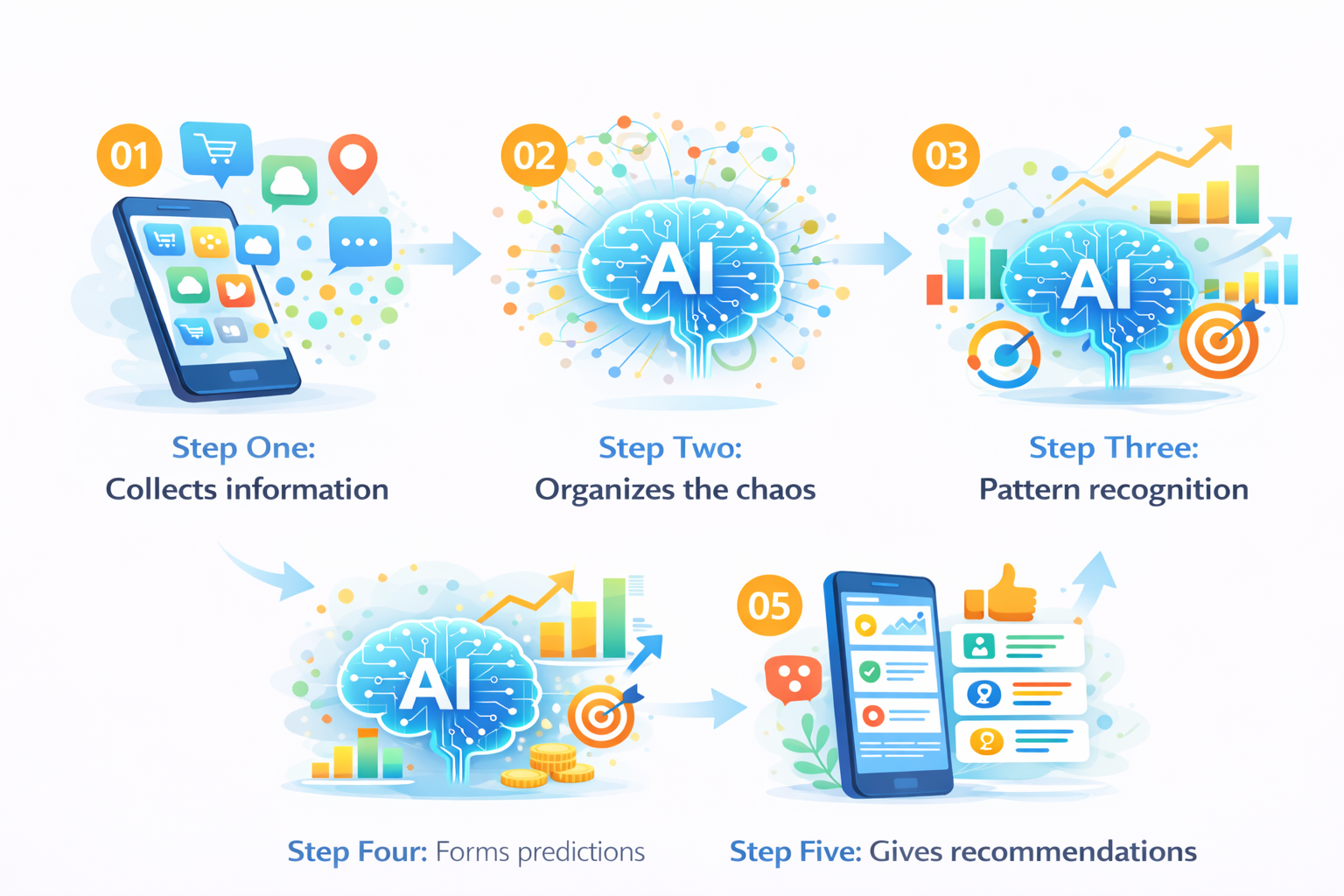
Step One: Your app collects information
Every time someone uses your app it creates little breadcrumbs. Where they tapped. How long did they stay on a page? What they searched for. Whether they finished what they started or bailed halfway through.
This happens automatically in the background. Users don’t see it. They’re just going about their business while your app quietly takes notes.
Step Two: AI organizes the chaos
Imagine dumping a thousand puzzle pieces on a table. That’s what raw data looks like. A giant mess.
Machine learning algorithms act like someone who’s really good at puzzles. They start sorting pieces by color. By edge type. By patterns. Suddenly, what looked like chaos has structure.
The artificial intelligence groups similar behaviors together. It notices that certain types of customers do similar things. That specific actions tend to lead to specific outcomes.
Your app might see that people who watch a demo video are three times more likely to make a purchase. Or that users who abandon their cart usually do it on the payment screen. Or that notifications sent at 7pm get opened way more than ones sent at noon.
Thousands of tiny observations are getting organized into useful categories.
Step Three: Pattern recognition kicks in
This is where things get interesting.
AI doesn’t just organize information. It learns from it. It starts recognizing cause and effect. If this happens, then that usually follows.
Think about how you learned to predict rain as a kid. Dark clouds usually mean a storm’s coming. You didn’t need a meteorology degree. You just noticed the pattern enough times that your brain connected the dots.
AI-powered analytics do the same thing, except way faster and with way more data points than any human brain could track.
It might be noticed that customers who browse on mobile but don’t buy within two days often come back and purchase from a computer later. That’s a pattern. One that changes how you think about mobile app engagement.
Or it spots that users who create an account on weekends stick around 40% longer than weekday signups. Another pattern. One that might shift your entire onboarding strategy.
Step Four: Predictions start forming
Once the AI understands patterns, it can make educated guesses about what comes next.
Sarah just logged in for the first time in three weeks. Her behavior matches other users who ended up canceling their subscriptions. The system flags her as at-risk.
David just viewed the same product page four times in two days. Historical data shows people who do that usually buy within 72 hours if you give them a small nudge. The AI suggests sending him a limited time offer.
This isn’t fortune telling. It’s probability based on tons of previous examples.
Business intelligence tools powered by AI essentially ask “We’ve seen this movie before and here’s how it usually ends.” Sometimes they’re wrong. But they’re right way more often than random guessing.
Step Five: You get recommendations you can actually use
Here’s where the rubber meets the road. All that processing has to result in something actionable or what’s the point?
Your AI analytics system provides more than just numerical data because it converts research results into accessible language-based recommendations.
Your checkout abandonment rate increases when customers reach the shipping cost page and you should consider implementing free shipping for orders that exceed a specific threshold.
Your application currently lacks sufficient video content because users between 25 and 34 years old consume video material at high rates.
Your organization should allocate more advertising funds to Instagram because it generates three times better conversion rates than Facebook.
The results show different outcomes because the first option presents a chart which requires you to decode its meaning while the second option provides a problem description together with recommended solutions.
What’s happening in real time vs what happens over time
Some AI insights work instantly. Is someone about to leave your app without buying? Trigger a popup with a discount code right then. Real-time data creates real-time responses.
Other insights need time to develop. Understanding seasonal trends. Tracking how feature updates affect long-term retention. Spotting gradual shifts in customer preferences.
Both matter. Quick reactions prevent immediate losses. Long-term pattern analysis shapes your overall strategy.
The feedback loop that makes everything smarter
Here’s the beautiful part. AI gets better the more you use it.
Every decision you make based on insights feeds back into the system. Did that recommendation work? Did conversions actually improve when you changed the checkout flow?
The machine learning models adjust based on results. What worked gets reinforced. What flopped gets reconsidered. The whole system evolves.
Your app isn’t just collecting data. It’s learning your specific business. Your specific customers. What works in your unique situation?
A clothing retailer and a food delivery service might both use AI analytics but the insights will look totally different because the user behavior is totally different.
The technology adapts to you. Not the other way around.
Does this require a massive technical overhaul?
Not usually. Most modern mobile applications can integrate AI capabilities without rebuilding from scratch.
Think of it like adding a smart feature to something that already works. Your app’s foundation stays the same. You’re just plugging in additional intelligence.
Boolean Inc. builds these systems so they fit into existing infrastructure. You’re not throwing away what you’ve already built. You’re making it smarter.
The heavy lifting happens in the background. You interact with dashboards and reports that make sense. Clean interfaces. Clear language. Insights you can share in a team meeting without needing a translator.
What about the learning curve?
Honestly? Way less painful than you’d think.
Nobody’s asking you to suddenly become a data scientist. The whole point is that AI handles the complicated math while you focus on business decisions.
Most teams get comfortable with their new analytics tools within a few weeks. The interfaces are designed for normal humans. Not engineers.
You’ll probably start small. Pick one key metric you want to improve. Maybe it’s user retention. Maybe it’s the conversion rate. Let the AI focus there first.
As you get comfortable, you expand. Add more metrics. Dig into more segments. But you control the pace.
So that’s the basic flow. Collection. Organization. Pattern recognition. Prediction. Recommendation. Learning.
Nothing magical about it. Just smart technology doing what it does best so you can do what you do best.
Real Business Benefits: From Guesswork to Data-Driven Decisions
Enough theory. Let’s talk money.
What does AI actually do for your bottom line? How does this translate into real business benefits you can take to the bank?
You stop bleeding revenue through invisible cracks
Most businesses lose money in ways they never see coming. A confusing button placement here. A too-long loading time there. A checkout flow that makes perfect sense to you but frustrates actual customers.
These small friction points add up fast.
AI-driven insights shine a spotlight on exactly where people get stuck. Where they give up. Where your app is costing you sales without you realizing it.
One Boolean Inc. client discovered their mobile app was losing 35% of potential purchases at the payment screen. Not because people didn’t want to buy. Because the page took seven seconds to load and folks assumed it was broken.
Seven seconds. That’s all it took to kill over a third of their revenue.
They fixed it in one update. The conversion rate jumped immediately.
Discover how retail businesses can boost revenue with a mobile app.
That’s money that was walking out the door every single day until data-driven decisions caught the problem.
You actually understand what customers want
How many times have you launched a feature you were absolutely sure people would love only to watch it get completely ignored?
Happens to everyone. We think we know what customers want. Then reality proves us wrong.
Customer insights powered by AI remove a huge chunk of that guesswork. You’re not relying on surveys where people tell you what they think you want to hear. You’re watching what they actually do when nobody’s asking.
User behavior tells the truth. Always.
Maybe you assumed your audience wanted more customization options. But the data shows they’re overwhelmed by the choices you already offer. They want simpler. Not more complex.
That one insight changes your entire product roadmap. Saves you months of building the wrong thing.
Your marketing budget stops getting wasted
Raise your hand if you’ve ever spent money on ads and wondered if any of it actually worked.
Everyone’s hand just went up.
AI analytics track customer journeys from first touch to final purchase. You see exactly which channels bring valuable users. Which campaigns attract people who stick around? Which efforts are basically lighting money on fire.
A retail client was splitting their budget evenly across five platforms. Seemed fair. Seemed balanced.
The actionable data told a different story. Instagram traffic converted at 4x the rate of their other channels. Pinterest users browsed but rarely bought. Twitter delivered almost nothing.
They reallocated the budget based on actual business performance. Same total spend. Way better ROI. That’s the power of making strategic decisions with real evidence.
Customer retention becomes predictable instead of random
Losing customers hurts. Losing them without knowing why hurts worse.
AI spots the warning signs before someone disappears. Changes in behavior that signal trouble brewing. Login frequency dropping. Feature usage declining. Engagement falling off a cliff.
You get flagged early. Early enough to actually do something about it.
Send a personalized message. Offer help. Provide an incentive to re-engage. Whatever makes sense for your business.
The point is you’re not waiting until they’re already gone. You’re catching them mid-exit and pulling them back. That directly impacts customer lifetime value and recurring revenue.
One subscription-based app we worked with reduced churn by 28% just by implementing AI-powered early warning systems. They didn’t change their product. They just started reaching out to at-risk users before those users made up their minds to leave.
Learn more about how mobile apps improve customer retention.
Personalization stops feeling impossible
Everyone talks about personalized customer experience like it’s the holy grail. And it kind of is.
People expect apps to understand them. To show relevant content. To remember preferences. To feel less like a one-size-fits-all product and more like something built just for them.
Doing that manually for thousands of users? Impossible.
AI handles it automatically. It segments your audience based on behavior. It serves different content to different groups. It adjusts recommendations in real time based on what each person responds to.
Someone who browses workout equipment sees fitness content. Someone who always buys on sale gets notified about discounts. Someone who watches every tutorial video gets served more educational material.
Same app. Completely different experience tailored to what each user actually cares about.
That level of personalization drives engagement through the roof. Customer satisfaction jumps. People feel understood. And understood customers become loyal customers.
You make faster decisions with more confidence
Speed matters in business. Opportunities don’t wait around while you schedule three meetings to analyze a spreadsheet.
Traditional reporting cycles are slow. You request data. Someone pulls it. You review it. By the time you make a decision, the market already shifted.
Real-time insights change that timeline completely. You see what’s happening now. You adjust now. You test ideas and get feedback within hours instead of weeks.
That agility becomes a serious competitive advantage. While competitors are still figuring out what happened last quarter you’re already optimizing for next week.
Business growth doesn’t come from perfect decisions. It comes from making good-enough decisions quickly and adjusting as you learn.
AI accelerates your entire decision making process without sacrificing quality.
Your team stops arguing about opinions and starts focusing on facts
Ever been in a meeting where everyone has a different opinion and nobody has proof? Those meetings drag on forever and usually end with whoever talks the loudest winning.
Data-driven decisions cut through that noise. The conversation shifts from “I think” to “the data shows.”
Not that opinions don’t matter. They do. But they work way better when combined with actual evidence.
Your gut feeling says customers want Feature A. Your coworker swears they need Feature B. The AI analytics reveal that users are actually struggling with Feature C, which both of you forgot existed.
Everyone saves face. Everyone learns something. And you move forward based on what’s actually happening instead of who argued better.
New revenue opportunities surface automatically
Sometimes the best business outcomes come from things you weren’t even looking for.
AI finds unexpected patterns. Customer segments you didn’t know existed. Use cases you never considered. Cross-sell opportunities hiding in plain sight.
A food delivery app noticed a small group of users ordering breakfast items late at night. Weird right? Turned out night shift workers wanted breakfast food at midnight.
Nobody was targeting that market. Nobody even knew it existed. But the user data surfaced the pattern.
They launched a “Breakfast Anytime” campaign aimed at night shift workers. New revenue stream unlocked. All because AI spotted something human analysts missed.
Your operational efficiency improves across the board
Better insights don’t just affect customer-facing decisions. They optimize internal operations too.
You learn which features require the most support tickets. Which processes create bottlenecks? Which updates actually move the needle versus which ones waste engineering resources?
Your team works smarter. Resources get allocated based on impact instead of assumptions. Efficiency gains compound over time. Mobile apps can also reduce operational errors across your growing business.
The confidence factor nobody talks about
Here’s something subtle but important. Making business decisions based on solid data feels different than making them based on hope.
The stress drops. The second-guessing quiets down. You sleep better.
You’re still taking risks. Every business decision involves some risk. But you’re taking calculated risks backed by evidence instead of blind leaps into the unknown.
That psychological shift matters. Confident leaders make better calls. Teams trust direction more when they understand the reasoning behind it.
So yeah. AI-powered analytics deliver tangible business benefits. More revenue. Less waste. Happier customers. Faster growth.
But how does this play out in actual industries? Let’s look at some real-world examples next.
Practical Ways AI Insights Transform Different Industries
AI analytics aren’t one-size-fits-all. Different industries use them in wildly different ways.
Let’s look at how this actually plays out in the real world.
Retail and E-commerce
Shopping apps live and die by conversion rates. AI spots exactly why people abandon carts. Too many steps at checkout? Shipping costs showing up too late? Product images not loading fast?
Predictive analytics also forecasts inventory needs. You stop overstocking items nobody wants and running out of bestsellers right when demand spikes.
One fashion retailer used AI to identify which products customers browsed repeatedly but never bought. Turned out the sizing information was confusing. They clarified it and sales jumped 22% on those items alone.
Here’s how to use mobile apps to grow your local business with similar strategies.
Healthcare and Wellness
Patient engagement makes all the difference here. AI tracks which appointment reminders actually get responses. Which educational content do people read versus ignore? When users are most likely to log symptoms or take medications.
A wellness app discovered its users fell off after day twelve. Always day twelve. So, they built an intervention specifically for that moment. Retention improved dramatically.
Business intelligence in healthcare also means spotting concerning patterns early. Users are reporting certain symptom combinations. Behaviors that historically signal someone needs extra support.
Food Delivery and Hospitality
Timing is everything in this space. AI figures out when people order. What they pair together. Which promotions drive actual orders versus just noise?
One delivery platform noticed that users who favorited restaurants but didn’t order within 48 hours usually needed a nudge. They started sending personalized deals to that segment. Conversion rate on those messages was insane compared to generic blasts.
Real-time data also optimizes delivery routes and predicts busy periods so you’re staffed appropriately.
Finance and Banking
Security matters here more than anywhere. AI catches unusual transaction patterns that might signal fraud. Spending behaviors that don’t match someone’s history.
But it’s not just about risk. Financial apps use insights to personalize money-saving tips. To suggest better budgeting based on actual spending habits. To predict when someone might overdraft before it happens.
Customer experience in banking comes down to trust. AI builds that trust by making the app feel like it actually understands your financial situation.
Fitness and Education
These apps succeed when users stick with them long-term. AI identifies exactly when people lose motivation. What keeps them coming back? Which features create habit formation?
A language learning app found that users who practiced for just five minutes daily stuck around way longer than users doing thirty-minute sessions twice a week. Total practice time was similar but consistency mattered more.
They restructured their entire app around short daily sessions. Engagement and retention both climbed.
Education platforms also use AI to personalize learning paths. Some users need more visual content. Others prefer text. The app adapts to individual learning styles automatically.
Entertainment and Media
Recommendation engines are the obvious use case here. But it goes deeper than “people who watched this also watched that.”
AI predicts which content will go viral. Which genres are trending up in specific demographics? When to release new episodes for maximum impact.
Streaming apps track exactly where people pause or rewind. That data shapes future content production. If everyone replays the same scene it tells creators something worked really well.
The common thread across all industries
Notice the pattern? Every industry uses AI analytics to understand user behavior at a deeper level. To predict what comes next. To personalize experiences. To make smarter business decisions faster.
The technology is the same. How you apply it depends entirely on what matters in your specific market.
Your industry has unique challenges. Unique customer expectations. Unique metrics that actually move the needle.
AI adapts to those specifics. It learns what success looks like for your business and helps you get more of it.
Getting Started: Bringing AI-Powered Analytics to Your Mobile App
You’re sold on the benefits. Now what?
Getting AI into your mobile application is not as complicated as it sounds. Here’s the straightforward path.
Figure out what you actually need
Don’t try to solve everything at once. Pick one business problem that’s costing you money or sleep.
Maybe it’s high cart abandonment. Maybe it’s customers leaving after their first month. Maybe it’s marketing spend that doesn’t seem to pay off.
Start there. One clear goal beats ten vague ones every time.
Audit what you already have
Your app probably already collects some data. Look at what’s there. What’s missing? What metrics actually matter for the goal you just picked?
You might have everything you need and just aren’t using it well. Or you might need to add tracking for specific user actions.
Choose the right AI tools
Plenty of options exist. Some plug right into existing apps. Others require more custom work.
The best choice depends on your budget, your timeline, and how complex your needs are.
Off-the-shelf solutions work great for standard analytics. Custom AI development makes sense when your business has unique requirements.
Check out the top mobile app features every business should have in 2026.
Start with a pilot program
Test on a small scale first. One feature. One user segment. One market.
See how it performs. Learn what works. Adjust what doesn’t. Then scale up once you’ve proven the concept.
This approach costs less and reduces risk. You’re not betting the whole farm on something unproven.
Work with people who’ve done this before
Building AI capabilities in-house from scratch takes time and specialized talent. Most businesses don’t have either sitting around unused.
Partnering with a mobile app development company that already knows this space speeds everything up. They’ve made the mistakes already so you don’t have to.
At Boolean Inc. we’ve integrated AI-powered analytics into apps across dozens of industries. We know what works. What doesn’t. And how to implement solutions that fit your specific situation without blowing your budget.
Explore how businesses transform operations with custom mobile apps.
Train your team on the new tools
The fanciest AI in the world means nothing if your team doesn’t use it. Make sure people understand how to read the dashboards. How to interpret insights. How to act on recommendations.
This doesn’t require a PhD. Just some basic onboarding and practice. Most teams get comfortable within a few weeks.
Measure results and iterate
Track whether AI insights actually improve your key metrics. Better conversion rates? Higher retention? Increased revenue?
If something’s working, double down on it. If it’s not, adjust your approach. AI implementation isn’t set-it-and-forget-it. It evolves as your business evolves.
The investment question
Costs vary wildly depending on the scope. Basic analytics integration might run a few thousand dollars. Advanced custom AI development can hit six figures.
But here’s the thing. Done right, this pays for itself fast. The revenue you stop losing. The efficiency you gain. The customers you keep instead of losing.
Most businesses see positive ROI within months, not years.
You don’t need to be a tech company
This works for traditional businesses just as well as startups. Restaurants use it. Healthcare practices use it. Retail stores use it.
If you have a mobile app and customers are using it, you can benefit from AI analytics. Period.
Ready to make smarter decisions backed by real data? The tools are here. The technology works. You just need to take the first step.
Conclusion
So, there it is.
AI-driven insights aren’t some futuristic concepts anymore. They’re working right now for businesses that decided to stop guessing and start knowing.
Your mobile app already has everything it needs to tell you what’s working and what’s not. Where customers get frustrated. Where they find value. What makes them stay or leave.
The question isn’t whether this data exists. It’s whether you’re doing anything useful with it.
Every day you wait is another day competitors get ahead. Another day you’re making decisions in the dark. Another day revenue slips through cracks you can’t even see.
But here’s the good news. You don’t need to figure this out alone.
Boolean Inc. has helped dozens of businesses turn their apps into intelligent systems that actually drive growth. We build solutions that fit your budget and your goals. No cookie-cutter approaches. No tech jargon you need a translator for.
Just real results. Better decisions. Smarter strategy.
The data’s already there. Let’s put it to work.
Your next big business breakthrough might be hiding in patterns you haven’t noticed yet. AI can find them. You just need to give it a chance.
Ready to stop guessing and start growing? Let’s talk.
FAQs
- How long does it take to implement AI analytics in an existing mobile app?
Basic integration takes about 4-6 weeks. More complex custom solutions can run 3-4 months. Most businesses start seeing useful insights within the first month, though. You don’t wait until everything’s perfect to benefit.
- Will AI analytics slow down my app’s performance?
Not if it’s done right. Most processing happens on cloud servers not on users’ phones. Your app stays fast. The heavy lifting happens behind the scenes where nobody notices.
- Do I need a data scientist on my team to use AI insights?
Nope. Modern AI tools are built for regular business people. The dashboards make sense. The recommendations use plain English. If you can read a basic report, you can use these insights.
- What’s the minimum number of users needed for AI analytics to work?
You need enough data to spot patterns. Usually, that’s around 1,000 active users per month. Below that, the insights get less reliable. But even smaller apps benefit from basic analytics.
- How much does adding AI capabilities typically cost?
Basic analytics integration starts around $5,000-$10,000. Advanced custom AI solutions can reach $50,000-$100,000+. But most businesses see positive ROI within 3-6 months. The money you save and earn typically covers the investment fast.