
App development in Austin costs $40,000–$150,000 for most startup products in 2026, with hourly rates of $120–$200 at Austin-based agencies and $55–$95 for Austin-led teams that use distributed engineers.
Austin is the strongest startup market in Texas by a wide margin, taking in $8.1 billion in venture funding in 2025 and roughly three quarters of all Texas VC. Founders here have three realistic options: a local agency, a local-led hybrid team, or offshore.
The right one depends on your budget, your stage, and how much you value sitting across a table from the people building your product.
| What you need to know | Austin, 2026 |
| Typical startup app cost | $40,000 – $150,000 |
| MVP cost (all-local agency) | $45,000–$90,000 |
| MVP cost (Austin-led hybrid) | $18,000 – $60,000 |
| Local agency hourly rate | $120 – $200 |
| Austin-led hybrid team rate | $55 – $95 blended |
| Senior mobile developer salary (in-house) | $150,000 – $190,000 |
| Venture funding raised, 2025 | $8.1B (Dealroom) |
| Share of Texas VC | ~76% |
| Startups in the ecosystem | ~2,234 (StartupBlink) |
Pricing figures are indicative estimates for budgeting, not audited market averages or guaranteed quotes. Actual costs depend on scope, team composition, seniority, and included services.
Key Takeaways
- Austin is a real tech hub, not a marketing slogan. $8.1B in 2025 funding, 61 unicorns, Capital Factory’s portfolio of 1,000+ companies, and a deep bench of engineers from UT, Dell, Oracle, Apple, and Tesla.
- That depth cuts both ways: more talent, but also more competition and higher salaries than anywhere else in Texas.
- App development in Austin isn’t automatically expensive. The local-agency rate is high; the local-led rate is not.
- The best reason to hire in Austin is proximity to decision-makers: discovery workshops, investor-ready demos, and a team that understands the Texas market.
- Vet local shops exactly as hard as you’d vet offshore ones. A ZIP code is not a credential.
- Boolean Inc. has been built from Austin since 2019. We’ll tell you where that helps and where it doesn’t.

Why Is Austin Good for Tech Startups?
Austin earned the “Silicon Hills” nickname in the 1990s. In 2026, the numbers back it up.
The Funding Is Here
Austin startups raised $8.1 billion in 2025, nearly ten times the 2020 figure, and pulled in $5.0 billion in the first half of 2026 alone. The city now captures about 76% of all venture capital invested in Texas, up from 34% a decade ago. Houston and Dallas are growing, but Austin is where the checks get written.
Local firms like Capital Factory (over 860 investments), LiveOak Venture Partners, 8VC, and Silverton Partners anchor the early-stage scene. Big-name coastal funds have Austin offices now, too.
The Talent Is Here
UT Austin graduates roughly 1,000 computer science and engineering students annually. Apple, Tesla, Oracle, Dell, Samsung, and Google all have substantial engineering operations in the Austin metro area. Together, these factors create a steady flow of experienced engineers who have built and scaled products and are open to startup opportunities.
The Culture Fits Founders
No state income tax. A cost of living that, while up sharply since 2020, is still well below the Bay Area. SXSW every March. A density of meetups, accelerators, and coworking spaces that makes it easy to find a co-founder, an advisor, or your first ten customers.
What It Means for Your App
More funding means more startups building apps, which means more agencies, more freelancers, and more competition for engineers. Prices reflect that. Austin is the most expensive place in Texas to build software and also the place with the most options.
How Much Does App Development Cost in Austin?
Short version: about the same as anywhere else in the US, if you’re hiring a US-staffed team. The platform, the features, and the team model drive costs far more than the city does.
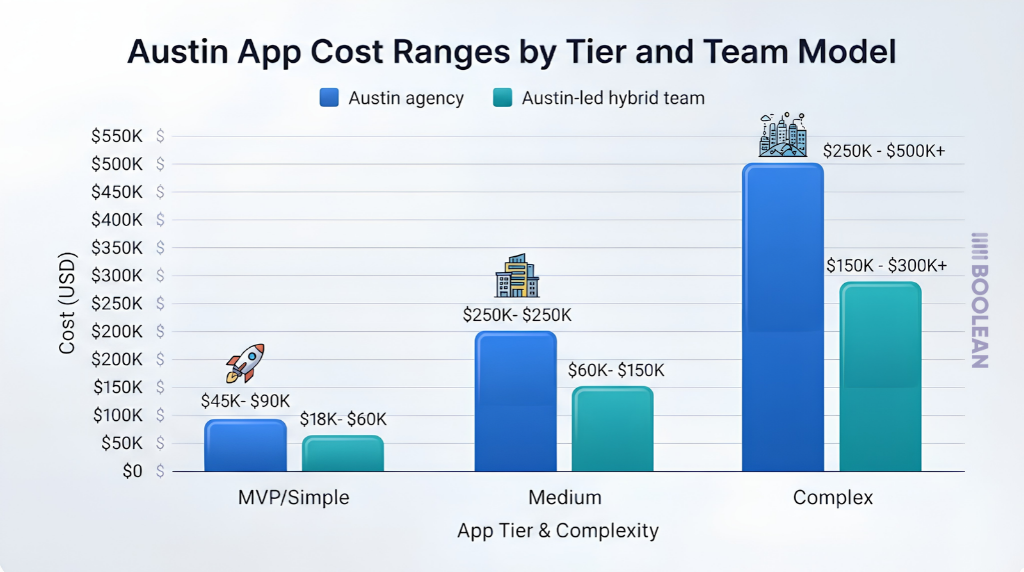
Cost by Complexity (Austin, 2026)
| Tier | What it includes | Austin agency | Austin-led hybrid team |
| MVP / simple | 5–10 screens, one core flow, basic backend | $45,000 – $90,000 | $18,000 – $60,000 |
| Medium | Payments, 2 user roles, integrations, admin panel | $120,000 – $250,000 | $60,000 – $150,000 |
| Complex | Real-time, compliance, custom logic, multiple apps | $250,000 – $500,000+ | $150,000 – $300,000+ |
These ranges illustrate potential budgets for comparable project scopes. Actual quotes may differ depending on team seniority, delivery process, project management, QA, and the work included.
What Drives the Number
The same levers as everywhere: number of platforms, screens and user roles, backend complexity, integrations, and compliance. If you want the full breakdown with per-feature pricing, our mobile app development cost guide walks through it, and the MVP cost guide covers how to keep a first version under $60,000.
One Austin-Specific Cost Factor
Many Austin startups are pre-seed or seed-stage, building to raise. That changes the brief: the app needs to demo well to investors and work for real users. Budget for polish on the three screens you’ll show in a pitch, and keep everything else lean.
What Is the Average Developer Hourly Rate in Austin?
Agency and Freelance Rates
| Who | Austin rate (2026) |
| Austin-based agency, all-local team | $120 – $200/hr |
| Austin senior freelance developer | $90 – $160/hr |
| Austin mid-level freelance developer | $60 – $100/hr |
| Austin-led agency, distributed engineering | $55 – $95/hr blended |
| Offshore agency (no Austin presence) | $25 – $50/hr |
In-House Salaries
If you’re hiring instead of contracting, Austin mobile developer salaries in 2026 run roughly:
- Mid-level (2–5 years): $115,000 – $145,000
- Senior (5+ years): $150,000 – $190,000
- Lead/architect: $180,000 – $230,000
Fully loaded (benefits, payroll tax, equipment), multiply by about 1.3. A two-engineer in-house team costs $350,000+ a year before you’ve hired a designer. Our freelancer vs agency vs in-house guide runs that math in detail.
Why Austin Rates Have Climbed
Tech salaries in Austin rose faster than almost any US metro between 2020 and 2024 as coastal companies relocated and remote workers arrived. They’ve stabilized since, but the gap to the Bay Area narrowed from roughly 35% to about 15–20%. Austin is no longer the cheap alternative it was. It’s the reasonable alternative.
For the national picture by region and team model, see our app development hourly rates breakdown.
Is Austin Cheaper Than San Francisco or New York for App Development?
Yes, but less than it used to be.
| Metro | Agency rate | Senior dev salary | Office cost | Startup funding, 2025 |
| San Francisco Bay Area | $150 – $250/hr | $190,000 – $250,000 | Highest | ~$90B+ |
| New York | $140 – $220/hr | $170,000 – $220,000 | Very high | ~$30B |
| Austin | $120 – $200/hr | $150,000 – $190,000 | Moderate | $8.1B |
| Houston | $100 – $180/hr | $130,000 – $170,000 | Moderate | ~$2B |
| Dallas | $110 – $180/hr | $135,000 – $175,000 | Moderate | ~$1.7B |
What That Means in Practice
A 1,200-hour app from a local agency runs about $144,000–$240,000 in Austin versus $180,000–$300,000 in San Francisco. Meaningful, not transformational.
The bigger savings come from team model, not geography. An Austin-led hybrid team delivers the same 1,200 hours for $66,000–$114,000. That’s the lever most Austin founders actually pull, whether they call it that or not.
Austin vs Houston and Dallas
Houston and Dallas run 10–20% cheaper for local talent, with smaller but growing ecosystems. If you’re a Houston founder, our Houston app development covers that market, and we’ll publish a dedicated Houston guide next week.
How Do I Find App Developers in Austin?
Six channels that actually work, ranked by how often they lead to a good outcome.
1. Founder Referrals
Ask three Austin founders who built their app and whether they’d hire the same team again. The second half of that question matters more than the first. Capital Factory’s community, Austin Startup Week, and the ATX Startups Slack are the fastest places to ask.
2. Clutch and GoodFirms, Filtered Properly
Filter for Austin, then sort by verified reviews, not by rank. Read the three-star reviews first; they’re the honest ones. Check that the reviewer’s project resembles yours in size and industry.
3. Accelerator and Investor Networks
Capital Factory, Techstars Austin, DivInc, and SKU keep lists of vetted vendors. If you’re in or applying to a program, ask the program director.
4. Austin Tech Events
Austin Startup Week (fall), SXSW (March), Austin Technology Council events, and the monthly Austin Mobile Developers meetup. You’ll meet agency founders and senior freelancers in person, which tells you more than a portfolio page.
5. LinkedIn, Narrowly
Search for “mobile developer” + Austin + the framework you’ve chosen (Flutter, React Native, Swift). Look for people who’ve shipped apps you can download. Message the ones whose portfolio apps have more than a handful of reviews.
6. University Channels
UT Austin’s Texas Venture Labs and the Cockrell School’s industry programs connect startups with faculty-vetted student teams and recent grads. Good for prototypes and pilots; not a substitute for a professional team on a product you’re raising on.
What Doesn’t Work
Googling “app developers Austin” and calling the first three ads. Those are paid placements. Some are excellent, some are lead-generation fronts for offshore shops with an Austin mailing address. Vet them the same way you’d vet anyone.
How to Evaluate an App Development Company in Austin
Being local is a convenience, not a qualification. Run every Austin shop through the same filter.
Ask These Nine Questions
- Can I download three apps you built? Then do it. Read the reviews. Check when they were last updated.
- Who exactly will work on my project? Names, roles, locations, and seniority. “Our team” is not an answer.
- Where do your engineers sit? Local, distributed, or offshore are all fine. Not knowing is not.
- Can I speak to two clients from the past twelve months? Recent, not showcase.
- What’s your discovery process? If the answer is “send us your requirements and we’ll quote,” keep looking.
- Fixed price or time-and-materials, and why? A good shop explains the trade-off instead of just picking the one that pays more.
- Who owns the code, and when? On each payment. In writing.
- What happens after launch? Maintenance plans, response times, cost.
- What would you cut from my scope? The best teams push back. The worst say yes to everything.
Red Flags
- A quote within 24 hours of a first call, with no discovery
- No apps you can actually download
- Refusal to name the engineers
- “We’ve never had a project go over budget”
- Pressure to sign before a specific date
We’ll publish a full red-flags guide later in this series.
Green Flags
- They talk you out of features
- They show you a sprint board from a current project
- They ask about your users before your features
- Their proposal has line items, not a single number
- Their lead engineer is on the sales call
Austin Agency vs Offshore vs Hybrid: Which Fits Your Startup?
Three realistic options for an Austin founder. Each one is right for someone.
All-Local Austin Agency
Rate: $120–$200/hr · Medium app: $120,000–$250,000
Choose it when: you’re well-funded, the product is complex or regulated, and you want every engineer in the same room for workshops. Also when investors or enterprise customers expect a fully domestic team.
Trade-off: price. For a seed-stage startup, this often means building half the product you planned.
Offshore Agency
Rate: $25–$50/hr · Medium app: $30,000–$65,000
Choose it when: you have a technical co-founder who’ll manage the team daily, your scope is locked, and async communication across a 10-hour time difference doesn’t bother you.
Trade-off: you become the project manager, the QA lead, and the architect. Rework and overhead typically add 25–40% to the invoice. No local accountability if it goes wrong.
Austin-Led Hybrid Team
Rate: $55–$95/hr blended · Medium app: $60,000–$150,000
Choose it when: you want someone in Austin owning the outcome, running discovery in person, and demoing in your time zone, but you can’t justify $150+/hr for every line of code.
Trade-off: you need to confirm the “Austin-led” part is real. Some shops have an Austin address and nothing else. Ask who you’ll meet in person and how often.
Side by Side
| All-local agency | Offshore | Austin-led hybrid | |
| Medium app cost | $120K – $250K | $30K – $65K | $60K – $150K |
| In-person workshops | Yes | No | Yes |
| Same-day decisions | Yes | Rarely | Yes |
| Your management time | Low | High | Low |
| US contract and IP | Yes | Varies | Yes |
| Best stage | Series A+ | Technical founders, any stage | Pre-seed to Series A |
How Long Does It Take to Build an App in Austin?
Location doesn’t change timelines much. Scope and team model do.
| Scope | Typical timeline | What slows it down |
| MVP | 8–14 weeks | Scope creep, slow feedback from founders, App Store review |
| Medium app | 4–7 months | Integrations, two-sided marketplaces, payment compliance |
| Complex app | 7–12+ months | Compliance (HIPAA, PCI), real-time systems, custom algorithms |
Austin-Specific Timing Notes
- Raising on the product? Back-plan from your pitch date. Investors want a working demo, not a Figma file. Leave four weeks of buffer for polish and App Store approval.
- Launching at SXSW? Everyone has the same idea. Agencies book up from December. Start by September.
- Hiring in-house instead? Add two to four months to recruit in Austin’s competitive market before anyone writes code.
What Boolean Inc. Does From Austin
We’ve been building apps from our office at 5900 Balcones Drive since 2019, and we run the hybrid model described above: discovery, product leadership, and client communication in Austin; engineering across a distributed team we’ve worked with for years.
What That Looks Like
- A discovery workshop at our office or yours, usually one or two sessions, before any quote
- A named project lead on Central time who you’ll talk to every week
- Design, development, QA, and PM under one blended rate, typically $55–$85/hr
- Flutter or React Native for most startup builds; native Swift and Kotlin when the product calls for it (we explain how we choose in our React Native vs Flutter guide)
- Demos every two weeks, a shared sprint board, and code in a repository you own from day one
What We’re Honest About
We’re not the right fit for every Austin startup. If you want every engineer badged into a downtown office, there are all-local shops that do that well, and they’ll cost what they cost. If you have a technical co-founder who wants to manage offshore developers directly, you don’t need us in the middle.
Where we’re a strong fit: pre-seed to Series A founders, non-technical or semi-technical, who need a product built properly on a budget that leaves room to launch it. Our Austin app development page has case studies and client reviews from exactly those projects.
The Bottom Line on App Development in Austin
Austin is the best place in Texas to build a startup and the most expensive place in Texas to hire developers. Those two facts are related.
The founders who do well here don’t overpay for a ZIP code and don’t underpay for an offshore gamble. They find a team that gives them Austin-level product thinking and accountability at a rate that fits a seed-stage budget, and they vet that team like their company depends on it. It does.
FAQs
How much does it cost to develop an app in Austin?
App development in Austin costs $45,000–$90,000 for an MVP and $120,000–$250,000 for a medium-complexity app at an all-local agency billing $120–$200 per hour. Austin-led hybrid teams with distributed engineers deliver the same scope for $18,000–$60,000 (MVP) and $60,000–$150,000 (medium) at $55–$95 per hour blended.
How do I find a good app developer in Austin?
Start with referrals from Austin founders, then check Clutch and GoodFirms filtered for verified Austin reviews. Capital Factory, Techstars Austin, and Austin Startup Week are strong in-person channels. Whatever the source, download the apps they’ve built, speak to two recent clients, and confirm who will actually work on your project.
Why is Austin good for tech startups?
Austin raised $8.1 billion in venture funding in 2025, about 76% of all Texas VC, and hosts roughly 2,234 startups and 61 unicorns. It combines UT Austin’s engineering pipeline, large employers like Apple, Tesla, and Oracle, no state income tax, and a dense network of accelerators led by Capital Factory.
What is the hourly rate for app developers in Austin?
Austin agencies with fully local teams charge $120–$200 per hour in 2026. Senior freelancers charge $90–$160. Austin-led agencies using distributed engineering bill $55–$95 blended. In-house senior mobile developers earn $150,000–$190,000 in base salary.
Is Austin cheaper than San Francisco for app development?
Yes, by roughly 15–25%. A 1,200-hour app runs about $144,000–$240,000 at an Austin agency versus $180,000–$300,000 in San Francisco. The gap has narrowed since 2020. Larger savings come from choosing a hybrid team model rather than from choosing a city.
How long does it take to build an app in Austin?
An MVP takes 8–14 weeks, a medium app 4–7 months, and a complex app 7–12 months or more. Location doesn’t change this much. If you’re launching around SXSW or a fundraising date, book your team three to four months ahead and leave a four-week buffer for App Store review.
Should I hire a local Austin agency or an offshore team?
Hire local or Austin-led if you’re a non-technical founder who needs in-person discovery, same-day decisions, and US contracts. Offshore works when you have a technical co-founder to manage the team and a locked scope. For most pre-seed to Series A startups, an Austin-led hybrid team is the practical middle: local accountability at roughly half the all-local price.
Does Boolean Inc. have an office in Austin?
Yes. Boolean Inc. has operated from 5900 Balcones Drive, Austin, TX 78731 since 2019, with a second office in Houston. Discovery workshops, project leadership, and client communication run from Austin; engineering is delivered by a long-standing distributed team.