TL;DR – Mobile App Development Cost in 2026
- Most business apps cost $40,000 to $150,000. Simple MVPs start around $18,000. Complex, multi-sided platforms run $250,000+.
- The real driver isn’t “features.” It’s screens, integrations, and platforms. Every extra platform adds 30-45% if you go native.
- Budget 15-20% of your build cost every year for maintenance. Nobody tells you this until the invoice arrives.
- Cross-platform (Flutter / React Native) cut the average client bill on our projects by roughly a third versus separate iOS and Android builds.
- Use the formula at the end to get within ±20% of your real number in 10 minutes.
The short answer: what an app costs in 2026
Let’s not bury it.
After building 100+ apps from our Austin and Houston offices since 2019, here’s what the numbers actually look like when we pull our project data:
| Complexity | Typical cost (2026) | Timeline | Example |
| Simple / MVP | $18,000 – $50,000 | 8-14 weeks | Booking app, internal tool, single-purpose utility |
| Medium | $50,000 – $150,000 | 4-7 months | Marketplace, fitness app with payments, client portal |
| Complex | $150,000 – $300,000+ | 7-12+ months | Fintech, telehealth, multi-vendor platform, super app |
That lines up with the broader market, too. Clutch’s 2026 pricing survey puts the average agency-built app at $90,780, with the most common bracket landing between $10,000 and $49,999.
So if someone quotes you $5,000 for a “full app,” they’re building a template.
And if someone quotes you $400,000 for a booking app, they’re building their yacht.
Everything below explains what sits between those two numbers.
Why every “app cost” article gives you a different number
Google “how much does an app cost” and you’ll get ranges from $5,000 to $1,000,000.
Not helpful.
Here’s why the spread is so wide:
1. “App” means five different things.
A single-screen calculator and Uber are both “apps.” One takes a week. The other took a decade and billions of dollars.
2. Most articles quote hours × rate. Nobody agrees on either.
A 1,200-hour project is $30,000 at $25/hr and $180,000 at $150/hr. Same app. Same code, in theory.
3. They ignore everything after launch.
Maintenance, server costs, App Store fees, and OS updates. These add 15-20% per year, forever.
4. Agencies inflate. Freelancers deflate.
Both are pricing to win the deal, not to inform you.
This article does something different: it walks through where the money goes, so you can sanity check any quote you receive.
App development cost by complexity tier
Complexity is the #1 predictor of cost. Here’s how we tier projects internally and what each tier actually includes.
Tier 1: Simple app / MVP ($18,000 – $50,000)
What it is: One core job, done well. 5-10 screens. One user type. Standard UI components.
Typical features:
- Email / social login
- User profile
- A primary flow (book, order, track, log)
- Push notifications
- Basic admin panel
Hours: 400-900
Team: 1 designer, 1-2 developers, 1 QA, part-time PM
Who it’s for: Founders validating an idea, businesses digitizing one manual process.
Reality check: The cheapest project in our 100+ dataset that shipped to the App Store and actually got used was $18,400. Anything under that, and something (usually QA or design) got skipped.
Tier 2: Medium complexity ($50,000 – $150,000)
What it is: Multiple user roles, real-time features, payments, and integrations.
Typical features:
- Everything in Tier 1, plus:
- Payments (Stripe, Apple Pay, Google Pay)
- Chat or real-time updates
- Geolocation / maps
- Two or more user roles (customer + vendor, patient + provider)
- Third-party API integrations (CRM, ERP, calendar)
- Analytics dashboard
Hours: 900-2,000
Team: 1 designer, 2-3 developers (front + back), 1 QA, 1 PM
Who it’s for: Funded startups, SMBs launching a customer facing product, and service companies replacing multiple tools.
Tier 3: Complex / enterprise ($150,000 – $300,000+)
What it is: Platforms with compliance requirements, heavy backend logic, or custom tech (AI, AR, IoT, video streaming).
Typical features:
- Everything in Tier 2, plus:
- HIPAA / PCI-DSS / SOC 2 compliance
- Custom algorithms (matching, pricing, recommendations)
- Video/audio streaming
- Multi-language, multi-currency
- Offline-first architecture
- Enterprise SSO, audit logs, role hierarchies
Hours: 2,000-5,000+
Team: 2 designers, 4-6 developers, 2 QA, 1 PM, 1 solutions architect, DevOps
Who it’s for: Healthcare, fintech, logistics, and enterprise operations.
What you’re actually paying for: cost breakdown by phase
Here’s something most agencies won’t show you: how your invoice splits across the project.
This is the average allocation across our medium-complexity projects:
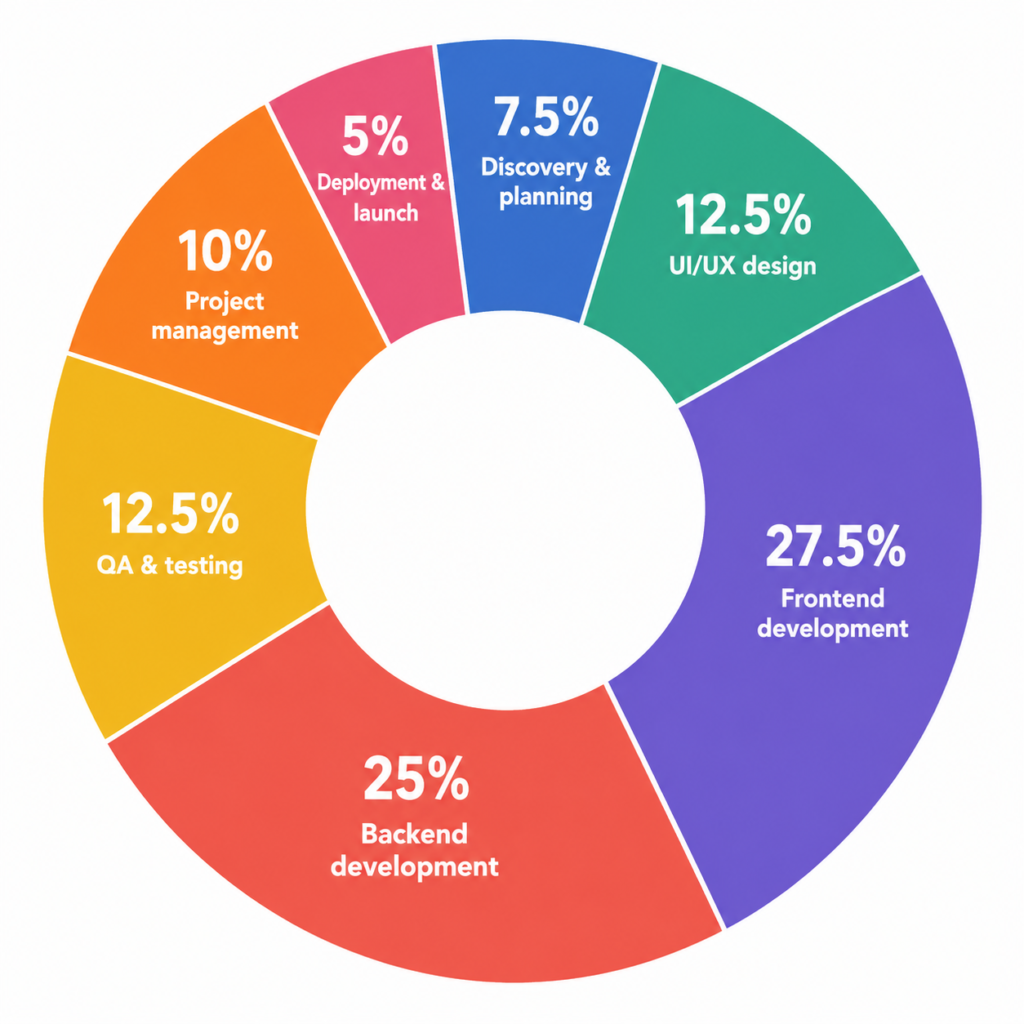
| Phase | % of budget | On a $90,000 project | What happens |
| Discovery & planning | 5-10% | $4,500 – $9,000 | Requirements, user flows, tech stack, scope doc |
| UI/UX design | 10-15% | $9,000 – $13,500 | Wireframes, prototype, design system, all screens |
| Frontend development | 25-30% | $22,500 – $27,000 | The app users touch (iOS/Android/cross-platform) |
| Backend development | 20-30% | $18,000 – $27,000 | Database, APIs, auth, admin panel, cloud setup |
| QA & testing | 10-15% | $9,000 – $13,500 | Manual + automated testing, device lab, bug fixes |
| Project management | 8-12% | $7,200 – $10,800 | Sprints, communication, risk management |
| Deployment & launch | 2-5% | $1,800 – $4,500 | Store submission, ASO basics, monitoring setup |
Two things jump out:
First, backend is often as expensive as the app itself. Clients see the screens and assume that’s the product. The server is the product. The screens are the window.
Second, QA is 10-15% for a reason. When someone quotes you dramatically cheaper, this is the line item that quietly disappears. You find out three weeks after launch when the 1-star reviews arrive.
The 7 factors that move your price the most
These are ranked by how much they swung final cost across our project data.
1. Number of platforms (impact: +30-45% per native platform)
Building for iOS and Android natively means two codebases, two teams, and roughly double the frontend cost.
Cross-platform frameworks change the math:
| Approach | Relative frontend cost | Best for |
| iOS only (Swift) | 1.0× | US-centric consumer apps, premium products |
| Android only (Kotlin) | 1.0× | Emerging markets, enterprise fleets |
| Both native | 1.8-2.0× | Performance-critical apps (gaming, AR, heavy media) |
| Flutter or React Native | 1.2-1.4× | 80% of business apps |
On our projects, Flutter and React Native builds have consistently come in 30-40% cheaper than dual-native builds with no measurable UX difference for typical business apps.
Read Also: Flutter vs React Native vs Xamarin
2. Number of screens and user roles (impact: linear, ~$1,500-$4,000 per unique screen)
Each unique screen needs design, development, and testing.
Each user role multiplies that. A marketplace has three apps hiding inside it: customer, vendor, and admin.
Quick math: 25 screens × 2 roles ≈ 40-50 unique screens ≈ $60,000-$120,000 in frontend work alone.
3. Backend complexity (impact: $10,000 – $80,000+)
| Backend need | Added cost |
| Simple CRUD + auth (Firebase / Supabase) | $8,000 – $15,000 |
| Custom API + relational DB + admin panel | $20,000 – $45,000 |
| Real-time (chat, live tracking, WebSockets) | +$10,000 – $25,000 |
| Microservices, queues, heavy scaling | $60,000 – $120,000+ |
4. Third-party integrations (impact: $2,000 – $15,000 each)
Every integration sounds “simple” until you read the API docs.
- Stripe payments: $3,000 – $8,000
- Maps + geofencing: $4,000 – $12,000
- Twilio SMS/voice: $2,000 – $5,000
- Salesforce / HubSpot CRM sync: $8,000 – $15,000
- EHR systems (healthcare): $15,000 – $40,000
5. UI/UX design depth (impact: $5,000 – $40,000)
Template-based design with standard components: $5,000 – $10,000.
Custom brand system, animations, micro-interactions, and user testing: $20,000 – $40,000.
Design is where you should spend if your app faces consumers. It’s where you can save if it’s an internal tool.
6. Compliance and security (impact: +20-35%)
HIPAA, PCI-DSS, GDPR, SOC 2. Each one adds encryption requirements, audit logging, access controls, and documentation.
A healthcare app that costs $80,000 without HIPAA typically costs $100,000-$110,000 with it.
Read Also: Regulatory-Ready Apps: Compliance with ADA, GDPR, HIPAA
7. Team location and engagement model (impact: 2-5× swing)
The same 1,200-hour project:
- US agency ($120-$200/hr): $144,000 – $240,000
- Hybrid US-led + offshore delivery ($50-$90/hr): $60,000 – $108,000
- Pure offshore ($20-$45/hr): $24,000 – $54,000
More on this in the hourly rates section below.
Cost to build popular types of apps in 2026
People rarely ask “how much does an app cost?” They ask “how much does an app like X cost?”
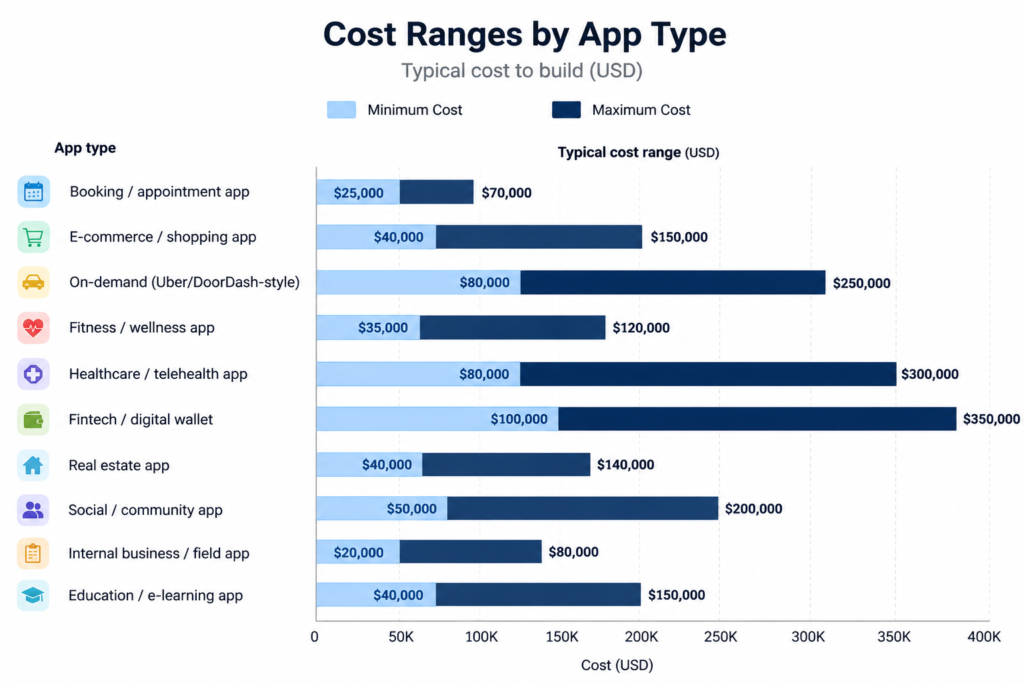
Here are the ranges from our project data and market benchmarks:
| App type | Typical cost | Key cost drivers |
| Booking / appointment app | $25,000 – $70,000 | Calendar sync, payments, reminders |
| E-commerce / shopping app | $40,000 – $150,000 | Catalog, cart, payments, inventory sync |
| On-demand (Uber/DoorDash-style) | $80,000 – $250,000 | Three apps, live tracking, dispatch logic |
| Fitness / wellness app | $35,000 – $120,000 | Wearable integration, video, subscriptions |
| Healthcare / telehealth app | $80,000 – $300,000 | HIPAA, video, EHR integration |
| Fintech / digital wallet | $100,000 – $350,000 | KYC, PCI, banking APIs, fraud detection |
| Real estate app | $40,000 – $140,000 | MLS/IDX feeds, maps, virtual tours |
| Social / community app | $50,000 – $200,000 | Feeds, chat, media, moderation |
| Internal business / field app | $20,000 – $80,000 | Offline mode, forms, ERP integration |
| Education / e-learning app | $40,000 – $150,000 | Video, quizzes, progress tracking, LMS |
Hourly rates: US vs offshore vs hybrid
The rate you pay is the second-biggest lever after scope.
| Region / model | Hourly rate (2026) | Pros | Cons |
| US / Canada agencies | $120 – $200+ | Time zone, communication, legal protection | Highest cost |
| US freelancers | $75 – $150 | Cheaper than agencies | Single point of failure, no QA/design |
| Eastern Europe | $45 – $90 | Strong engineering | 7-10 hr time gap |
| Latin America | $40 – $80 | US time zones | Smaller talent pool for niche stacks |
| South Asia | $20 – $50 | Lowest cost, large talent pool | Quality variance, management overhead |
| Hybrid (US PM/leads + offshore delivery) | $50 – $95 blended | US accountability at offshore-ish prices | Requires a mature agency process |
Our take: Pure offshore works if you can manage developers. Most non-technical founders can’t and shouldn’t have to.
The hybrid model, US-based leadership and client contact with a distributed engineering team, is how we deliver most projects from Austin and Houston. It’s why our medium-complexity apps land in the $50K-$120K range instead of $150K-$250K.
Hidden costs nobody puts in the proposal
Here’s where budgets go to die.
Your build quote is the upfront cost. Here’s what follows:
Ongoing costs (yearly)
| Item | Annual cost | Notes |
| Maintenance & updates | 15-20% of build cost | OS updates, bug fixes, library upgrades |
| Cloud hosting (AWS/GCP/Azure) | $1,200 – $30,000+ | Scales with users |
| Apple Developer Program | $99 | Required for App Store |
| Google Play Console | $25 one-time | Required for Play Store |
| Third-party API fees | $500 – $20,000+ | Maps, SMS, payments (% of revenue), email |
| Monitoring / crash reporting | $0 – $3,000 | Sentry, Firebase Crashlytics, Datadog |
| App Store commission | 15-30% of in-app revenue | Reduced to 15% under $1M/yr |
One-time costs people forget
- App Store Optimization (ASO) assets: $1,000 – $5,000
- Legal (privacy policy, terms, data agreements): $1,000 – $5,000
- Security audit / penetration test: $5,000 – $20,000 (mandatory for fintech/health)
- Marketing launch: Whatever you think, double it
The real 3-year cost
A $90,000 app isn’t a $90,000 app.
- Year 0: $90,000 build
- Years 1-3: ~$15,000/yr maintenance + ~$6,000/yr hosting and services
3-year total: ~$153,000
Plan for it now and it’s a line item. Discover it later and it’s a crisis.
We’ll do a full deep-dive on app maintenance costs later in this series.
Real example: what a $62,000 app looked like
Abstract ranges are fine. Real projects are better.
Client: A Texas-based service business (anonymized; details shared with permission)
Problem: Customers booked by phone. Staff double-booked. No-shows ran 22%.
Goal: A customer-facing booking app + staff admin panel.
Scope:
- Customer app: 14 screens (browse, book, pay, reschedule, reminders, reviews)
- Staff panel: 9 screens (web-based)
- Stripe payments, Google Calendar sync, push + SMS reminders
- Cross-platform via Flutter (iOS + Android from one codebase)
Cost breakdown:
| Phase | Hours | Cost |
| Discovery & planning | 40 | $3,200 |
| UI/UX design | 110 | $8,800 |
| Flutter app development | 320 | $25,600 |
| Backend + admin panel | 190 | $15,200 |
| QA & testing | 85 | $6,800 |
| PM & launch | 30 | $2,400 |
| Total | 775 hrs | $62,000 |
Timeline: 13 weeks from kickoff to App Store approval.
Results after 6 months:
- No-show rate dropped from 22% to 9% (automated reminders)
- 61% of bookings moved to the app
- Front-desk staff hours reduced by ~15/week
Ongoing cost: ~$900/month (maintenance retainer + hosting + Twilio).
Had this client gone dual-native, the frontend line would have been roughly $45,000 instead of $25,600. Same app. $20,000 more.
That’s the cross-platform decision in one number.
How to estimate your own app cost (formula)
You can get within ±20% of a real quote in 10 minutes.
Step 1: Count your unique screens
List every screen. Login, home, profile, settings, each step of your main flow. Be honest. Most people undercount by 30%.
Step 2: Estimate hours per screen
- Simple screen (list, form, settings): 12-20 hours (design + dev + QA)
- Medium screen (dashboard, checkout, map): 25-40 hours
- Complex screen (real-time chat, video call, custom editor): 50-100 hours
Step 3: Add backend hours
- Basic (auth + database + simple API): 150-250 hours
- Standard (custom API, admin panel, integrations): 300-600 hours
- Advanced (real-time, microservices, compliance): 800-2,000 hours
Step 4: Add integrations
~40-80 hours each for standard APIs (payments, maps, SMS). 150+ for enterprise systems.
Step 5: Add overhead
Multiply your total by 1.25 for PM, testing coordination, meetings, and deployment.
Step 6: Multiply by your rate
Pick the blended hourly rate that matches your team model from the table above.
Worked example
- 20 screens: 8 simple (16 hr) + 10 medium (30 hr) + 2 complex (60 hr) = 548 hours
- Standard backend: 400 hours
- 3 integrations: 180 hours
- Subtotal: 1,128 hours × 1.25 = 1,410 hours
- At $65/hr blended (hybrid model): ≈ $91,650
- At $150/hr (US agency): ≈ $211,500
That’s your range. Anyone quoting far outside it either misunderstood your scope or wants you to.
9 ways to lower your app development cost without killing quality
1. Start with an MVP, not a “Version 1”
Ship the one flow that proves the business case. Add the rest after you have users telling you what they want. This alone cuts first-release cost by 40-60%. (Our MVP design service exists for exactly this.)
2. Go cross-platform unless you have a specific reason not to
Flutter or React Native. One codebase. 30-40% savings. Native only when you need bleeding-edge hardware access or gaming-grade performance.
3. Use a Backend-as-a-Service for v1
Firebase, Supabase, or AWS Amplify can replace $30,000 of custom backend with $10,000 of configuration. Migrate later if you scale.
4. Cut integrations ruthlessly
Do you need a CRM sync on day one? Or can someone export a CSV weekly for the first three months?
5. Use a design system instead of designing every pixel
Material Design or Apple HIG components, customized to your brand. Half the design cost, and users already know how to use it.
6. Write a real scope document before getting quotes
Vague scope = padded quotes. Every agency prices in uncertainty. Remove the uncertainty, and you remove the padding.
7. Fix the scope, then choose your pricing model
- Fixed-price: Best for well-defined MVPs
- Time & materials: Best for evolving products
- Dedicated team: Best for ongoing development past v1
8. Choose a hybrid team model
US-based leadership and communication with distributed delivery. You keep accountability and time-zone overlap without paying $180/hr for every line of code.
9. Budget for maintenance from day one
Not a savings tactic exactly, but it prevents the most expensive mistake: launching an app you can’t afford to keep alive.
The bottom line on mobile app development cost
If you remember three things:
- Most business apps cost $40K-$150K. Under $18K, quality was cut somewhere. Over $300K, you’d better be building something genuinely complex.
- Scope drives cost more than anything. Screens × roles × platforms × integrations. Control those, and you control your budget.
- The build is 60-70% of your 3-year cost. Plan for the rest.
And one more, because it matters: the cheapest quote is almost never the cheapest app. We’ve rebuilt dozens of apps that were “done” by someone else for $15,000. The rebuild always costs more than doing it right would have.
If you’re deciding whether an app is even the right move yet, our post on when a business should shift from website to mobile app is the place to start. If you already know you need one, keep reading.
FAQs
How much does it cost to build a mobile app in 2026?
Most business apps cost between $40,000 and $150,000 in 2026. Simple MVPs start around $18,000-$50,000, medium-complexity apps run $50,000-$150,000, and complex or enterprise apps range from $150,000 to $300,000 or more. Industry surveys put the average agency-built app near $90,000.
How much does it cost to make a simple app?
A simple app with 5-10 screens, user login, one core flow, and push notifications typically costs $18,000 to $50,000 and takes 8-14 weeks. Costs below that usually mean design, QA, or backend work has been cut.
How much does an app cost per hour to develop?
App development hourly rates in 2026 range from $20-$50 for offshore teams, $45-$90 for Eastern Europe and Latin America, $50-$95 blended for hybrid US-led teams, and $120-$200+ for US agencies. A typical medium app requires 900-2,000 development hours.
Is it cheaper to build an iOS or Android app?
Costs for a single platform are roughly equal. Android sometimes costs 10-15% more in QA because of device fragmentation. Building both natively nearly doubles frontend cost, which is why most businesses now use Flutter or React Native to ship both platforms from one codebase.
How much does it cost to maintain an app per year?
Plan for 15-20% of the original build cost per year. A $90,000 app typically needs $13,000-$18,000 annually for updates, bug fixes, OS compatibility, and security patches, plus $1,200-$30,000 in hosting and third-party service fees depending on usage.
How much does it cost to build an app like Uber?
An on-demand app like Uber or DoorDash costs $80,000-$250,000 for a market-ready version, because it’s really three apps (customer, driver, admin) with live tracking, dispatch logic, and payments. A stripped-down MVP can be built for $60,000-$90,000.
Can I build an app for $5,000?
You can build a template or no-code app for $5,000, and for some internal tools that’s enough. A custom app with real backend logic, professional design, and testing cannot be delivered for that price by a legitimate team in 2026.
How long does it take to build a mobile app?
Simple apps take 8-14 weeks, medium apps 4-7 months, and complex apps 7-12+ months. Clutch’s 2026 data shows an 11-month average for agency projects, though MVP-focused builds are usually much faster.
What’s the difference between fixed-price and time-and-materials pricing?
Fixed price gives you a set cost for a defined scope, which is ideal for MVPs with clear requirements. Time-and-materials bills actual hours, which suits evolving products. Most agencies add 15-25% risk padding to fixed-price quotes, so a tight scope document saves real money.
Get a Free Project Estimate in 24 Hours
You now know more about app pricing than most people who’ve already hired an agency.
Tell us what you’re building and we’ll send you a scoped, line-item estimate, the same format as the case study above, within one business day. No sales call required unless you want one.