
TL;DR – MVP Development Cost in 2026
- Most startup MVPs cost $15,000 to $60,000. Under $15K you’re usually buying a prototype, not a product. Over $80K you’ve stopped building an MVP.
- The single biggest cost mistake is scope, not rate. Founders who cut from 20 features to 5 save more money than founders who cut their hourly rate in half.
- A realistic first-year MVP budget is build cost × 1.5. The extra covers the iteration you’ll absolutely need after real users show up.
- No-code MVPs ($2K-$15K) are legitimate for validating demand. They’re not a shortcut to a scalable product.
- There’s a budget template at the end you can copy into a spreadsheet today.
What an MVP costs in 2026 (the honest range)
Here’s the number most people came for.
After building 100+ apps, many of them as first versions for founders, the MVP projects we’ve delivered cluster like this:
| MVP tier | 2026 cost range | Timeline | What you get |
| Lean MVP | $15,000 – $30,000 | 6-10 weeks | One platform, one core flow, 5-8 screens |
| Standard MVP | $30,000 – $60,000 | 10-16 weeks | Cross-platform payments or integrations, 10-15 screens, admin panel |
| Complex MVP | $60,000 – $120,000 | 16-24 weeks | Multiple user types, real-time features, compliance, custom logic |
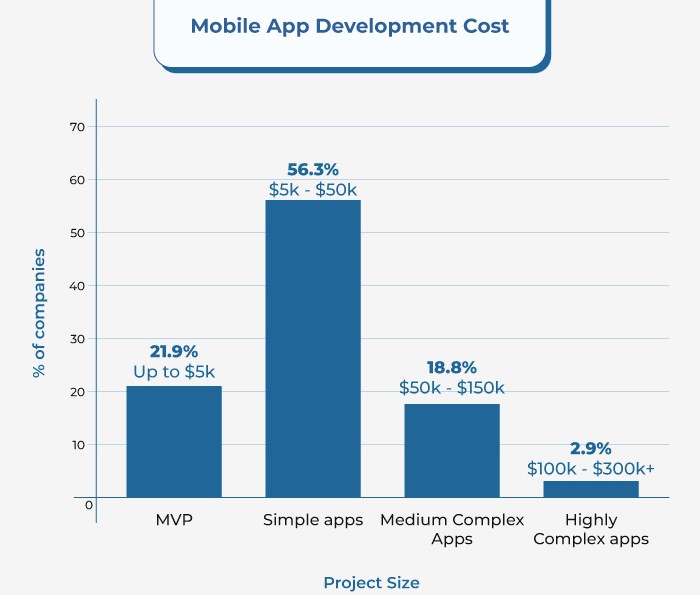
The wider market agrees. The GoodFirms 2026 survey found that 78.2% of app development companies quote MVPs at $50,000 or less (56.3%). That’s the sweet spot, and it matches what we see.
Now for the part that matters more than the range: why your number lands where it does.
Because two founders can walk into our office with “the same idea” and leave with quotes $40,000 apart. Neither quote is wrong. They just want different things and haven’t realized it yet.
First, let’s agree on what an MVP actually is
This sounds basic. It isn’t.
Half the MVP budgets that blow up do so because the founder and the dev team meant different things by “MVP.”
An MVP is the smallest version of your product that lets a real user complete the core job, so you can learn whether they’ll pay for it.
That definition has three parts, and all three affect cost:
“Smallest version” means you cut everything that isn’t the core job. Not “small-ish.” Smallest.
“Real user completes the core job” means it has to actually work. Login, data saved, no crashes. This is what separates an MVP from a prototype.
“So you can learn” means analytics, feedback loops, and the ability to change things quickly are part of the build. Not afterthoughts.
Prototype vs MVP vs Version 1
People use these interchangeably. They cost wildly different amounts.
| Prototype | MVP | Version 1.0 | |
| Purpose | Show the idea | Test the idea with real users | Serve the market |
| Works? | Looks like it works | Actually works, narrowly | Works broadly |
| Users | Investors, co-founders | 50-500 early adopters | Everyone |
| Cost (2026) | $2,000 – $10,000 | $15,000 – $60,000 | $80,000 – $250,000+ |
| Time | 1-3 weeks | 6-16 weeks | 5-12 months |
If you’ve been quoted $8,000 for an “MVP,” you’re likely getting a prototype with a nicer name. If you’ve been quoted $150,000, someone’s building your Version 1 and calling it an MVP to close the deal.
We wrote a full explainer on this in our MVP in mobile app development guide. This post picks up where that one leaves off: the money.
MVP cost by build path: no-code, freelancer, agency, in-house
How you build changes the price more than what you build, at least at MVP stage.
Path 1: No-code / low-code ($2,000 – $15,000)
Bubble, FlutterFlow, Adalo, Glide, Softr. Plus a freelancer or your own weekends.
Real cost breakdown:
- Platform subscription: $30 – $500/month
- Freelance no-code builder: $2,000 – $12,000
- Integrations (Zapier, Make, Stripe): $50 – $300/month
When it’s right: You’re testing whether anyone wants this at all. Landing page, waitlist, simple booking, a basic marketplace with manual fulfillment behind the scenes.
When it’s wrong: You need offline mode, heavy custom logic, real-time features, or you’re building for a regulated industry. You’ll hit a wall around month 4 and rebuild from scratch. We’ve done a lot of those rebuilds. They’re not cheap.
Honest take: No-code MVPs are a fantastic way to spend $5,000 to learn whether you should spend $50,000. Treat them as a validation tool, not a product.
Path 2: Freelancer ($8,000 – $40,000)
One developer, sometimes two, usually offshore.
What you’re really buying: Development hours. Not design. Not QA. Not project management. Not architecture decisions.
Where it works: You’re technical enough to write a proper spec, review code, and manage timelines. Or you have a technical co-founder doing that.
Where it breaks: The freelancer gets a better gig mid-project. Or you discover at week 9 that there’s no test coverage and the database schema can’t support the feature you need next. Or the app “works” on their phone and crashes on yours.
Not every freelancer. But enough that we hear this story roughly once a month.
Path 3: Agency ($20,000 – $80,000)
A team: designer, 1-3 developers, QA, project manager.
What you’re buying: The whole thing. Discovery, design, code, testing, launch, and someone accountable when it goes wrong.
The trade: More expensive per hour, but usually fewer hours wasted and far less of your own time consumed. For a non-technical founder, that last part is the actual value.
Watch for: Agencies who quote MVPs at $100K+. That’s not an MVP anymore. Either your scope is wrong or their model is.
At Boolean Inc., most first-version projects we take on land between $25,000 and $60,000. If a founder’s scope is pushing past that, we usually stop and have a “what are we actually testing?” conversation before anyone signs anything.
Path 4: In-house team ($60,000 – $150,000 for the first version)
Hire a designer and one or two engineers.
Real math: Two mid-level engineers in the US cost $12,000-$20,000/month fully loaded. A 4-month MVP is $50,000-$80,000 in salary alone, before design, before recruiting fees, before the 6-8 weeks it takes to hire them.
When it makes sense: You’ve raised a seed round, the product is the company, and you’ll need this team for years anyway.
When it doesn’t: Pre-revenue, pre-funding, or you’re a non-tech business adding an app to an existing operation.
We’ll go much deeper on freelancer vs agency vs in-house in a dedicated post soon, because the decision deserves more than four paragraphs.
Quick comparison
| Path | Cost | Time to launch | Your time required | Risk |
| No-code | $2K – $15K | 1-6 weeks | Medium | Rebuild later |
| Freelancer | $8K – $40K | 8-20 weeks | High | Abandonment, quality |
| Agency | $20K – $80K | 6-16 weeks | Low | Overscoping |
| In-house | $60K – $150K | 12-24 weeks (incl. hiring) | Very high | Fixed cost burn |
MVP cost by complexity: three tiers with real feature lists
Let’s get specific about what’s in each tier. Vague tiers are how budgets slip.
Lean MVP: $15,000 – $30,000
The test: “Will people use this to do one thing?”
Typical feature set:
- Email or Google/Apple sign-in
- Onboarding (2-3 screens)
- One primary flow (create a booking, log a workout, post a request)
- A list/detail view of what the user created
- Basic push notifications
- Simple settings and profile
- Analytics (Mixpanel, Amplitude, or Firebase)
What’s NOT in it: Payments, chat, maps, multiple user roles, admin dashboards beyond a database view.
Platform: One. iOS or Android, or a mobile-responsive web app. Usually built in Flutter so the second platform is cheap later.
Team: 1 designer (part-time), 1 developer, 1 QA (part-time), PM oversight.
Hours: 300-550.
Standard MVP: $30,000 – $60,000
The test: “Will people pay for this, and does the two-sided part work?”
Typical feature set:
- Everything in Lean, plus:
- Payments (Stripe, in-app purchases, or subscriptions)
- Two user roles (customer + provider, buyer + seller, patient + clinic)
- One meaningful integration (calendar, maps, SMS)
- A real admin panel (approve users, view transactions, handle disputes)
- Cross-platform (iOS + Android from one codebase)
- Email transactional flows (receipts, reminders)
Team: 1 designer, 2 developers (one leaning frontend, one backend), 1 QA, 1 PM.
Hours: 550-1,000.
This is where most of our MVP work sits. It’s also where the MVP design service is built around, because it’s the tier that actually gets startups to their first paying customers.
Complex MVP: $60,000 – $120,000
The test: “Can we prove the hard technical thing works, safely, with real users?”
Typical feature set:
- Everything in Standard, plus one or more of:
- Real-time features (live tracking, chat, collaborative editing)
- Compliance (HIPAA for health, PCI scope for fintech, COPPA for kids)
- Custom algorithm (matching, pricing, recommendation, AI/LLM integration)
- Video or audio
- Three or more user roles
- Offline-first architecture
Team: 1-2 designers, 3-4 developers, 1-2 QA, 1 PM, architect involvement.
Hours: 1,000-2,000.
A warning about this tier: If your “MVP” is here, ask yourself hard whether the complex thing is truly needed to test the idea, or whether it’s needed to ship the product. Those are different. Telehealth needs HIPAA on day one; that’s non-negotiable. A recommendation algorithm can usually be faked with a curated list for the first 200 users.
Where the money goes: a line-by-line MVP budget
Here’s the average allocation across our Standard MVP projects. If your quote looks nothing like this, ask why.
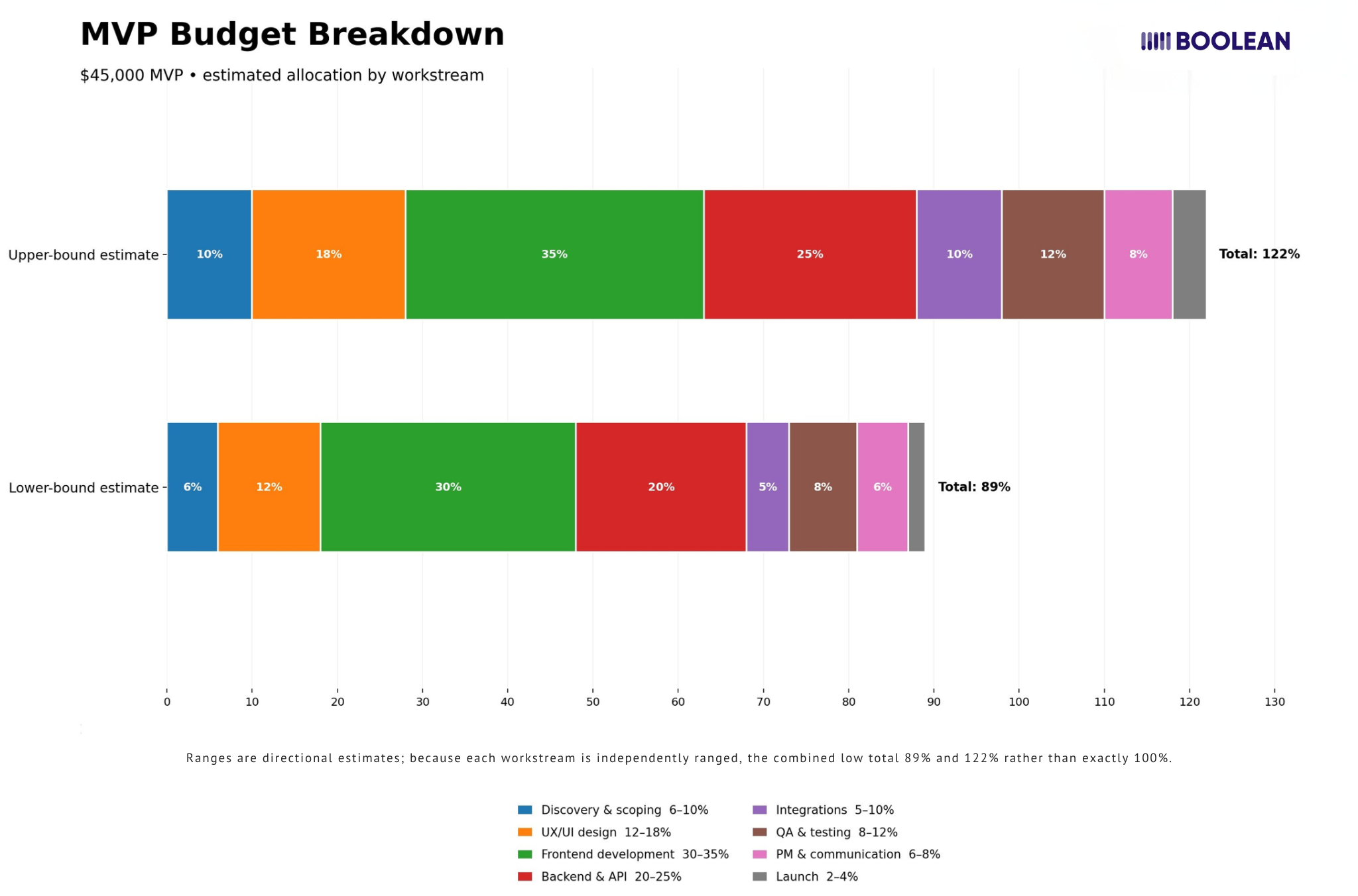
| Line item | % of budget | On a $45,000 MVP | What’s included |
| Discovery & scoping | 6-10% | $2,700 – $4,500 | Workshops, user stories, feature prioritization, tech decisions, scope document |
| UX/UI design | 12-18% | $5,400 – $8,100 | User flows, wireframes, clickable prototype, final screens, design system basics |
| Frontend (app) development | 30-35% | $13,500 – $15,750 | The screens, navigation, state, offline handling, platform quirks |
| Backend & API | 20-25% | $9,000 – $11,250 | Database, authentication, business logic, admin panel, cloud setup |
| Integrations | 5-10% | $2,250 – $4,500 | Payments, notifications, email, maps, analytics |
| QA & testing | 8-12% | $3,600 – $5,400 | Test plans, manual testing across devices, regression, bug fixing |
| PM & communication | 6-8% | $2,700 – $3,600 | Sprint planning, demos, decisions, keeping you informed |
| Launch | 2-4% | $900 – $1,800 | Store listings, screenshots, submission, review fixes, monitoring |
Three things worth noticing:
Design is bigger than most founders expect. 12-18%. Cutting it to 5% is the single most common false economy. Bad UX in an MVP means your test results are garbage: you can’t tell whether users left because they don’t want the product or because they couldn’t figure out the button.
Discovery isn’t optional overhead. The $3,000 you spend defining scope saves $15,000 of “wait, I thought that was included.”
QA is where cheap quotes hide the savings. If a quote is 30% below the others, this line is usually where it went.
The 6 decisions that decide your MVP price
These are the levers. Pull them consciously.
1. How many things are you testing? (Biggest lever by far)
An MVP tests one hypothesis. “Will busy parents pay $9/month for automated meal planning?” That’s one.
“Will parents pay for meal planning, and will they share recipes socially, and will grocery stores pay for placement?” That’s three products.
Every additional hypothesis roughly adds 40-70% to cost. Pick one. Prove it. Then fund the next one with what you learned.
2. One platform or two?
| Choice | Relative cost | When |
| Web app only (responsive) | 0.8× | B2B tools, dashboards, anything used at a desk |
| iOS only | 1.0× | US consumer, premium positioning |
| Android only | 1.0× | Emerging markets, field/logistics workforces |
| Flutter / React Native (both) | 1.2-1.35× | Most consumer MVPs |
| Native iOS + native Android | 1.8-2.0× | Almost never for an MVP |
If you genuinely need both stores on day one, Flutter or React Native is the answer. Dual-native for an MVP is spending money to prove nothing extra.
3. Custom backend or Backend-as-a-Service?
For most MVPs, Firebase or Supabase replaces $12,000-$20,000 of custom backend with $4,000-$8,000 of configuration and glue code.
You’ll possibly outgrow it. That’s fine. Outgrowing your backend means you have users, which means you have money, which means you can afford to migrate.
We compared the options in detail in our BaaS platforms guide. Short version: Firebase for speed, Supabase if you want Postgres and an easier exit later.
4. Payments: now or later?
Adding Stripe to an MVP is $3,000-$7,000 all-in (integration, receipts, refund handling, webhooks, testing).
That’s worth it if “will they pay?” is your hypothesis. It’s a waste if your hypothesis is “will they use it?” In that case, take payments manually (invoice, Stripe payment link) for your first 50 customers and build it properly when the answer’s yes.
5. Design depth
- Template-driven design (system components, light branding): $3,000 – $6,000
- Custom, brand-led design (unique components, illustrations, animations): $10,000 – $20,000
Consumer app competing on feel? Spend on design. B2B tool solving an ugly problem? Templates are fine, nobody’s choosing their inventory app for its animations.
6. Who’s building it (rate)
Same 700-hour Standard MVP:
- Offshore freelancer at $30/hr: $21,000
- Hybrid agency (US-led, distributed team) at $60/hr: $42,000
- US agency at $150/hr: $105,000
We covered rates by region in our mobile app development cost breakdown. The short version: rate matters, but scope matters 3× more. A disciplined $60/hr team that builds 700 hours beats a $30/hr team that meanders through 1,400.
Where founders overspend (and where they underspend)
We’ve watched a lot of MVP budgets get spent. Some patterns.
Where the money gets wasted
1. Building for scale before there are users.
Microservices. Kubernetes. Multi-region databases. For 200 users. We’ve seen $30,000 go into infrastructure for apps that never crossed 1,000 downloads. A single server and a managed database will carry you to 50,000 users in most cases.
2. Admin panels that rival the product.
Founders imagine themselves managing thousands of users and spec out a gorgeous admin dashboard. For your first 500 users, a database viewer and a spreadsheet export are enough. Save $8,000-$15,000.
3. “While we’re in there” features.
Dark mode. Social sharing. Referral codes. Multi-language. Each one sounds like a two-day job. Together they’re six weeks and $18,000. None of them test your hypothesis.
4. Custom everything.
Custom auth instead of Firebase Auth. Custom charts instead of a library. Custom video player. Each choice adds 20-60 hours for a result users can’t distinguish.
5. A second round of design after development starts.
Redesigning mid-build is the most expensive way to make design decisions. Nail the clickable prototype, test it with 5 people, then start development.
Where founders cut too deep
1. QA.
“We’ll test it ourselves.” You won’t, not properly, and your first 100 users will find every bug you didn’t. First impressions in the App Store don’t get second chances.
2. Analytics and feedback tools.
An MVP without analytics is an expensive guess. Mixpanel or Amplitude plus a feedback widget costs maybe $1,500 to wire in. Skipping it means you finish the MVP and still don’t know what happened.
3. Onboarding.
The three screens that explain what the app does and get the user to their first success. Founders skip them because “the app is self-explanatory.” It isn’t. Your day-1 retention will tell you.
4. The post-launch budget.
More on this below, but it’s the biggest one.
Real example: a $34,000 MVP, start to finish
Ranges are useful. A real project is better.
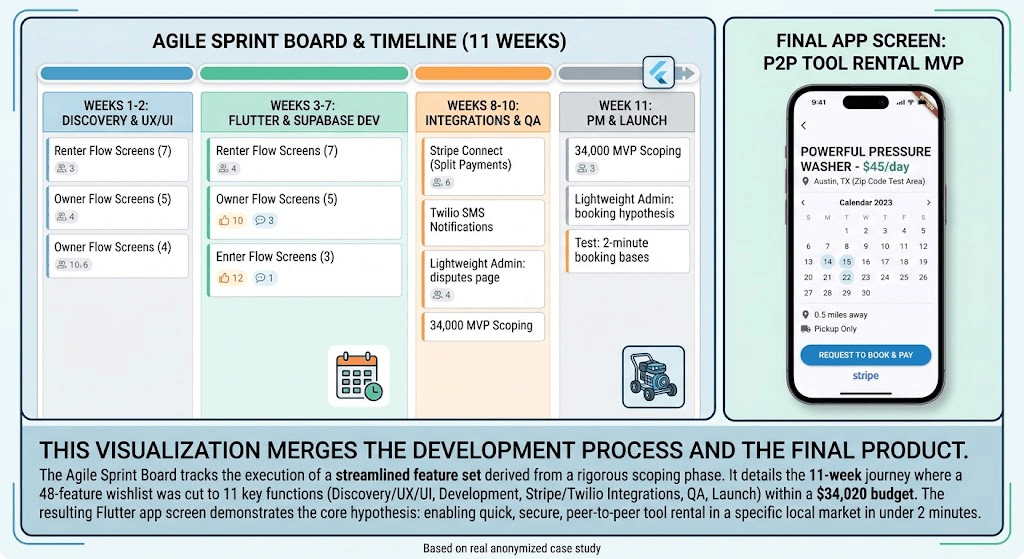
Client: A two-person founding team in Texas building a peer-to-peer equipment rental app (think: rent a pressure washer from a neighbor instead of Home Depot). Anonymized with permission.
Starting point: A 22-page pitch deck, a 48-feature wishlist, and $40,000 in pre-seed money that also had to cover marketing.
What we cut in discovery (week 1): Their 48 features became 11. Gone for v1: in-app chat (replaced with SMS via Twilio), insurance integration (manual for now), user ratings (post-MVP), delivery scheduling (pickup only), and 33 others.
The one hypothesis: “Will homeowners in one Austin zip code rent tools from strangers if the booking takes under 2 minutes?”
Final scope:
- Renter flow: browse by category, view listing, request dates, pay, confirm pickup (7 screens)
- Owner flow: list an item with photos, approve requests, mark returned (5 screens)
- Stripe Connect for split payments
- Twilio SMS for all notifications (no push, no in-app chat)
- Supabase backend with row-level security
- Flutter, shipped to iOS and Android
- Lightweight admin: Supabase dashboard + one custom “disputes” page
Cost breakdown:
| Phase | Hours | Cost |
| Discovery & scoping workshop | 32 | $2,240 |
| UX/UI design (incl. clickable prototype tested with 6 users) | 88 | $6,160 |
| Flutter development | 205 | $14,350 |
| Backend (Supabase + edge functions) | 72 | $5,040 |
| Stripe Connect + Twilio integration | 38 | $2,660 |
| QA (3 device tiers, 2 regression cycles) | 34 | $2,380 |
| PM & launch | 17 | $1,190 |
| Total | 486 hrs | $34,020 |
Timeline: 11 weeks, kickoff to both stores.
What happened next:
- 140 sign-ups in the first 5 weeks (one zip code, flyers and a local Facebook group)
- 31 completed rentals
- Average booking time: 1 min 40 sec
- Hypothesis: validated, with a twist. Owners were fine. Renters wanted delivery. That “cut” feature became the first post-MVP build.
Post-MVP spend over the next 4 months: ~$11,000 (delivery scheduling, ratings, a few fixes). They raised a small angel round on the traction numbers.
Had they built all 48 features, our estimate was $115,000-$130,000 and 7+ months. They’d have launched with $0 left for marketing and learned the same thing about delivery.
That’s what an MVP budget is for.
The full first-year MVP budget nobody plans for
Here’s the mistake we see more than any other: founders budget for the build and nothing else.
The build is roughly two-thirds of what you’ll spend in year one.
Post-launch costs for a Standard MVP
| Item | First-year cost | Notes |
| Iteration & new features | 30-50% of build cost | You will learn things that require changes. That’s the point. |
| Bug fixes & OS updates | 10-15% of build cost | iOS and Android ship major updates every year. Things break. |
| Hosting & BaaS | $600 – $6,000 | Firebase/Supabase free tiers run out around 1-5K active users |
| Third-party services | $1,200 – $8,000 | Stripe fees, Twilio, email, analytics, monitoring |
| App store accounts | $124 | Apple $99/yr, Google $25 once |
| Legal | $1,000 – $4,000 | Privacy policy, terms, any data agreements |
| Domain, landing page, email | $500 – $3,000 | Often forgotten entirely |
The real math
$45,000 Standard MVP:
- Build: $45,000
- Iteration (40%): $18,000
- Maintenance (12%): $5,400
- Services & hosting: ~$5,000
- Legal & misc: ~$3,000
First-year total: ~$76,000.
That’s why we tell founders: budget your MVP at build cost × 1.5, minimum. If you have $50,000 total, plan a $30,000-$33,000 build, not a $50,000 one.
Running out of money three weeks after launch, right when you’ve finally got users telling you what to fix, is the most painful way an MVP fails. And it’s completely avoidable.
For a longer view of how the MVP fits into the years after, our post on building a long-term app roadmap lays out the stages.
How to cut MVP cost without building junk
Some of this echoes the sections above. It’s worth having in one list.
1. Write the hypothesis before the feature list
One sentence: “We believe ‘user’ will ‘action’ because of ‘reason.'” Every feature has to serve that sentence or it goes in the parking lot. This is a $0 exercise that regularly saves $20,000.
2. Do a paid discovery sprint before committing to a build
$2,000-$5,000 for 1-2 weeks of scoping, user flows, and a clickable prototype. You’ll get a tighter fixed-price quote, and if the prototype tests badly, you’ve saved yourself the whole build. Most serious agencies, Boolean Inc. included, offer this as a standalone engagement.
3. Test the prototype with 5 real people before writing code
Not friends. Not family. Five people from your target market, 20 minutes each. You’ll find the two confusing screens now, for free, instead of after they’re coded.
4. Fake the hard parts
Recommendation engine? Curate a list by hand. Automated matching? Do it manually behind the scenes for the first 100 users. AI feature? Have a human answer in the chat window. Users can’t tell the difference and you save $15,000-$40,000 until you know it matters.
5. One platform, or cross-platform. Never dual-native.
Covered above. Worth repeating.
6. Use managed services for everything that isn’t your core product
Auth, payments, email, SMS, file storage, analytics, crash reporting. There’s a service for each, and the free tiers cover MVP volume. Building any of these yourself is money burned.
7. Ship to a single market
One city. One zip code. One customer segment. Fewer edge cases, less localization, faster feedback. Expansion is a post-MVP problem.
8. Choose fixed price for a tight scope
If discovery produced a clear scope document, ask for a fixed price. You get budget certainty, and the agency has an incentive to keep scope disciplined too. Just know that a fixed-price quote includes some risk padding, usually 10-20%, and that changing scope midway reopens the price.
9. Keep a “v1.1” list, and be proud of it
Every good idea that comes up during the build goes on the list. Not into the build. You’ll be shocked how many of them look unnecessary once real users are in the app.
A copy-paste MVP budget template
Fill this in for your own project. Use the midpoint of each range if you’re unsure.
Build a budget.
| Line | Your estimate | Typical range (Standard MVP) |
| Discovery & scoping | $ | $2,500 – $4,500 |
| UX/UI design | $ | $5,000 – $9,000 |
| Frontend development | $ | $12,000 – $18,000 |
| Backend & API | $ | $6,000 – $12,000 |
| Integrations | $ | $2,000 – $5,000 |
| QA & testing | $ | $3,500 – $6,000 |
| Project management | $ | $2,500 – $4,000 |
| Launch & store submission | $ | $800 – $2,000 |
| Build subtotal | $ | $34,000 – $60,000 |
Post-launch (first 12 months)
| Line | Your estimate | Typical |
| Iteration reserve | $ | 40% of build |
| Maintenance reserve | $ | 12% of build |
| Hosting & BaaS | $ | $600 – $6,000 |
| Third-party services | $ | $1,200 – $8,000 |
| Legal | $ | $1,000 – $4,000 |
| Store accounts | $ | $124 |
| Landing page, domain, email | $ | $500 – $3,000 |
| Post-launch subtotal | $ |
First-year total = Build + Post-launch
Sanity check: Is this ≤ your available capital minus your marketing budget? If not, cut scope, not QA.
So, what should you actually budget?
If you’ve read this far, here’s the summary:
- Have less than $15,000? Build a no-code MVP or a clickable prototype. Validate demand. Come back for the real build once you’ve got a waitlist or early revenue.
- Have $25,000 – $50,000? You can build a proper Lean or Standard MVP. Keep the build to two-thirds of that. Reserve the rest.
- Have $60,000 – $100,000? Standard MVP, comfortable iteration budget, room for one technically ambitious feature if the hypothesis truly needs it.
- Have $150,000+? You can afford a Complex MVP. Ask yourself, honestly, whether you should build one. Most companies at this budget do better with a Standard MVP and a much bigger marketing budget.
And the meta-point: MVP development cost is mostly a scope decision dressed up as a pricing question. The founders who get the most out of their money aren’t the ones who found the cheapest developer. They’re the ones who were most ruthless about what not to build.
If you’re earlier than this, still figuring out whether an app is the right vehicle at all, start with when a business should move from website to mobile app. And if you want the whole journey mapped out, our app development guide from idea to launch covers each stage.
FAQs
How much does MVP development cost in 2026?
Most startup MVPs cost $15,000 to $60,000 in 2026. Lean single-platform MVPs run $15,000-$30,000, standard cross-platform MVPs with payments and an admin panel run $30,000-$60,000, and complex MVPs with real-time features or compliance requirements run $60,000-$120,000. GoodFirms’ 2026 survey found 78% of agencies quote MVPs at $50,000 or less.
How long does it take to build an MVP?
A lean MVP takes 6-10 weeks, a standard MVP 10-16 weeks, and a complex MVP 16-24 weeks. Add 1-2 weeks upfront for discovery and scoping. Timelines stretch most often because of scope additions mid-project, not because of technical difficulty.
Can I build an MVP for $10,000?
Yes, with limits. $10,000 buys a solid no-code MVP, a clickable prototype plus a landing page, or a very narrow single-flow app from a freelancer. It won’t buy a custom, tested, cross-platform app with payments from a professional team. Use a $10,000 budget to validate demand, then raise or earn the budget for a full build.
What is the difference between an MVP and a prototype?
A prototype looks like the product but doesn’t work; it’s for demonstrating the concept to investors or testers and typically costs $2,000-$10,000. An MVP actually works for a narrow use case with real users and real data, costing $15,000-$60,000. You can’t validate willingness to pay with a prototype.
How much should I budget for after the MVP launches?
Plan for 40-60% of your build cost in the first year after launch: roughly 40% for iteration based on user feedback and 10-15% for maintenance and OS updates, plus $2,000-$15,000 for hosting, services, and legal. A $45,000 MVP realistically costs about $75,000 in its first year.
Is it cheaper to build an MVP with no-code tools?
Yes, no-code MVPs cost $2,000-$15,000 versus $15,000+ for custom development. The trade-off is limits on custom logic, performance, offline use, and scalability. Most no-code MVPs that succeed get rebuilt in code within 6-12 months, so treat the no-code spend as validation cost, not product investment.
How many features should an MVP have?
Enough to let one type of user complete one core job, usually 5-12 features across 5-15 screens. If your MVP feature list is above 20, you’re building a Version 1, and your cost will reflect that. Every feature should trace back to the single hypothesis you’re testing.
Should I hire a freelancer or an agency for my MVP?
A freelancer ($8,000-$40,000) works if you can write specs, review code, and manage the project yourself. An agency ($20,000-$80,000) makes sense for non-technical founders who need design, QA, and project management handled. The agency costs more per hour but typically wastes fewer hours and far less of your time.
Get a Free MVP Estimate in 24 Hours
Send us your idea, a feature list (the longer is fine, we’ll help you cut it), and your budget range. We’ll come back within one business day with a scoped, line-item estimate in the same format as the case study above, plus an honest note on what we’d cut and why.