
Hire a freelancer if your budget is under $30,000, the scope is small and clear, and you (or someone on your team) can manage a developer. Hire an agency if you’re a non-technical founder or business owner with a $30,000–$300,000 project who needs design, development, QA, and project management handled end to end.
Build in-house if the app is your company, you’ve raised funding, and you’ll need the team for years, because the first year costs $250,000–$500,000 before a single feature ships.
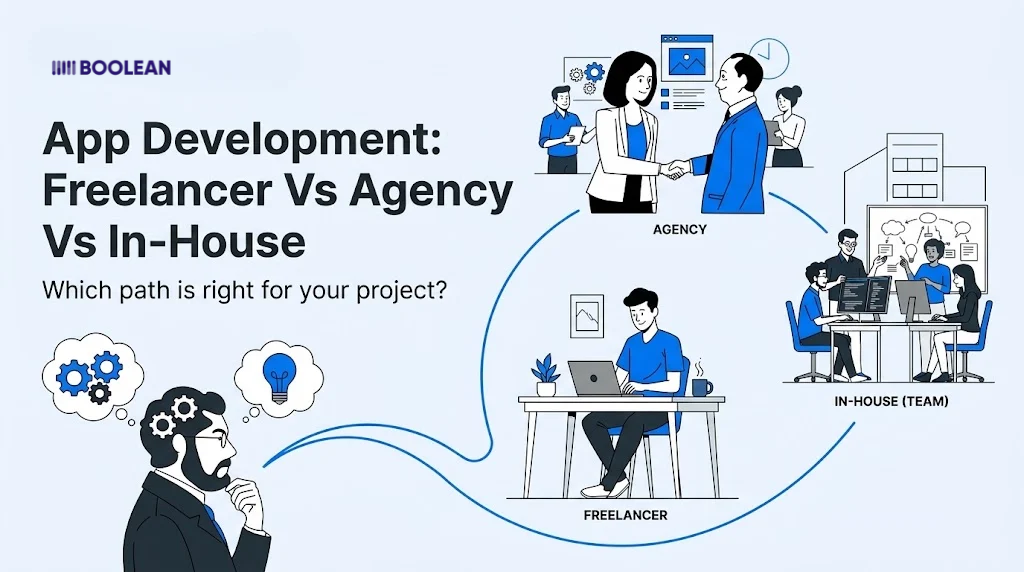
| Freelancer | Agency | In-house | |
| Typical project cost (medium app) | $25,000 – $70,000 | $60,000 – $180,000 | $250,000 – $500,000 (year one, fully loaded) |
| Time to start | Days | 1–3 weeks | 2–4 months (hiring) |
| Your management time | High | Low | Very high at first, then medium |
| Includes design, QA, PM? | Rarely | Yes | Only if you hire for them |
| Risk of abandonment | High | Low | Low (but people quit) |
| Best for | Small scoped work, technical owners | First products, non-technical founders, SMBs | Funded startups where the product is the company |
Key Takeaways
- The cheapest option per hour is rarely the cheapest project. Freelancers bill $30–$150/hour but shift design, QA, and management onto you.
- Agencies cost more per hour and less per outcome for most first-time builders because they bundle the five roles a real app needs.
- In-house looks like a salary line and is actually a $250K+ first-year commitment once you add recruiting, benefits, tooling, and the 3–4 months before anyone ships.
- The deciding factor is who manages the work, not who writes the code. If that person is you and you’re not technical, freelancers are a gamble.
- Most successful startups use more than one model over time: agency for v1, in-house as the product proves itself, freelancers for specialist gaps.
- Whatever you choose, get IP assignment in writing before the first line of code.
The Real Question: Who’s Managing the Build?
Most articles on this topic compare hourly rates. That’s the least useful comparison.
An app needs five jobs done: product definition, design, development, testing, and project management. A freelancer does one of them. An agency does all five. An in-house team does all five once you’ve hired for all five.
So the first question isn’t “how much does each cost?” It’s “who’s doing the other four jobs?“
If the answer is “me,” and you’ve never shipped software, that’s where projects go wrong. Not because the freelancer was bad, but because nobody was writing specs, catching bugs, or noticing in week six that the architecture couldn’t support week ten’s feature.
Keep that lens on as you read the three options.
Option 1: Freelancer
What It Is
One developer, sometimes two, hired through Upwork, Toptal, a referral, or directly. Usually billed hourly or per milestone.
What It Costs
| Freelancer type | Hourly rate | Medium app (900–1,200 hrs) |
| Offshore (South Asia, SE Asia) | $20 – $45 | $20,000 – $50,000 |
| Nearshore / Eastern Europe | $35 – $75 | $35,000 – $85,000 |
| US-based | $75 – $150 | $70,000 – $170,000 |
Rates by region are covered in our app development hourly rates guide. Those figures are for development only. Add $4,000–$15,000 for a separate freelance designer and $2,000–$8,000 for independent QA if you want them.
Where Freelancers Win
- Speed to start. You can have someone working tomorrow.
- Cost for small, clear scopes. A landing page, a feature addition, a bug backlog, a well-specified MVP under 400 hours.
- Specialist work. Need one week of a Bluetooth expert or a payments integration specialist? A freelancer is perfect.
- You’re technical. If you can write specs, review pull requests, and run QA, a freelancer gives you labor without overhead.
Where Freelancers Fail
- Bus factor of one. They get sick, get a better gig, or disappear. We’ve inherited more than one project where the freelancer stopped replying at 70% done. There’s no escalation path.
- No design, no QA, no PM. Unless you hire separately and coordinate them yourself.
- Architecture debt. A solo developer optimizes for shipping today. Nobody’s reviewing whether the database schema survives month six.
- Scope ambiguity. Without a PM, every “small change” is a negotiation.
- IP and security. Freelance agreements vary wildly; many founders discover after the fact that they don’t clearly own their code.
The Honest Verdict
Freelancers are the right call for maybe 20% of app projects: small, clearly scoped, with a technical owner. For a non-technical founder building a first product, they’re the highest-variance option available. Sometimes it works beautifully. Often it costs twice the original quote once a second developer has to untangle it.
Option 2: Agency
What It Is
A company with a team: designers, developers, QA, and project management. You contract for a project or a retainer. Someone is accountable for the outcome, not just the hours.
What It Costs
| Agency type | Blended hourly | Medium app |
| Offshore agency | $25 – $50 | $30,000 – $65,000 |
| Hybrid (US-led, distributed team) | $50 – $95 | $60,000 – $120,000 |
| US-only agency | $120 – $200 | $140,000 – $250,000 |
See our mobile app development cost breakdown for what drives those ranges.
Where Agencies Win
- All five jobs, one contract. Discovery, design, development, QA, PM. You talk to one person.
- Accountability. There’s a company, a contract, a reputation, and a project manager whose job is your deadline.
- Continuity. If a developer leaves, the agency replaces them. Your project doesn’t stop.
- Process. Sprints, demos, staging environments, release checklists. Things a solo developer rarely sets up.
- Breadth. Need a native iOS specialist for one week, or a DevOps engineer for the launch? They’re down the hall.
- Lower management load. You make decisions; you don’t chase tasks.
Where Agencies Fail
- Cost per hour is higher. You’re paying for the roles a freelancer makes you do yourself.
- Overscoping. Some agencies pad proposals. A $40,000 MVP becomes a $110,000 “platform.” Watch for it.
- Account-manager layers. At larger agencies, you may talk to a salesperson who talks to a PM who talks to developers. Insist on direct access to the lead engineer.
- Quality varies enormously. “Agency” covers everything from a two-person shop reselling offshore labor to a 200-person firm. Vet hard.
- Knowledge leaves at the end. Unless you negotiate documentation and handover, you can be dependent on them for every change.
The Honest Verdict
For non-technical founders, SMB owners adding a product, and funded startups that aren’t ready to build an engineering org, an agency is usually the right call for version one. The premium over a freelancer buys the four jobs you can’t do yourself, plus someone to blame if it goes wrong, which is worth more than it sounds.
This is the model Boolean Inc. operates: a US-led team out of Austin and Houston with distributed engineers, billing a blended rate that includes design, QA, and PM. We’ll cover what working with an agency should look like week by week in a dedicated post later in this series.
Option 3: In-House Team
What It Is
You hire employees. At minimum, one or two developers. Realistically, for a real product: a designer, two to three engineers, and someone to lead them.
What It Actually Costs
This is where founders underestimate most, so let’s do the full math for a minimal US-based team.
| Role | Base salary | Fully loaded (×1.3) |
| Senior mobile engineer / lead | $160,000 | $208,000 |
| Mid-level engineer | $125,000 | $162,500 |
| Product designer | $120,000 | $156,000 |
| Annual team cost | $526,500 |
Add:
- Recruiting: 20–25% of first-year salary per hire via agency, or 2–3 months of your own time. Call it $60,000–$100,000 for three roles, or several months of delay.
- Tooling and infrastructure: $15,000–$30,000/year (laptops, licenses, CI, cloud, design tools).
- Time to productivity: 2–4 months to hire, 1–2 months to ramp. First feature ships around month five.
Realistic year-one cost for a three-person team: $600,000–$700,000, with nothing shipped until roughly month five.
A leaner version (two mid-level engineers, contract designer, you as PM) runs $350,000–$450,000 and still carries the hiring delay.
Where In-House Wins
- The product is the company. If you’re a software startup, your engineering team is your core asset. Agencies can’t be that.
- Deep domain knowledge. Employees learn your users, your data, and your edge cases in a way contractors don’t.
- Speed of iteration after launch. No scoping, no change orders. Just build.
- You’ve raised money and the board expects a team.
- Long-horizon products. Five years of continuous development is cheaper in-house than on retainer.
Where In-House Fails
- Pre-revenue, pre-funding. You can’t afford it, and you shouldn’t try.
- Hiring risk. A bad senior hire costs six months and $200,000. Non-technical founders are poorly positioned to evaluate engineers.
- Fixed cost burn. Payroll doesn’t pause when the roadmap does.
- Skill gaps. Two engineers can’t cover iOS, Android, backend, DevOps, and design. You’ll hire contractors anyway.
- Non-software businesses. A restaurant group or a logistics company building an app rarely needs a permanent engineering team.
The Honest Verdict
In-house is the right endgame for software companies. It’s the wrong starting point for almost everyone. Build v1 with an agency or a strong freelancer, prove the market, raise or earn the money, then hire, with a working product to recruit against and real requirements to hire for.
Cost Comparison: The Same App, Three Ways
A medium-complexity app: cross-platform, payments, two user roles, admin panel, and roughly 1,100 hours. Here’s the realistic total cost of getting it to the App Store, including the things people forget to count.
| Freelancer (offshore, $40/hr) | Agency (hybrid, $70/hr) | In-house (2 engineers + contract design) | |
| Development | $44,000 | $77,000 (all roles, blended) | $85,000 (5 months of 2 salaries, loaded) |
| Design | $8,000 (separate freelancer) | included | $12,000 (contractor) |
| QA | $4,000 (separate) or your time | included | your time |
| Project management | your time | included | your time |
| Recruiting / hiring | $0 | $0 | $40,000 or 3 months of your time |
| Rework and overhead | +25% (~$11,000) | +12% (~$9,000) | +10% (~$8,500) |
| Your time (at $150/hr) | ~250 hrs = $37,500 | ~60 hrs = $9,000 | ~400 hrs = $60,000 |
| Realistic total | ~$104,000 | ~$95,000 | ~$205,000 |
| Time to App Store | 5–7 months | 4–5 months | 8–10 months (incl. hiring) |
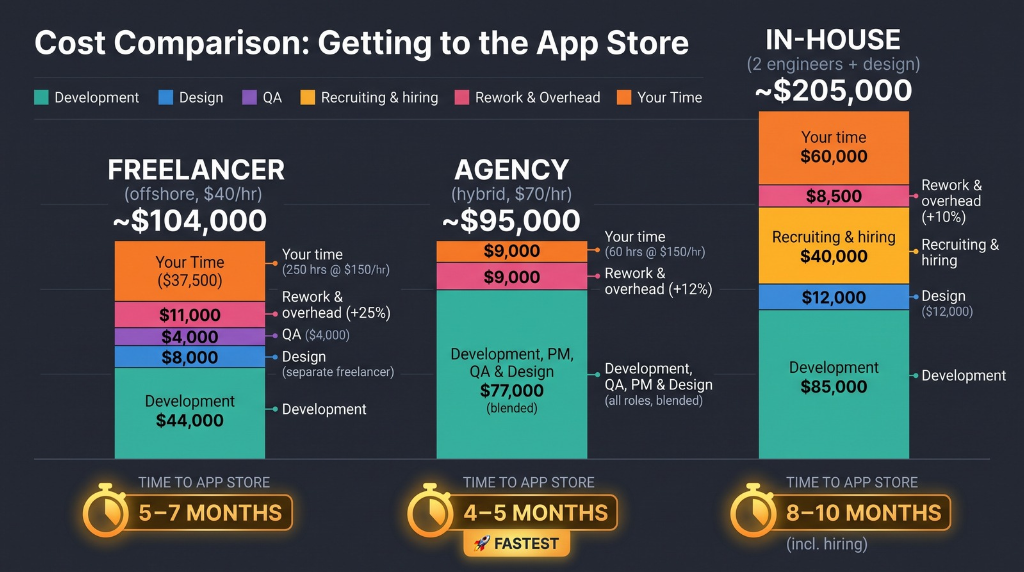
Two things stand out:
The freelancer isn’t cheaper once you count your own hours. The invoice is lowest. The project isn’t.
In-house is twice the cost for v1, and that’s before you’ve paid salaries for months six through twelve. It only makes sense if those months produce value, which means you need a product to iterate on, which means you needed v1 built some other way.
The Hybrid Models Most People End Up With
In practice, few companies pick one model and stay there. The common paths:
Agency → In-House
Build v1 with an agency. Validate the market. Raise or earn. Hire an in-house lead who takes over the codebase, with the agency on a reducing retainer during handover. This is the most common path for startups that work out, and it’s why handover documentation should be in your agency contract from day one.
In-House Core + Agency Capacity
A small in-house team owns the product and architecture; an agency provides surge capacity for a big release or a platform expansion. Often called staff augmentation or a dedicated team arrangement.
Agency + Freelance Specialists
The agency builds and runs the project; a freelancer with a rare skill (a specific SDK, a compliance certification, a niche platform) is brought in for a defined piece. Good agencies arrange this themselves.
Freelancer + Fractional CTO
For technical-ish founders who want freelancer economics with oversight: hire a fractional CTO ($3,000–$10,000/month, a few hours a week) to write specs, review code, and manage the freelancer. Closes most of the freelancer-model gaps for less than an agency.
Which Hybrid Fits You
| Situation | Model |
| Pre-seed, non-technical founder | Agency for v1 |
| Pre-seed, technical founder | Freelancers, or build it yourself with freelance help |
| Seed-funded, product-led startup | Agency for v1 → in-house by month 9–12 |
| Established non-software business adding an app | Agency, likely long-term with a maintenance retainer |
| Existing engineering team, need mobile capacity | Staff augmentation / dedicated agency team |
| Tiny budget, clear spec, patient timeline | Freelancer + fractional CTO |
Decision Matrix: Budget × Technical Skill × Timeline
Find your row.

| Your budget | You’re technical (or have a technical lead) | You’re non-technical |
| Under $30,000 | Freelancer. Write a tight spec. Review everything. | No-code tool or a small fixed-price agency MVP. Avoid freelancers unless referred by someone you trust. |
| $30,000 – $100,000 | Freelancer team with you as PM, or a hybrid agency if you’d rather spend your time elsewhere. | Agency. Fixed-price for a scoped MVP. See our MVP cost guide for scoping. |
| $100,000 – $300,000 | Agency for speed, or start hiring a lead now and use an agency to bridge. | Agency. Insist on direct engineer access and a handover plan. |
| $300,000+ | Hire in-house, use an agency to ship v1 while you recruit. | Agency for v1, hire a technical lead with the agency’s help, transition over 6–12 months. |
Timeline modifier: if you need something in under three months, that rules out in-house entirely and makes a freelancer risky. Agencies with an existing team are the only option that reliably ships fast.
Eight Non-Negotiables Regardless of Who You Hire
These protect you under any model.
- IP assignment in writing, before work starts. You own the code on payment. Not at project end. Not “upon final invoice.” On each payment.
- Access to the repository from day one. Your GitHub, your account, their access. If they disappear, the code doesn’t.
- A written scope with acceptance criteria. Even a two-page one. “The user can book a slot and receive a confirmation email” is testable. “Booking feature” isn’t.
- Staging environment and demo cadence. You see working software every one to two weeks, not a reveal at the end.
- Named people. Who exactly is working on this? What happens if they leave?
- Documentation and handover as a deliverable. README, architecture notes, deployment steps, credentials inventory. Priced into the project.
- Two recent references you can call. Not showcase clients. Clients from the last twelve months.
- An exit clause. Either side can end the engagement with notice; you keep everything built and paid for.
A freelancer, agency, or employee who pushes back on any of these is telling you something.
We’ll go deeper on vetting in an upcoming post on red flags when hiring an app development company. Our complete app development guide also covers how a well-run project should unfold from idea to launch.
The Bottom Line
- Freelancer: cheapest invoice, most work for you, highest variance. Right for small scopes and technical owners.
- Agency: mid-range cost, lowest management load, highest accountability. Right for first products and anyone who can’t be their own PM, designer, and QA.
- In-house: highest cost and slowest start, best long-term fit when the product is the company. Right as a destination, rarely as a starting point.
Choose based on who manages the build. Everything else is a rate card.
FAQs
Is it better to hire a freelancer or an agency for app development?
An agency is better for most non-technical founders and businesses building a first product, because it includes design, QA, and project management alongside development. A freelancer is better for small, clearly scoped work when you or a technical lead can manage the developer directly. Freelancers cost less per hour; agencies usually cost less per finished, working app.
How much does it cost to hire an agency vs a freelancer for an app?
For a medium-complexity app, freelancers invoice $25,000–$70,000 (development only) and agencies $60,000–$180,000 (all roles). Once you add separate design, QA, rework, and your own management time, the freelancer path typically lands at $90,000–$110,000 realistic total versus $90,000–$100,000 for a hybrid agency.
How much does an in-house app development team cost?
A minimal US-based team of two engineers and a designer costs $500,000–$650,000 in year one when fully loaded with benefits, recruiting, and tooling, and usually ships nothing until month four or five. A leaner two-engineer setup with contract design runs $350,000–$450,000.
When should a startup build an in-house development team?
Build in-house when the product is the core of your business, you’ve raised funding or have revenue to sustain payroll, and you’ll need continuous development for years. Most startups should build v1 with an agency, validate the market, then hire in-house with a working product to recruit against.
What are the risks of hiring a freelance app developer?
The main risks are abandonment (a single developer with no backup), missing roles (no design, QA, or project management unless you add them), architecture shortcuts that surface months later, and unclear IP ownership. These risks drop sharply if you’re technical enough to manage the work or you add a fractional CTO.
What is a hybrid or staff augmentation model?
Staff augmentation means an agency supplies developers who work inside your existing team under your management. A hybrid model more broadly combines approaches: for example, an agency builds v1 while you hire an in-house lead, or an in-house core team uses agency capacity for big releases.
How do I protect my app idea when hiring outside developers?
Sign an NDA before sharing details, require written IP assignment that transfers ownership on each payment, keep the code in a repository you control from day one, and make documentation and handover a paid deliverable. Reputable agencies and freelancers agree to all of this without hesitation.
Can I switch from an agency to an in-house team later?
Yes, and it’s the most common path for successful startups. Negotiate documentation, clean architecture, and a handover period into the original agency contract. A good agency will help you hire your technical lead and support a 3–6 month transition.