
What Do App Developers Charge Per Hour in 2026?
US agencies charge $120–$200 per hour. Offshore teams in South Asia charge $20–$50. Eastern Europe and Latin America sit at $40–$90. Hybrid teams, US-based leadership with distributed engineers, land at $50–$95 blended.
The rate you see on the proposal is not the rate you pay, though. After management overhead, rework, and communication delays, an offshore $35/hour often behaves like $50–$60. A US $160/hour is usually close to $160. A well-run hybrid at $70/hour typically stays near $80.

| Team model | Quoted rate (2026) | Realistic effective rate | Best fit |
| US agency | $120 – $200 | $130 – $220 | Regulated, complex, or high-stakes products |
| US freelancer | $75 – $150 | $90 – $170 | Small scoped work with a technical owner |
| Nearshore (Latin America) | $40 – $80 | $50 – $95 | Teams needing US time-zone overlap |
| Offshore (Eastern Europe) | $45 – $90 | $55 – $105 | Strong engineering depth, async-friendly work |
| Offshore (South Asia) | $20 – $50 | $30 – $70 | Well-specified work with strong internal management |
| Hybrid (US-led, distributed delivery) | $50 – $95 | $60 – $105 | Most startups and SMBs building a first or second product |
Everything below explains where those numbers come from, why the “effective” column matters more than the “quoted” one, and how to choose.
Where 2026 Rate Data Comes From
Hourly rate articles are notorious for quoting each other in a loop. So here’s what this one draws on:
- Clutch’s 2026 Mobile App Pricing Guide, built from verified client reviews. Its headline finding: the most common hourly band across app development companies globally is $25–$49, and the average project cost is $90,780.
- Published regional rate surveys from 2026 that separately track agency and freelancer rates by country.
- Our own proposal and invoice data across the projects Boolean Inc. has scoped and delivered, which is where the “effective rate” figures in this article come from.
One caution about Clutch’s data specifically: because the platform lists thousands of offshore firms, its “average” skews low. A US-based company whose stated rate is $25–$49 is almost always billing offshore labor. That doesn’t make it a bad option. It does mean the label “US company” tells you very little about who is writing your code.
App Development Hourly Rates by Region
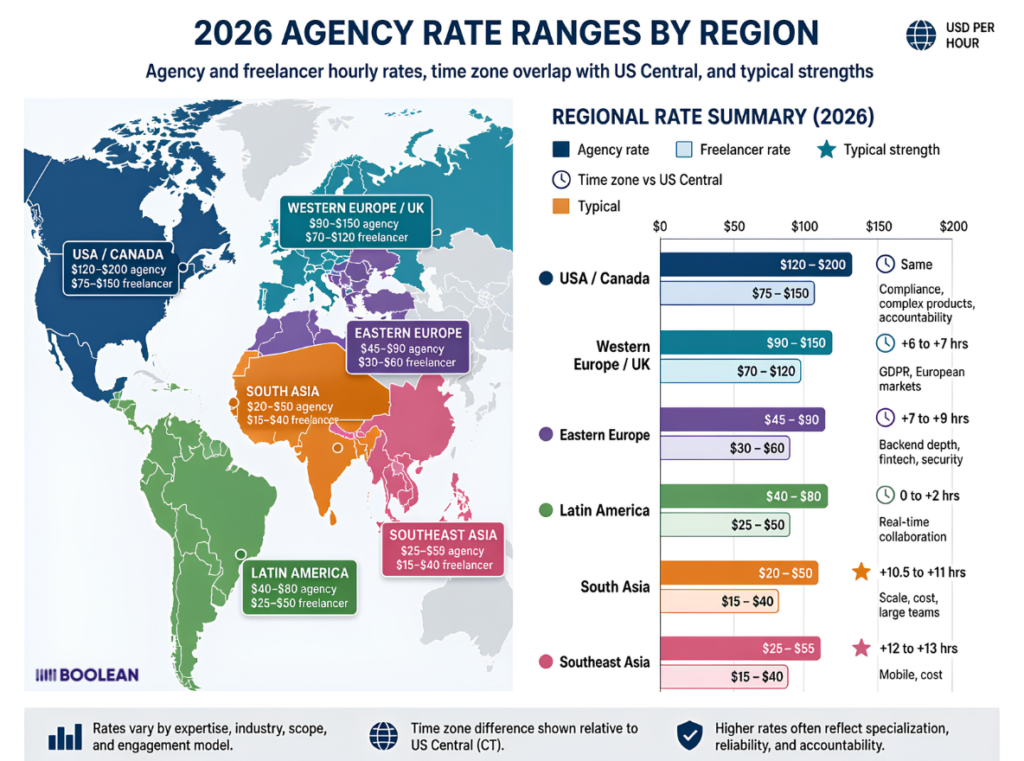
United States and Canada
Agencies: $120–$200/hour. Freelancers: $75–$150/hour. Senior specialists in fintech, ML, or regulated healthcare: $200–$250+.
The rate reflects salaries. A mid-level mobile developer in Austin or Houston earns roughly $110,000–$140,000 a year; fully loaded with benefits, tools, and overhead, that’s $75–$95 per billable hour before the agency makes a dollar. There is no way to bill $60/hour for US-employed engineers and stay in business.
What you’re paying for beyond the code: same-time-zone communication, US contract law and IP protection, easier in-person meetings, and, usually, more experience with US-specific requirements like HIPAA, ADA accessibility, and App Store review politics.
Western Europe and the UK
Agencies: $90–$150/hour. Freelancers: $70–$120/hour.
Rarely the right choice for a US buyer unless you’re targeting European users or need GDPR-native expertise. The time-zone gap (5–6 hours) is manageable; the rate advantage over US teams is modest.
Eastern Europe (Poland, Romania, Ukraine, Czechia, Bulgaria)
Agencies: $45–$90/hour. Freelancers: $30–$60/hour.
Long-standing reputation for strong computer science education and engineering depth, especially in backend, fintech, and security work. Poland and Romania sit at the upper end of the band; Ukraine and Bulgaria toward the lower end.
The trade-off is time zone: 6–8 hours ahead of US Eastern, 7–9 ahead of Central. You get 2–3 hours of overlap in your morning. Teams that work well asynchronously handle this fine; teams that need to talk daily feel it.
Latin America (Mexico, Colombia, Brazil, Argentina)
Agencies: $40–$80/hour. Freelancers: $25–$50/hour.
The main selling point is time zone. Mexico City is on US Central Time. Bogotá and Lima are on Eastern. That overlap is worth real money in a project where decisions need to be made quickly.
Rates have climbed 15–25% since 2022 as US companies discovered the region. The talent pool for common stacks (React Native, Node, Flutter) is solid; for niche stacks, it thins out quickly.
South Asia (India, Pakistan, Bangladesh)
Agencies: $20–$50/hour. Freelancers: $15–$40/hour. Senior engineers at established firms: $45–$65.
The largest talent pool on earth and the lowest rates. Also the widest quality variance. The best teams in this region are excellent and priced accordingly ($45–$65). The $15–$20 tier is where most horror stories come from, and they aren’t really about the region. They’re about what $15/hour buys anywhere.
Time zone is the hard constraint: 9.5–11 hours ahead of US Central. Overlap is early morning or late evening, one or the other.
Southeast Asia (Philippines, Vietnam)
Agencies: $25–$55/hour. Growing quickly, particularly in Vietnam for mobile work. English proficiency in the Philippines is strong. Time zone challenges are similar to South Asia.
Regional Rate Summary (2026)
| Region | Agency rate | Freelancer rate | Time zone vs US Central | Typical strength |
| USA / Canada | $120 – $200 | $75 – $150 | Same | Compliance, complex products, accountability |
| Western Europe / UK | $90 – $150 | $70 – $120 | +6 to +7 hrs | GDPR, European markets |
| Eastern Europe | $45 – $90 | $30 – $60 | +7 to +9 hrs | Backend depth, fintech, security |
| Latin America | $40 – $80 | $25 – $50 | 0 to +2 hrs | Real-time collaboration |
| South Asia | $20 – $50 | $15 – $40 | +10.5 to +11 hrs | Scale, cost, large teams |
| Southeast Asia | $25 – $55 | $15 – $40 | +12 to +13 hrs | Mobile, cost |
Rates by Seniority and Role
Region is only half the picture. Within any region, role and seniority swing the rate by 2–3×.
Developer Seniority
| Level | US | Eastern Europe / LatAm | South Asia |
| Junior (0–2 yrs) | $60 – $100 | $25 – $40 | $12 – $25 |
| Mid-level (2–5 yrs) | $100 – $150 | $40 – $65 | $25 – $40 |
| Senior (5+ yrs) | $150 – $220 | $60 – $95 | $40 – $65 |
| Architect / lead | $180 – $250+ | $80 – $120 | $55 – $80 |
Role Within the Team
| Role | Relative to developer rate | Notes |
| UI/UX designer | 0.8 – 1.0× | Senior product designers command developer-level rates |
| QA engineer (manual) | 0.5 – 0.7× | Often the first thing cut from cheap quotes |
| QA automation engineer | 0.8 – 1.0× | |
| Project manager | 0.8 – 1.1× | |
| DevOps / cloud engineer | 1.0 – 1.3× | Scarce; priced accordingly |
| Solutions architect | 1.2 – 1.6× | Usually part-time on a project |
Why Blended Rates Exist
Almost no serious project is 100% senior developers. A typical medium app team might be one senior lead, two mid-level developers, a designer, a QA engineer, and a part-time PM. The blended rate is the weighted average of all of them, and it’s the number you should compare between proposals.
A proposal quoting “$180/hour” for an all-senior US team and one quoting “$70/hour blended” for a hybrid team are not describing the same thing. Ask for the team composition behind any rate.
The Number That Actually Matters: Effective Cost Per Productive Hour
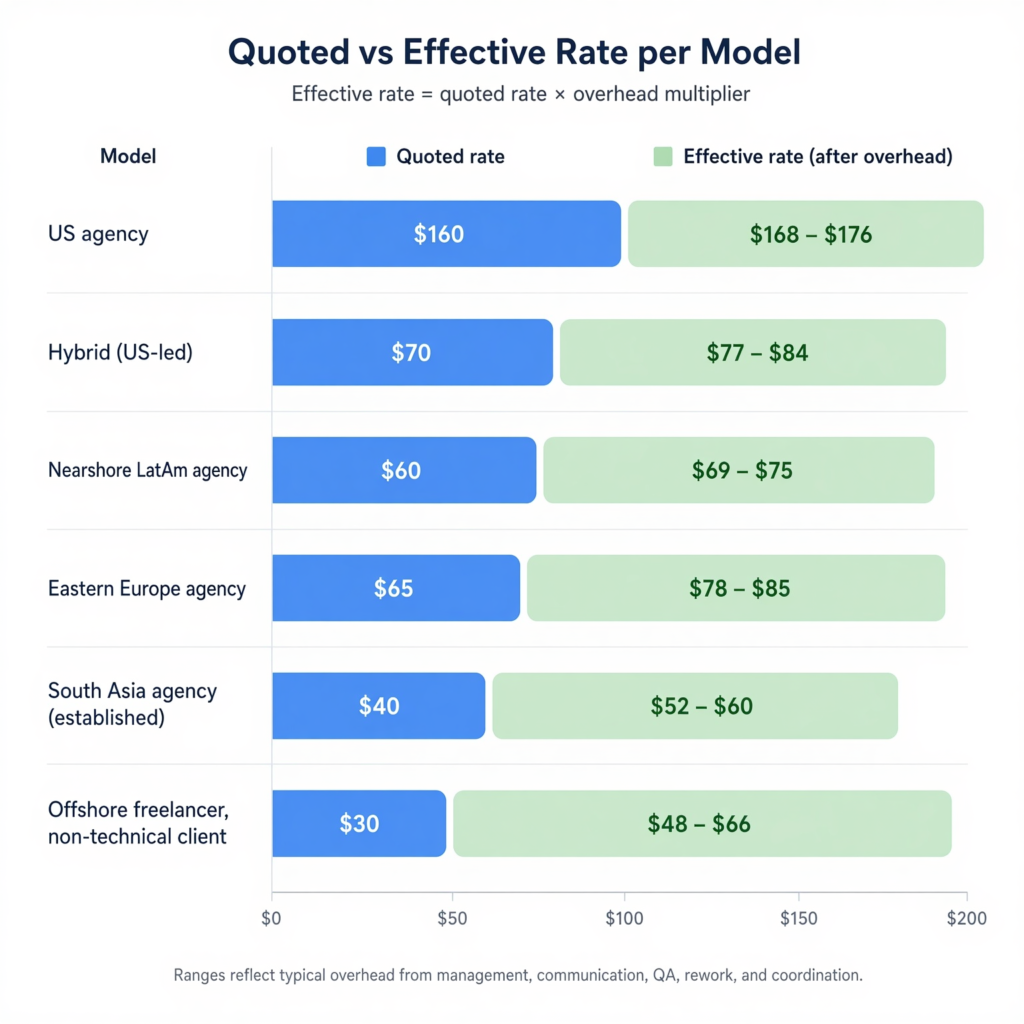
This is the section most rate articles skip, and it’s the one that decides whether offshore development saves you money.
Quoted rate × hours billed = invoice. But invoice ÷ useful output is your real cost. Three things drive a wedge between them:
Management Overhead
Someone has to write specs, answer questions, review work, and make decisions. With a US agency, that’s mostly their PM. With a pure offshore team or freelancer, it’s usually you, or a technical person you hire.
If a founder spends 10 hours a week managing an offshore team, and the founder’s time is worth $150/hour, that’s $1,500 a week added to the project, roughly $18,000 over a three-month build. On a $40,000 offshore project, the real cost is $58,000.
Rework
Misunderstood requirements get built wrong and rebuilt. Time zones, language nuance, and thin specs all increase rework. Our observation across projects we’ve inherited: pure offshore work with a non-technical client typically carries 20–35% rework; well-run hybrid or onshore work carries 8–15%.
Communication Latency
A question asked at 4 PM Central to a team in Karachi or Kyiv gets answered the next morning. Over a project, those 16-hour round trips add days. Days are money, especially if you’re paying a monthly retainer or burning runway.
Effective Rate Table
| Model | Quoted rate | Overhead multiplier | Effective rate |
| US agency | $160 | 1.05 – 1.10× | $168 – $176 |
| Hybrid (US-led) | $70 | 1.10 – 1.20× | $77 – $84 |
| Nearshore LatAm agency | $60 | 1.15 – 1.25× | $69 – $75 |
| Eastern Europe agency | $65 | 1.20 – 1.30× | $78 – $85 |
| South Asia agency (established) | $40 | 1.30 – 1.50× | $52 – $60 |
| Offshore freelancer, non-technical client | $30 | 1.60 – 2.20× | $48 – $66 |
The takeaway: offshore is still cheaper than the US. Meaningfully so. But the gap between a $30 freelancer and a $70 hybrid team, after overhead, is closer to $60 vs $80 than $30 vs $70. And that narrower gap buys you a lot of risk reduction.
US vs Offshore vs Hybrid: The Real Trade-Offs
When a US Agency Is Worth $150+/Hour
- Regulated industries where a compliance mistake is a six- or seven-figure problem (HIPAA, PCI, FINRA)
- Products where the app is the company and you’re raising on the quality of the engineering
- Complex integrations with US enterprise systems (Epic, Salesforce, legacy ERPs)
- You need people in the room, physically, for workshops or stakeholder alignment
- Speed of decision-making matters more than cost
When Pure Offshore Makes Sense
- You have a technical leader in-house who can write specs, review code, and manage daily
- The scope is tightly defined and unlikely to change
- Async work is fine: you don’t need same-day answers
- You’re extending an existing product with clear patterns to follow
- Budget is the binding constraint and you accept the management load
When Hybrid Wins
The hybrid model puts US-based project leadership, product thinking, and client communication on top of a distributed engineering team. You talk to someone in your time zone who is accountable for the outcome; they manage the developers.
It fits when:
- You’re a non-technical founder or business owner. You need someone to own the “how,” not just execute the “what.”
- Requirements will evolve. Most first products do. Hybrid teams absorb change better than fixed offshore scopes.
- You want US accountability without US-only pricing. Contracts, IP, and escalation stay domestic.
- The project is mid-sized: $40,000–$250,000, where a US agency’s rate would push you out of budget but the risk of pure offshore is too high.
Trade-Off Matrix
| Factor | US agency | Hybrid | Nearshore | Offshore (established) | Offshore freelancer |
| Hourly cost | Highest | Medium | Medium-low | Low | Lowest |
| Your time required | Lowest | Low | Medium | High | Very high |
| Time-zone overlap | Full | Full (leadership) | Full | 2–3 hrs | 0–2 hrs |
| Legal / IP protection | US | US | Varies | Varies | Weak |
| Handles scope change | Well | Well | Moderately | Poorly | Poorly |
| Risk of abandonment | Very low | Low | Low | Medium | High |
| Best project size | $150K+ | $40K – $250K | $30K – $150K | $20K – $100K | < $30K |
What a 1,200-Hour Project Costs Under Each Model
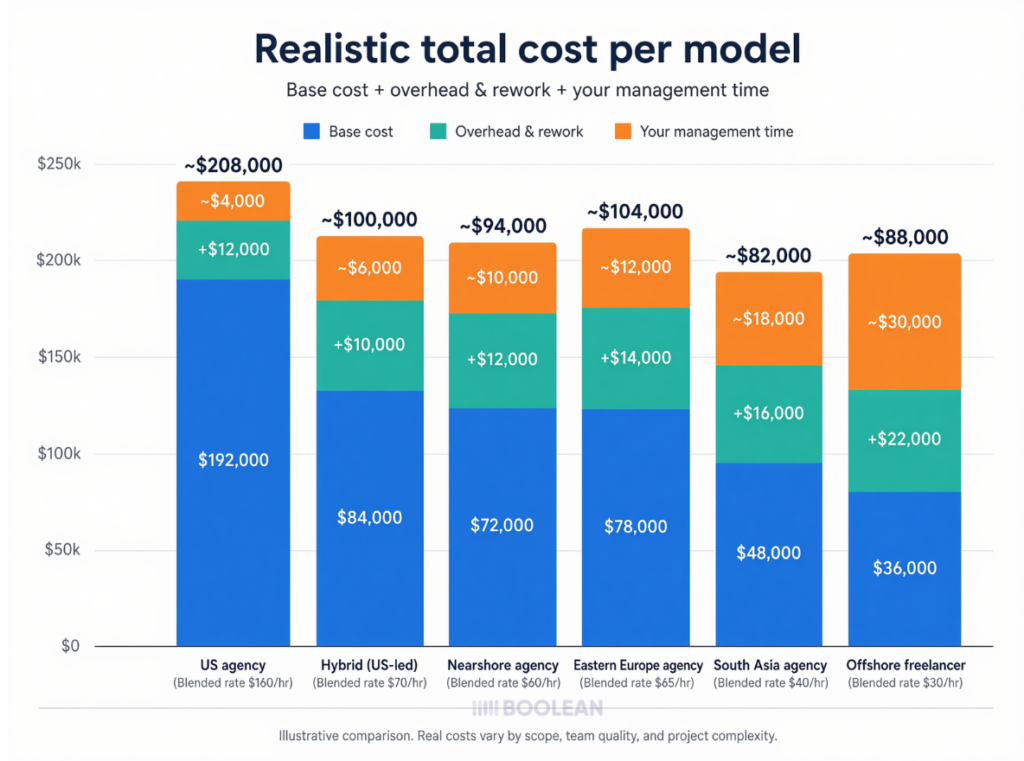
Let’s price a typical medium-complexity app: cross-platform, payments, two user roles, admin panel. Around 1,200 hours of total effort. (For where that figure comes from, see our full mobile app development cost breakdown.)
| Model | Blended rate | Base cost | Overhead & rework | Your management time | Realistic total |
| US agency | $160 | $192,000 | +$12,000 | ~$4,000 | ~$208,000 |
| Hybrid (US-led) | $70 | $84,000 | +$10,000 | ~$6,000 | ~$100,000 |
| Nearshore agency | $60 | $72,000 | +$12,000 | ~$10,000 | ~$94,000 |
| Eastern Europe agency | $65 | $78,000 | +$14,000 | ~$12,000 | ~$104,000 |
| South Asia agency | $40 | $48,000 | +$16,000 | ~$18,000 | ~$82,000 |
| Offshore freelancer | $30 | $36,000 | +$22,000 | ~$30,000 | ~$88,000 |
Notice two things:
The freelancer isn’t the cheapest option once you count your own time. The base cost is a third of the hybrid model; the realistic total is nearly the same, and it comes with far more risk.
The hybrid, nearshore, and Eastern European options cluster at roughly half the US agency price. Between those three, the choice is mostly about time-zone preference and who takes on the management burden.
How Boolean Inc. Structures a Hybrid Team
Since we’re recommending the model, it’s fair to show how it works in practice.
Leadership in Texas
Project leads, product strategy, discovery workshops, and client communication run from our Austin and Houston offices. The person you talk to every week is on Central time, understands US business context, and is accountable for the delivery, not just the hours.
Distributed Engineering
Developers, designers, and QA are drawn from a team that spans multiple time zones. They’re employees or long-term contractors, not gig workers assembled per project. Continuity matters: the engineer who built your v1 is the engineer who maintains it.
What the Blended Rate Covers
A typical Boolean Inc. project bills between $55 and $85 per hour blended, depending on team composition and seniority. That includes design, development, QA, and project management. There are no separate “PM fees” or “QA add-ons.”
What It Looks Like Day to Day
- Weekly demo and planning call in your time zone
- A shared board where you see every task and its status
- Direct access to the lead engineer, not just an account manager
- Decisions turned around same-day; code shipped in two-week sprints
We won’t pretend this model is perfect for everyone. If you need every team member in a US office, or you have a technical co-founder who wants to manage developers directly, other models fit better. But for the founders and business owners who make up most of our clients, it’s the arrangement that gets a product shipped at a price that leaves money for launching it.
Pricing Models: Hourly, Fixed, Dedicated Team
The hourly rate is one input. How it’s applied changes your risk profile.
Time and Materials (Hourly)
You pay for hours worked, billed weekly or monthly, against an estimate.
Best for: evolving products, ongoing development after launch, anything where scope will change.
Watch for: no cap, no estimate, or an estimate with no breakdown. Ask for a not-to-exceed figure.
Fixed Price
A set fee for a defined scope, usually paid in milestones.
Best for: well-specified MVPs, discovery-phase deliverables, rebuilds of existing products.
Watch for: the 10–25% risk padding baked in, and change-order costs when scope moves. A fixed price is only as good as the scope document behind it. Our MVP cost guide covers how to write one.
Dedicated Team (Monthly Retainer)
You reserve a team, usually 2–5 people, for a monthly fee. Effective hourly rates are typically 10–20% below time-and-materials.
Best for: post-launch product development, companies planning 6+ months of continuous work.
Watch for: paying for bench time if you don’t have a steady backlog.
Which Model Per Phase
| Phase | Recommended model | Why |
| Discovery / scoping | Fixed price | Small, well-defined, produces the spec |
| MVP build | Fixed price or capped T&M | Scope is set; cap protects you |
| Post-launch iteration | Time and materials | Scope is driven by user feedback |
| Ongoing product development | Dedicated team | Lowest effective rate, best continuity |
Eight Questions to Ask Before You Accept Any Hourly Rate
- Who exactly is on the team, and at what seniority? Get names and roles. A blended rate hides a lot.
- Where are the engineers located, and what are their working hours in my time zone?
- Who is my single point of contact, and are they technical? An account manager relaying messages to developers is a bottleneck.
- Does the rate include design, QA, and project management? Or are those separate lines?
- What’s included in “an hour”? Meetings? Code review? Deployment? Some firms bill only development time and eat the rest; some bill everything.
- What’s your rework policy? If something is built wrong because of a misunderstanding, who pays?
- Who owns the code, and when? IP should transfer on payment, not at project end.
- Can I talk to two clients from the last year? Not their showcase clients. Recent ones.
A team that answers all eight clearly is worth a higher rate than one that dodges three of them.
Summary: Choosing Your Rate in 2026
- US agencies ($120–$200/hr) are the right call when the cost of failure is high and budget isn’t the constraint.
- Pure offshore ($20–$60/hr) works when you have technical management in-house and a locked scope. Without those, the effective rate climbs fast.
- Hybrid ($50–$95/hr) is where most startups and small businesses should start looking: US accountability and communication, distributed engineering cost, and a total project price roughly half of a US-only team.
Whatever you choose, compare effective rates and team composition, not the headline number. The cheapest quote is rarely the cheapest project.
For a broader look at how to run a project end to end, our complete app development guide covers each stage from idea to launch, and the custom software development guide does the same for non-mobile projects.
FAQs
What is the average hourly rate for app development in 2026?
Rates range from $20 to $200+ per hour depending on region and model. US agencies charge $120–$200, Eastern European and Latin American teams $40–$90, South Asian teams $20–$50, and hybrid US-led teams $50–$95 blended. Clutch’s 2026 data shows the most common global band is $25–$49, skewed by the large number of offshore firms listed.
How much does it cost to hire an app developer in the US?
US freelance app developers charge $75–$150 per hour; agencies charge $120–$200. Senior specialists in regulated or niche fields (fintech, ML, healthcare) charge $200–$250+. These rates reflect US salaries of $110,000–$160,000 for experienced mobile developers plus overhead.
Is offshore app development cheaper than US development?
Yes, on quoted rates, offshore is 50–80% cheaper. After accounting for management overhead, rework, and communication delays, the effective saving is typically 40–60% for established offshore agencies and can shrink to 20–30% for low-cost freelancers managed by a non-technical client.
What is a hybrid development team?
A hybrid team combines US-based project leadership, product strategy, and client communication with distributed or offshore engineers. Clients get same-time-zone accountability and US contracts while paying a blended rate of $50–$95 per hour, roughly half the cost of an all-US team.
What is a blended hourly rate?
A blended rate is the weighted average across every role on the project team: senior and mid-level developers, designers, QA, and project management. It’s the right number to compare between proposals, because a “$180/hour senior developer” quote and a “$70/hour blended” quote describe different team structures.
Which region offers the best value for app development?
For US buyers, Latin America offers the best time-zone overlap at $40–$80/hour, Eastern Europe the strongest engineering depth at $45–$90, and hybrid US-led teams the best balance of accountability and cost at $50–$95. South Asia is cheapest at $20–$50 but requires the most hands-on management.
Should I choose fixed price or hourly billing?
Use fixed price for well-defined scopes such as discovery and MVPs; expect 10–25% risk padding. Use time-and-materials with a not-to-exceed cap for evolving products and post-launch work. Use a dedicated team retainer for 6+ months of continuous development to get the lowest effective rate.
Why do some US companies quote $25–$49 per hour?
Because their engineering is offshore. A US business address doesn’t mean US-based developers. Ask where the engineers sit, what their hours are in your time zone, and who your day-to-day contact is before comparing that rate to a genuinely US-staffed team.