
Introduction
Customers do not want to call support anymore.
They do not want hold music.
They do not want long email threads.
They do not want to repeat the same issue again and again.
They want answers fast.
On their phone.
On their own time.
That is why the future of customer self service is moving quickly toward mobile.
Today, customer self-service through mobile apps is becoming a normal part of how businesses serve people.
Instead of waiting for an agent, customers want to track orders, book services, update account details, find answers and solve simple issues by themselves.
It is easy to see why.
A good digital self-service experience feels faster and less stressful than traditional support. One tap can do what used to take a phone call. A few screens can solve what once needed three emails.
This is also why mobile self-service solutions are becoming a bigger part of modern customer support. They save time for customers and reduce pressure on support teams at the same time.
At Boolean Inc., we are seeing more businesses invest in self-service mobile applications because they understand a simple truth: support is no longer only about answering questions. It is about giving customers control.
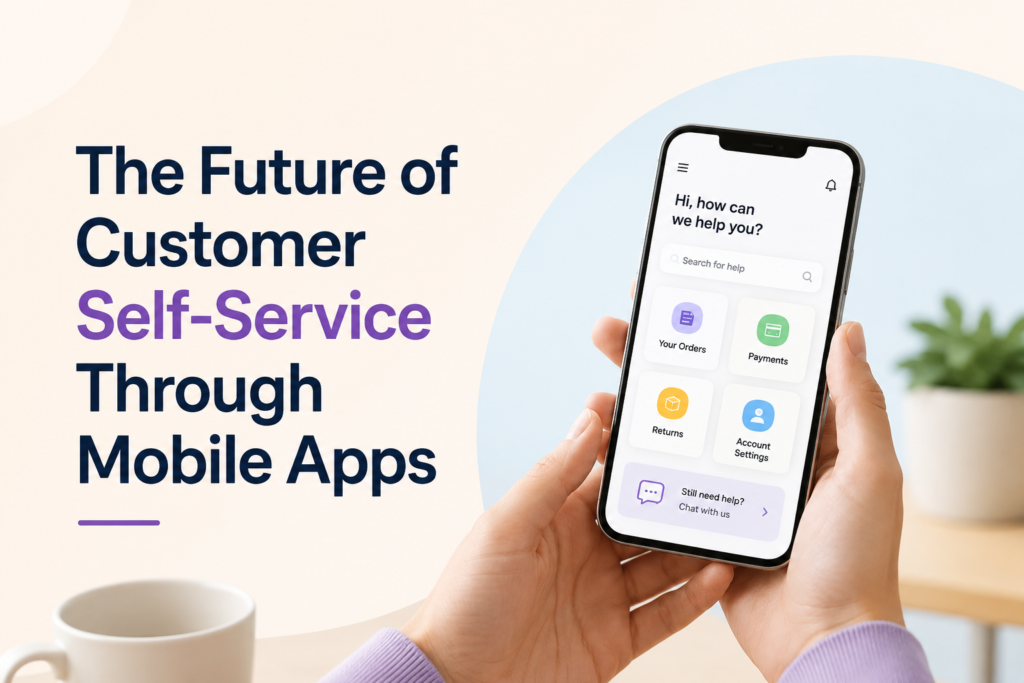
In this blog, we will look at why customers prefer self-service apps, what makes a strong self-service mobile app and how the next wave of customer self-service technology will shape support in 2026 and beyond.
For many businesses, this shift is already becoming a real competitive advantage.
Why Traditional Customer Support Is Losing Ground Fast
Traditional support is not disappearing overnight.
But it is losing patience from customers very quickly.
People used to accept waiting on a call. They accepted slow replies. They accepted business hours. That is no longer true.
Now they expect speed.
They expect convenience.
They expect answers without friction.
That is one big reason customers don’t want to call support anymore.
The old model feels too slow
Phone support and email support still have a place.
But for everyday problems, they often feel heavy.
A customer wants to:
- track an order
- reset a password
- check an appointment
- update account details
- find a simple answer
None of these feels worth a ten minute call.
Or a twelve hour email wait.
That is why customer self-service technology is growing so fast. It removes the delay between the question and the answer.
Support teams are also under pressure
This shift is not only about customer behavior.
It is also about what businesses can realistically manage.
Many support teams spend too much time answering the same basic questions again and again. That creates pressure on staff and slower response times for everyone else.
Here is what that usually looks like:
| Traditional support issue | What happens |
| High volume of simple questions | Teams get overloaded |
| Long wait times | Customers get frustrated |
| Repeated manual replies | Staff lose time |
| Limited support hours | Customers wait longer |
| Scattered tools and channels | Service becomes inconsistent |
This is exactly why traditional customer support is failing in many growing businesses. It is not always about poor staff. Often the system itself is too manual.
That is why more companies are moving toward digitized support workflows that reduce repetitive work and create faster customer help.
Customers compare you to the best experience they have had
This part matters.
Customers do not compare your support only to direct competitors.
They compare it to the best app they used this week.
If they can book a taxi in seconds and track food in real time, then they start expecting that same speed from every business. That is shaping the future of customer self-service and the wider digital self-service experience.
So when a business still says “please call us for help” it feels outdated.
Not always broken.
Just harder than it should be.
Mobile is changing the expectations
This is where mobile customer support apps and self-service software for customer support are changing the game.
Instead of making customers wait for help, businesses can now give them tools to solve common problems themselves. Faster for the customer. Lighter for the support team.
That is why customer self-service trends 2026 are pointing in one direction.
Less waiting.
Less calling.
More mobile.
More control.
More self-service.
What Customer Self-Service Through Mobile Apps Actually Looks Like
Customer self-service through mobile apps is simple at its core.
It gives people a way to solve common problems without waiting for support.
That may sound basic. But in practice, it changes the whole support experience.
Instead of asking customers to email, call or wait, a good app lets them handle routine tasks on their own. Fast. Quietly. On their phone.
What customers can usually do inside a self-service app
A strong self-service app can help customers with things like:
- checking order status
- booking or rescheduling appointments
- updating personal details
- finding answers in a help center
- tracking payments
- downloading invoices
- starting a return or request
- chatting with a bot for quick answers
These features are not fancy for the sake of being fancy.
They save time.
And that is what customers care about most.
Why this feels better than traditional support
The real value is convenience.
A customer does not need to wait for office hours.
They do not need to repeat their issue to three different people.
They do not need to search through old emails.
They open the app.
They tap what they need.
They move on.
That is the kind of digital self-service experience people now expect.
What a good self-service journey looks like
A useful app should feel clear from the first screen.
Here is a simple flow:
| Customer need | App action |
| “I want to check my order” | Open order tracking |
| “I need help with a payment” | View payment history or contact support |
| “I want to change my booking” | Reschedule inside the app |
| “I have a quick question” | Use FAQ or AI chatbot |
| “I want to update my profile” | Edit details in seconds |
When this works well, support feels easy instead of frustrating.
The best self-service apps solve real problems
The best features for self-service mobile apps are usually the ones customers use most often. Not the flashy ones. The practical ones.
That often includes:
- order tracking
- FAQs and knowledge base
- account management
- ticket creation
- live chat or chatbot support
- appointment changes
- payment support
- notification updates
These are the building blocks of strong self-service app solutions for businesses.
They reduce pressure on support teams and give customers more control.
And once that starts working well, businesses often begin to see fewer tickets and happier users without needing to add more staff.
The Features That Make a Self-Service Mobile App Genuinely Useful
Not every self-service app is helpful.
Some look modern but still make customers work too hard.
That is the difference between having an app and having a good one.
If you are wondering what makes a good self-service mobile app, the answer is simple. It should remove effort. Do not add more of it.
Start with the basics customers actually use
The best features for self-service mobile apps are usually the most practical ones.
Customers want to do simple things quickly.
That often means:
- order tracking
- appointment booking or rescheduling
- account updates
- invoice and payment history
- FAQ or help center
- ticket submission
- live chat or chatbot support
- push notifications for updates
These features help turn support into a smoother mobile experience instead of another task.
Good self-service feels easy from the first tap
A customer should not have to think too much.
They should know where to go right away.
That means a good app needs:
| Feature | Why it matters |
| Clear navigation | Customers find help faster |
| Fast login or secure access | Less friction at the start |
| Search bar in help section | Answers appear quickly |
| Order or booking history | Customers solve repeat issues alone |
| In-app chat or bot | Quick support without calling |
| Notifications | Customers stay informed without asking |
This is how mobile self-service solutions improve support. They make common actions fast and visible.
The best apps reduce tickets before they happen
This part is important.
A strong self-service app does not only answer problems. It prevents them.
For example:
- order tracking reduces “where is my order” questions
- payment history reduces billing confusion
- appointment reminders reduce missed visits
- account settings reduce support requests for basic changes
That is a practical answer to how to reduce support tickets with mobile apps.
Less repetitive support.
More time for teams to handle real issues.
Personalization also matters
People want relevant help.
Not generic screens that treat everyone the same.
A useful app can show the right support options based on what the customer is doing. Someone waiting for a delivery may need tracking first. Someone with an active booking may need reschedule options first.
That is one reason customer experience mobile apps perform better than traditional support channels. They can make the support journey feel more personal without making it more complicated.
At Boolean Inc., we often see businesses get better results when they build self-service around real customer habits instead of copying generic templates.
A good self-service app should also grow with the business
Customer needs change.
Your app should be able to grow too.
That is why many businesses connect support features with wider mobile app features like bookings, payments and service access. It creates one smoother journey instead of sending customers across different tools and channels.
That same thinking is key when businesses turn services into app experiences.
In the end, good self-service app development is not about adding everything possible.
It is about adding the things customers will actually use.
How AI Is Quietly Changing the Way Customers Get Help
AI is not replacing customer support.
It is changing how support starts.
That is the important shift.
In many businesses, the first layer of help no longer comes from a person. It comes from a smart system inside the app that can answer simple questions, guide users and solve common issues in seconds.
That is why AI-powered customer self-service is becoming a major part of the future of customer self-service.
What AI is actually doing inside self-service apps
When people hear AI, they often think of something complex.
In reality, most customers use it in very simple ways.
For example:
- an AI chatbot answers common questions
- the app suggests help articles based on the issue
- payment problems trigger the right support path
- order delays create automatic updates
- account issues get routed faster to the right team
This is what AI chatbot integration in mobile apps looks like in real business use.
Not flashy.
Just useful.
Why customers like it
Customers do not care whether support is powered by AI or not.
They care whether it saves time.
If a chatbot helps them track an order in ten seconds, that feels helpful.
If the app recommends the right answer before they even open a ticket, that feels smooth.
If a support issue gets handled faster because the app already understands the context, that feels better than starting from zero.
That is one reason how AI is changing customer self-service has become such a big topic. It improves speed without forcing customers through a long support process.
Where AI helps most
AI works best when the problem is common and repeatable.
That includes:
| Support task | How AI helps |
| Basic FAQs | Gives instant answers |
| Order tracking | Shares live status updates |
| Password or login help | Guides users step by step |
| Ticket routing | Sends the issue to the right team |
| Product or service suggestions | Recommends the next best option |
This is where customer support automation tools become valuable.
They reduce manual work.
They shorten response time.
They make support feel available even when a full team is not online.
AI should support people not trap them
This part matters.
A self-service app should never make customers feel stuck in a loop.
If AI can solve the problem, great.
If not, the app should make it easy to move to human support.
That balance is what makes customer service automation through apps work well. The goal is not to hide your support team. The goal is to protect their time for issues that truly need them.
AI also improves the business side
There is another benefit here.
AI does not only help customers. It helps businesses spot patterns faster too.
If the same question appears again and again, the app can flag it. If support requests rise after a certain step, the business can fix that part of the journey.
If one type of issue keeps repeating, the team can improve the product or process behind it.
That is where self-service starts connecting with real-time business data. The support experience becomes a source of insight not just a cost center.
This is a long-term shift
AI will not replace every support interaction.
But it will keep improving the first response layer inside mobile customer support apps.
That is one of the clearest future trends in mobile customer support.
Faster help.
Smarter routing.
Less repetition.
And a much better starting point for both customers and support teams.
What Businesses Gain When Customers Can Serve Themselves
The benefits go far beyond convenience.
When customers can solve simple issues on their own the whole business starts working better.
That is why the benefits of customer self-service mobile apps are now getting serious attention from both small businesses and large enterprises.
Support teams get breathing room
Most support teams spend too much time on repeat questions.
Things like:
- Where is my order
- How do I reset my password
- Can I change my booking
- Where can I find my invoice
These are easy problems. Yet they fill inboxes and phone lines every day.
A good self-service app handles them without needing a support agent every time. That reduces ticket volume and gives teams more time for issues that actually need human attention.
This is one reason businesses using mobile automation often see support improve at the same time.
Customers get faster help
This is the most obvious win.
Customers do not have to wait.
They do not have to call.
They do not have to explain the same issue twice.
They open the app and get what they need.
That speed improves the digital self-service experience and makes the business feel easier to deal with overall.
Costs become easier to manage
Support is expensive when every task depends on people.
As a business grows, the pressure grows too.
More customers usually means more messages, more calls and more staff hours.
Self-service changes that pattern.
| Without self-service | With self-service |
| More tickets as the business grows | Fewer basic tickets |
| More manual replies | More automated answers |
| Higher support workload | Better team efficiency |
| Slower customer response | Faster problem resolution |
That is why many enterprise customer self-service apps are built around speed and scale. They help companies grow without letting support costs grow at the same pace.
Customer experience gets better
Good self-service is not only about reducing work.
It improves the way customers feel about the brand.
When people can track, manage and solve issues easily, they feel more in control. That leads to less frustration and better trust.
This is a big reason customer experience mobile apps are becoming part of long-term business strategy. Better support often leads to stronger retention and better reviews.
Businesses learn more from support behavior
Every self-service action creates useful insight.
You can see:
- which questions appear most
- where customers get stuck
- which features they use often
- what support issues keep repeating
That data helps businesses improve the product, the service and the support flow itself. It also helps them own customer data instead of relying fully on outside platforms.
The bigger gain is simple
Customers get control.
Teams get time.
Businesses get a support model that scales better.
That is why self-service app solutions for businesses are not just a support upgrade anymore. They are becoming a smarter way to run customer service.
Conclusion
Customer support is changing fast.
People want answers without waiting and help without friction and support that fits into their day. That is why the future of customer self-service is moving toward mobile first experiences.
The businesses that adapt early will be in a much stronger position. They will reduce support pressure, improve response speed and create a better overall customer journey.
A strong self-service app does not remove human support. It makes support smarter. It handles simple tasks quickly and gives customers more control while freeing teams to focus on more important issues.
That is the real value of customer self service through mobile apps.
At Boolean Inc., we see this shift becoming more important every year as businesses look for better ways to improve service and build stronger direct relationships with customers.
The future is clear.
Customers want support in their hands.
And mobile apps are how businesses deliver it.
FAQs
- How are AI-powered mobile apps transforming customer self-service?
AI-powered apps provide instant support, personalized experiences, and smarter issue resolution without human assistance.
- Why do customers prefer self-service mobile apps in 2026?
Customers prefer self-service apps because they offer faster, 24/7 support with seamless mobile accessibility.
- What are the latest trends in customer self-service apps?
Top trends include AI chatbots, voice support, predictive assistance and personalized mobile experiences.
- Can self-service mobile apps improve customer satisfaction?
Yes, self-service apps improve satisfaction by reducing wait times and giving users quick control over their issues.
- What features make a customer self-service app successful?
Successful self-service apps include AI chatbots, live tracking, smart FAQs, secure payments and personalized dashboards.