
Introduction
Running a service-based business sounds simple from the outside.
Serve clients well.
Stay organized.
Grow steadily.
But real life looks different.
Appointments shift.
Messages pile up.
Follow-ups get missed.
Client notes sit in different places.
And small gaps turn into bigger problems fast.
This is where client management starts to feel heavier than it should.
A salon owner deals with bookings and cancellations all day.
A consultant tracks client conversations across email and chat.
A clinic tries to manage reminders and records without slowing the front desk.
Different businesses. Same issue.
Too much client information. Not enough structure.
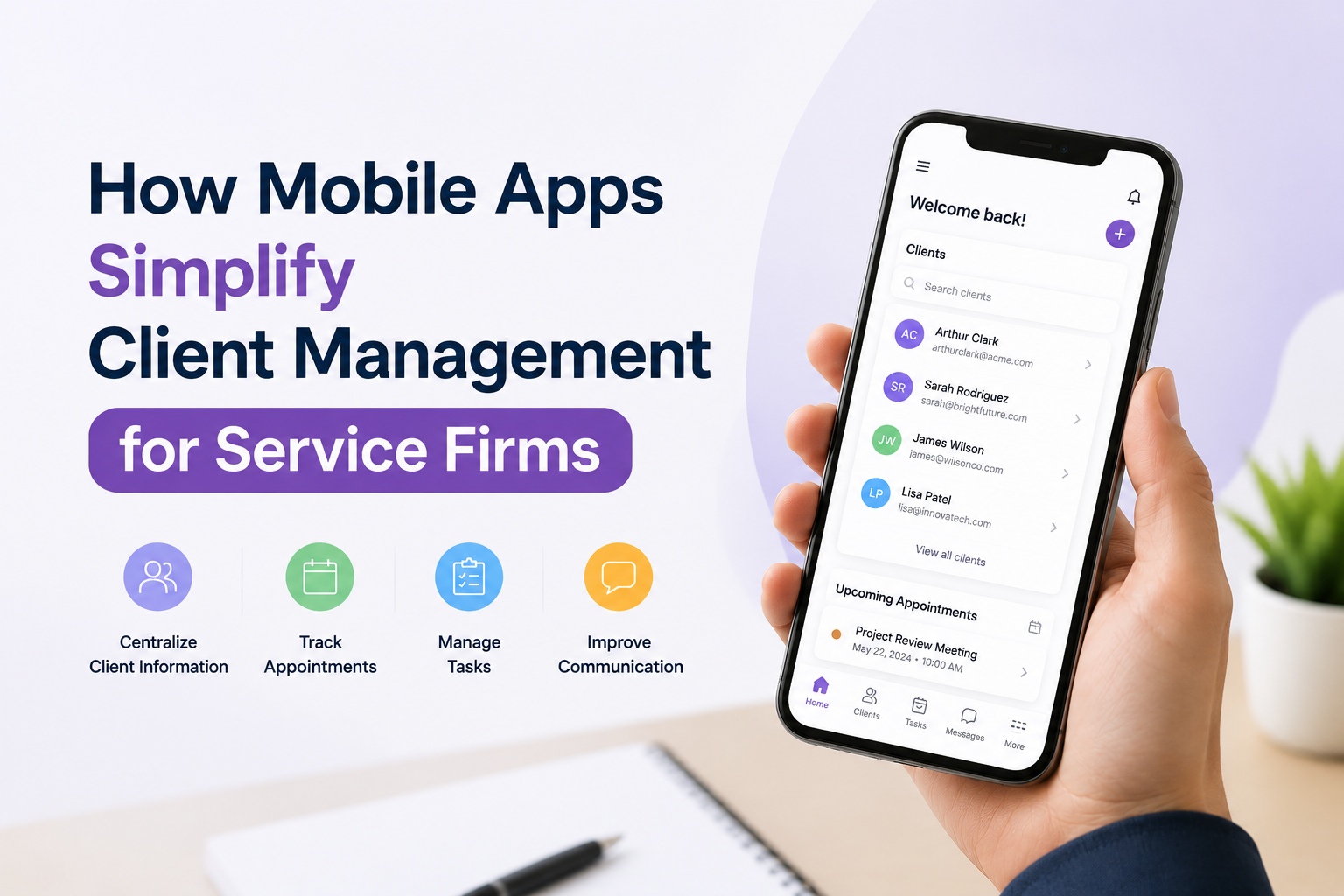
That is why more service businesses are turning to mobile apps. A good app can help with appointment scheduling, client communication, service tracking and payment updates in one place. It turns scattered tasks into a smoother system.
And that matters because clients notice everything.
They notice when replies are slow.
They notice when they need to repeat details.
They notice when booking feels harder than it should.
At Boolean Inc., we see more service brands investing in mobile apps because better client management is no longer just an internal need. It is part of the client experience itself.
In this blog, we will look at how mobile apps help service-based businesses organize client data, improve follow-ups and reduce manual work without making things more complicated.
Why Client Management Breaks Down Without the Right Systems
Client management usually does not fail all at once.
It slips little by little.
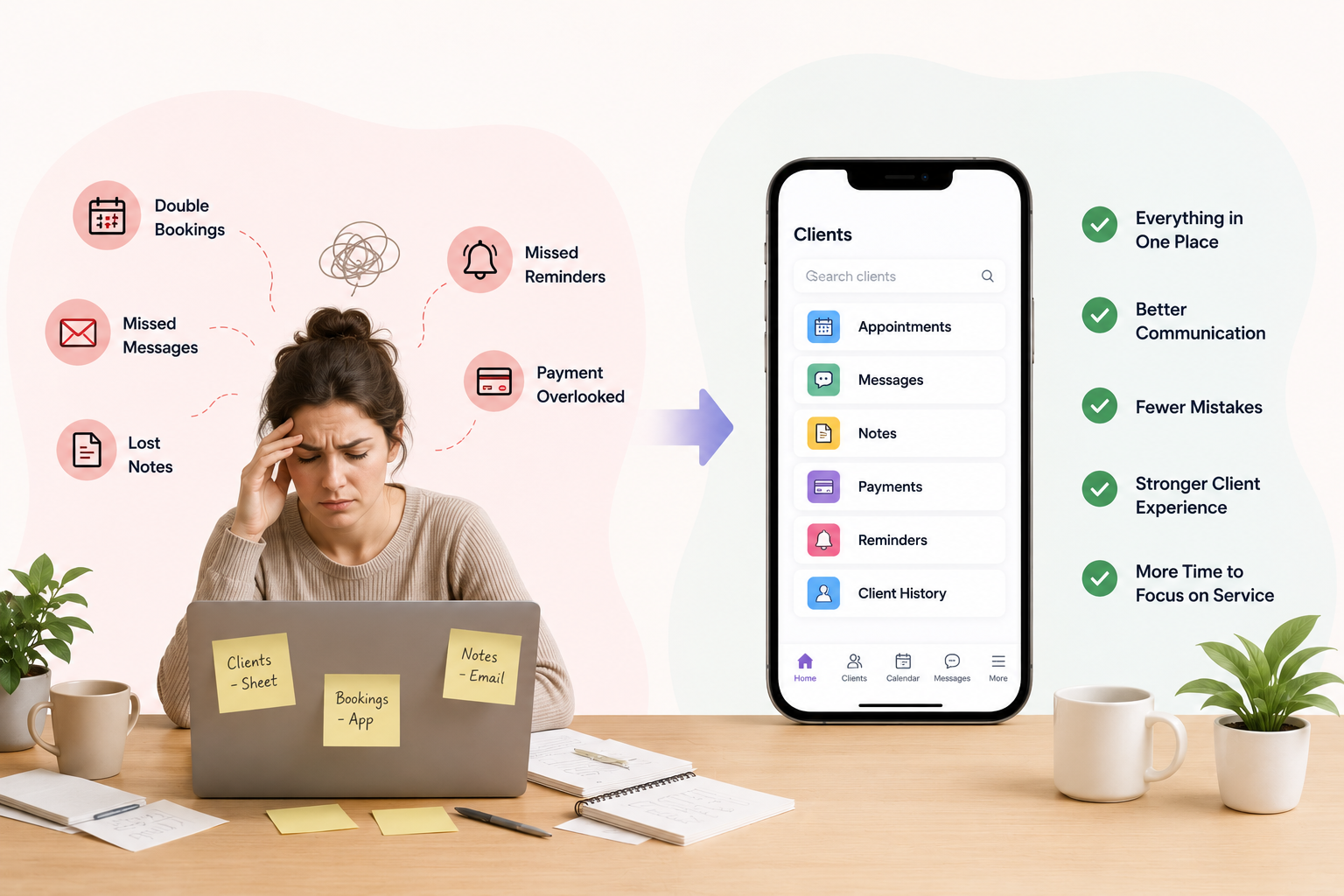
A missed reminder here.
A delayed reply there.
A lost note.
A double booking.
A follow-up that never happens.
A payment detail that gets overlooked.
None of these seems huge on their own.
Together, they create a messy client experience.
The problem is usually not effort
Most service businesses care deeply about their clients.
The issue is not effort. It is structured.
In many businesses, client information lives in too many places at once.
That is where things start to break.
For example:
- appointments in one tool
- payments in another
- notes in a spreadsheet
- conversations in email or chat
- reminders done manually
At first, this feels manageable.
Then the business grows and simple tasks start taking too much time.
Small gaps create bigger problems
A team member cannot find the latest client note.
So, the client has to explain everything again.
A booking change is updated in one place but not another.
So, two people arrive for the same slot.
A reminder is missed because someone got busy.
So, the client assumes the business is disorganized.
These are not technical problems.
They are everyday workflow problems.
And clients notice them quickly.
What this looks like in daily business
Here is how the breakdown usually happens:
| Common issue | What it leads to |
| Client data is stored in different places | Slow responses and confusion |
| Manual booking updates | Double bookings or missed slots |
| No central message in history | Repeated questions and lost context |
| Follow-ups done by hand | Missed opportunities and weaker retention |
| Scattered payment records | Billing mistakes and client frustration |
The table looks simple. The real cost is not.
When these issues repeat every week, they affect trust, time and revenue.
Clients feel the friction even if they never say it
A business may see this as an internal problem.
Clients experience it as poor service.
They feel it when they need to repeat information.
They feel it when support is slow.
They feel it when a booking mistake affects their day.
They feel it when the service itself is good, but the process around it feels frustrating.
That is often when loyalty starts to weaken.
Not because the service is bad.
Because the experience around it feels harder than it should.
Growth makes weak systems worse
A small team can often survive on workarounds.
But growth exposes every weak spot.
More clients mean more communication.
More bookings. More follow-ups.
More moving parts also mean more chances for errors.
That is why many businesses eventually move from manual processes to digital systems. They need a setup that can handle more clients without creating more confusion behind the scenes.
The warning signs are usually obvious
If any of these sound familiar, your current setup may already be under pressure:
- your team asks each other for client updates all day
- clients repeat the same details often
- follow-ups depend on memory
- no one sees the full client history in one place
- scheduling and billing feel disconnected
These signs matter.
Because once client management becomes reactive, service quality usually follows.
And that is exactly where mobile apps start becoming useful.
How Mobile Apps Bring All Client Information Into One Place
One of the biggest advantages of a mobile app is centralization.
Instead of storing client details across email, spreadsheets, chat tools and separate booking platforms, a mobile app brings everything into one connected system. That alone can change how a service business runs.
When client information is easy to find, teams respond faster and work with more confidence.
What a mobile app can centralize
A well-built client management app can bring together:
- client profiles and contact details
- appointment history and upcoming bookings
- service preferences and notes
- payment records and invoices
- message history and support requests
- reminders and follow-up tasks
This gives the business one clear view of each client.
Not fragments.
A full picture.
Why this matters in practice
When information is scattered, every task takes longer.
A team member has to check one system for bookings and another for payments and then search through old messages for context. That slows down service and increases the chance of mistakes.
When everything sits inside one mobile platform, the process becomes much simpler.
| Without a mobile app | With a mobile app |
| Client data is spread across tools | Client data is available in one place |
| Teams ask each other for updates | Teams can check live records instantly |
| Booking and billing feel disconnected | Appointments and payments stay linked |
| Follow-ups rely on memory | Follow-ups can be scheduled and tracked |
| Service history is hard to review | Full client history is easy to access |
This is where mobile apps start functioning like a practical mobile CRM for service-based businesses.
Better records lead to better service
Centralized client data does more than improve organization.
It improves the experience clients actually receive.
If a salon can see service history before the next appointment, recommendations feel more personal. If a consultant can review notes before a call, the conversation feels more prepared. If a clinic can view booking and billing details together, front desk interactions become much smoother.
That is a direct improvement in client management.
At Boolean Inc., we often see businesses gain the most value when they build apps around the way their teams already work instead of forcing staff into disconnected tools. That is why many companies start by turning business workflows into mobile app features.
One place creates better control
When client information is centralized, managers also gain better visibility.
They can track client activity, monitor follow-ups and spot service gaps earlier. This makes decision-making easier and helps the business stay consistent as it grows.
For service businesses, that consistency matters.
Because client relationships are built on details.
And details are much easier to manage when they are all in one place.
Key Features That Help Service Businesses Manage Clients More Effectively
A mobile app becomes truly valuable when it does more than store information.
It needs to support the exact client management moments where service businesses usually lose time or make mistakes.
These features are the ones that typically deliver the biggest day to day improvement.
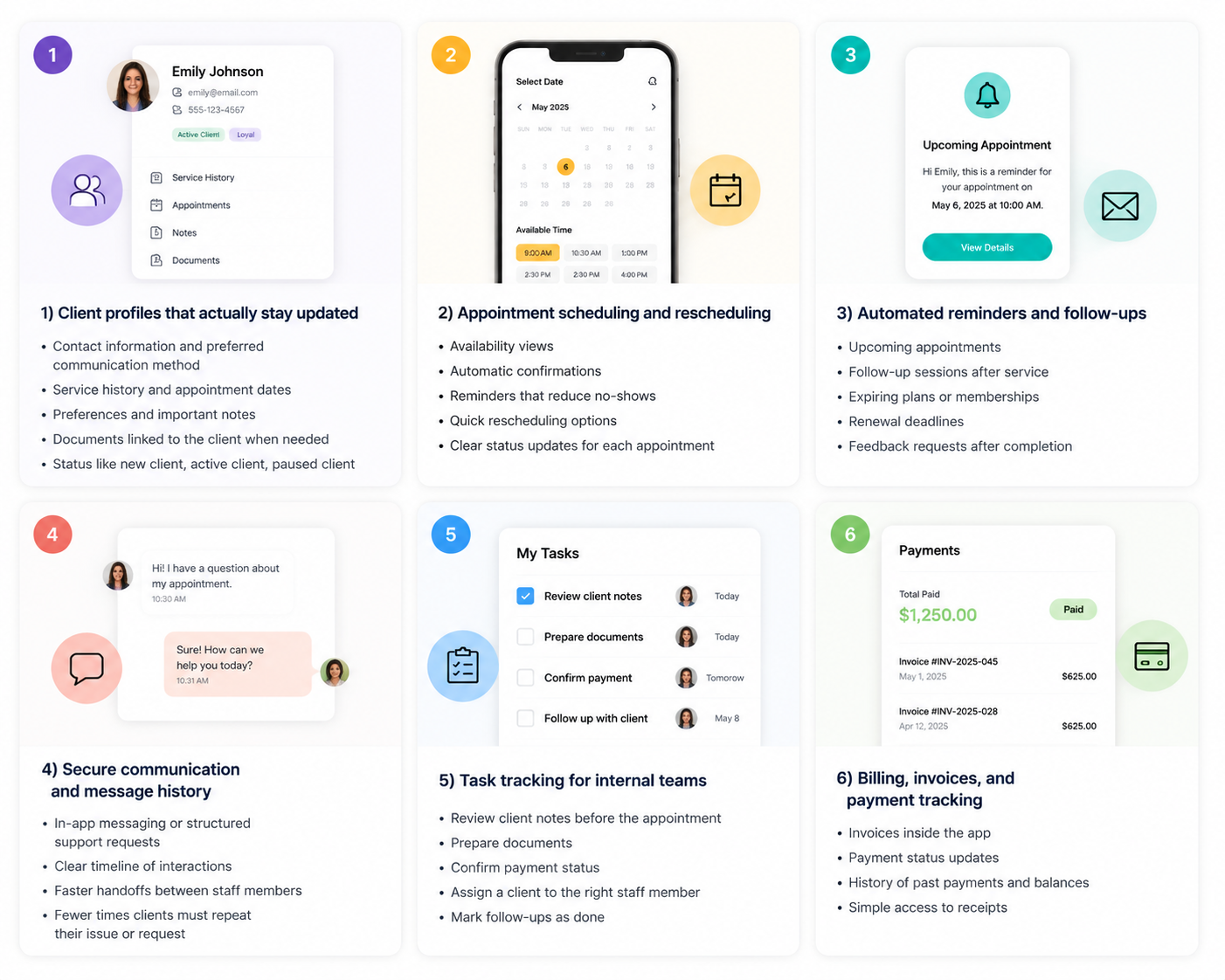
1) Client profiles that actually stay updated
Client profiles should be more than names and phone numbers.
The app should store and update details like:
- contact information and preferred communication method
- service history and appointment dates
- preferences and important notes
- documents linked to the client when needed
- status like new client, active client, paused client
When client profiles stay current, staff spend less time searching and more time serving.
2) Appointment scheduling and rescheduling
Scheduling is where many service businesses feel the most pressure.
Your app should let clients book and reschedule easily while your team stays in control.
That includes:
- availability views
- automatic confirmations
- reminders that reduce no-shows
- quick rescheduling options
- clear status updates for each appointment
This is a direct way to improve how clients experience your service.
3) Automated reminders and follow-ups
Manual follow-ups often break because people get busy.
A mobile app makes follow-ups consistent.
It can send reminders for:
- upcoming appointments
- follow-up sessions after service
- expiring plans or memberships
- renewal deadlines
- feedback requests after completion
This reduces missed moments that often lead to churn.
4) Secure communication and message history
When messages live across different apps, context gets lost.
A client management mobile experience should keep communication organized.
That means:
- in-app messaging or structured support requests
- a clear timeline of interactions
- faster handoffs between staff members
- fewer times clients must repeat their issue or request
This supports smoother service delivery.
5) Task tracking for internal teams
Client management is not only about customers. It is also about internal execution.
A good app should help teams track tasks like:
- review client notes before the appointment
- prepare documents
- confirm payment status
- assign a client to the right staff member
- mark follow-ups as done
Task tracking keeps the workflow clean and predictable.
6) Billing, invoices, and payment tracking
Many service businesses struggle when billing sits separately from client management.
When payment history stays connected to the client profile, the business avoids confusion and reduces administrative workload.
That can include:
- invoices inside the app
- payment status updates
- history of past payments and balances
- simple access to receipts
This feature improves both client trust and operational clarity.
For service businesses focused on retention, these capabilities often connect naturally with building client experiences through mobile app journeys where booking, reminders, and follow-ups feel seamless.
How Mobile Apps Improve Communication and Follow-Ups With Clients
Client management is really a communication problem before it becomes anything else.
If updates are late or messages get missed or follow-ups depend on memory, the client experience starts to weaken. Even when the service itself is good.
That is why mobile apps make such a practical difference for service-based businesses.
They help teams stay connected with clients in a more consistent way.
Communication becomes more organized
Without a mobile app, client communication often gets scattered.
Some messages happen on email.
Some happen on WhatsApp.
Some happen by phone.
Some stay in a team member’s head.
That makes it hard to track what was said and what still needs action.
A mobile app creates one cleaner communication flow. Clients can receive booking confirmations, reminders, updates and follow-ups in one place. Teams can check message history quickly without searching across different tools.
Follow-ups stop depending on memory
This is one of the biggest improvements.
In many service businesses, follow-ups happen only when someone remembers to send them. That works until the team gets busy.
Then small things start slipping:
- a thank you message after a service
- a reminder for the next appointment
- a payment follow-up
- a check-in after a consultation
- a review request
These details matter more than they seem.
They help clients feel looked after. They also support better client retention over time.
A mobile app can automate much of this. That means the business stays responsive even on busy days.
| Communication task | How a mobile app helps |
| Appointment confirmation | Sends it instantly |
| Reminder before visit | Automates it at the right time |
| Service follow-up | Triggers it after the visit |
| Payment reminder | Sends clear updates without manual effort |
| Client re-engagement | Prompts return visits with timely messages |
Faster communication improves trust
Clients do not expect perfection.
They do expect clarity.
If they know when their appointment is, what happens next and how to reach you, the relationship feels smoother. That is a real part of client management.
For service businesses, trust often grows through these small moments. A timely reminder. A clear update. A simple follow-up after the service is complete.
Those things are easy to miss manually.
They are much easier to manage through a mobile app.
Better follow-ups also support growth
Good follow-up is not only about being polite.
It is also a growth tool.
A well-timed message can bring a client back for another visit. A post-service check-in can uncover a problem before it turns into a complaint. A quick review request can help build trust with future clients.
That is one reason more businesses are turning services into app experiences. Communication becomes part of the service itself instead of something that happens outside it.
The result is simple
Less chasing.
Less forgetting.
Less confusion.
And more consistent client communication without adding more pressure to the team.
That is what makes mobile apps so useful for service-based businesses trying to streamline client management.
Real Business Benefits of Streamlining Client Management Through Mobile
When client management gets easier, the whole business feels lighter.
Teams spend less time chasing details.
Clients get a smoother experience.
And the business becomes easier to grow.
That is the real value of using a mobile app well.
What improves in practical terms
Here is what service-based businesses usually gain:
| Business area | What improves |
| Scheduling | Fewer missed appointments and less booking confusion |
| Communication | Faster updates and better message history |
| Follow-ups | More consistency and fewer missed opportunities |
| Payments | Clearer billing and fewer manual checks |
| Client retention | Better repeat business through smoother service |
| Team efficiency | Less admin work and more time for actual service |
These changes may look small on paper.
In daily operations, they add up quickly.
Time starts going back to the team
Manual client management eats time in quiet ways.
Checking messages.
Confirming bookings.
Looking for past notes.
Following up on unpaid invoices.
A mobile app removes much of that repetition. The team can then focus more on service quality instead of admin work.
This is one reason many businesses move from scattered tools to a more connected system. Over time they start building a private app ecosystem that supports bookings, communication and payments in one place.
Clients are more likely to come back
Good client management is not only about staying organized.
It is also about making the experience feel easy.
When clients can book quickly, get reminders on time and avoid repeating information, they are more likely to return. That creates stronger retention without the business having to push harder every time.
Managers get better visibility, too
A mobile app does not only help front-line teams.
It also helps owners and managers see what is happening more clearly. They can track appointments, follow-ups and payment activity without waiting for updates from three different places.
That matters because better visibility leads to better decisions. Many businesses notice this once they start working with real-time business data instead of delayed reports and scattered records.
Growth becomes easier to handle
Service businesses often hit the same wall.
More clients should mean more revenue.
But it also creates more pressure, more admin and more room for mistakes.
A mobile app helps remove that pressure by giving the business a system that can scale better. It also helps companies reduce dependency on third-party platforms that limit how they manage client relationships.
That shift gives businesses more control over how they serve and retain their clients.
The business case is simple
Better client management leads to:
- fewer errors
- faster service
- better retention
- stronger team productivity
- more control as the business grows
That is why mobile apps are becoming more than a convenience for service-based businesses.
They are becoming part of how strong client relationships are managed every day.
How Boolean Inc. Helps Service Businesses Build Smarter Client Management Systems
Many service businesses know where client management starts to break.
They see missed follow-ups, scattered records and too much manual work.
What they often need is a practical way to bring everything together without making the process harder for staff or clients.
That is where Boolean Inc. comes in.
Instead of pushing generic features, the focus is on building mobile apps around the real workflow of the business. That can include bookings and reminders, client notes and payment tracking and follow-ups in one connected experience.
This approach helps service businesses:
- reduce admin time
- organize client information better
- improve response speed
- create smoother repeat experiences
- build stronger long-term client relationships
The goal is not just to launch an app.
The goal is to make client management feel simpler and more reliable every day.
Conclusion
Client management affects everything.
It shapes how organized your business feels, how smooth the client experience becomes and how easy it is to grow without creating more chaos behind the scenes.
That is why mobile apps are becoming such a valuable tool for service-based businesses.
They bring client information into one place. They improve communication. They simplify follow-ups. And they reduce the manual work that slows teams down every day.
When those pieces come together, the result is not just better organization.
It is a better service.
At Boolean Inc., we see more businesses making this shift because they want a client management system that works for their real day-to-day operations and not against them.
The right mobile app does not just help you manage clients.
It helps you serve them better from the first interaction to the next return visit.
FAQs
- How does a mobile app improve client management for small businesses?
It centralizes bookings, notes, and payments into one place so you don’t have to search through different tools or paper records. - Can a mobile app really reduce missed appointments?
Yes, automated push notifications and reminders ensure clients stay informed, which significantly lowers no-show rates. - Is it hard for staff to switch from manual notes to a mobile app?
Not if the app is built around your existing workflow; most teams find it much easier once they stop juggling spreadsheets and paper. - Does an app help with client follow-ups after a service?
Definitely, as you can schedule automatic messages or reminders to check in with clients, ensuring no one feels forgotten. - How do mobile apps help with client data security?
Apps provide a secure, private environment for storing sensitive client information compared to scattered emails or physical notebooks.