Introduction
Let’s face it.
WhatsApp and email have been around for years. Most businesses still depend on them daily. They get the job done. Or at least they used to.
But something is shifting.
The mobile application market tells the story clearly. It is expected to grow from USD 333.93 billion in 2025 to USD 391.3 billion in 2026.
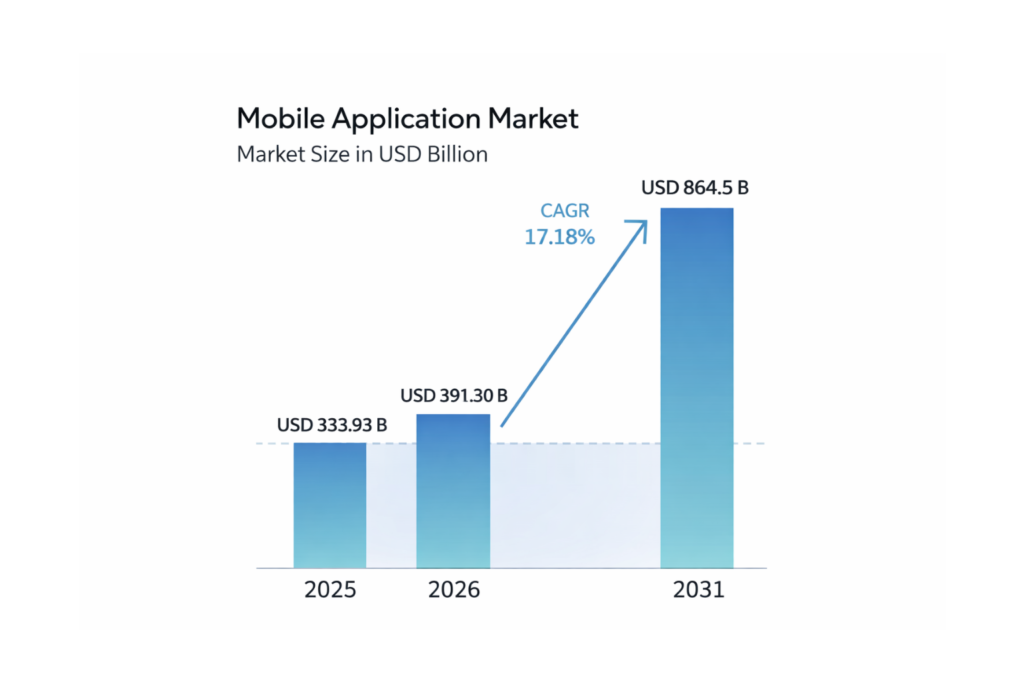
By 2031, this number could reach USD 864.5 billion at a 17.18% CAGR. Businesses everywhere are placing their bets on mobile apps. (source)
And there are good reasons behind this shift.
WhatsApp groups turn chaotic fast. Important messages sink to the bottom. Email inboxes overflow with promotional noise. Customers lose patience waiting for replies that come too late.
These tools were built for simple conversations, not for running a growing business.
A dedicated mobile app changes everything. It creates a direct line between you and your customers. No distractions. No middleman. No platform controlling how you communicate.
Your brand gets its own space. Your customers get faster responses. Your team gets organized workflows instead of scattered chats.
In this guide, we break down why this shift matters for your business. You will see the real limitations of WhatsApp and email. You will discover what mobile apps offer that these old tools simply cannot match.
At Boolean Inc. we have helped businesses make this exact transition successfully. Now, let us walk you through everything you need to know.
The Growing Limitations of WhatsApp and Email for Business
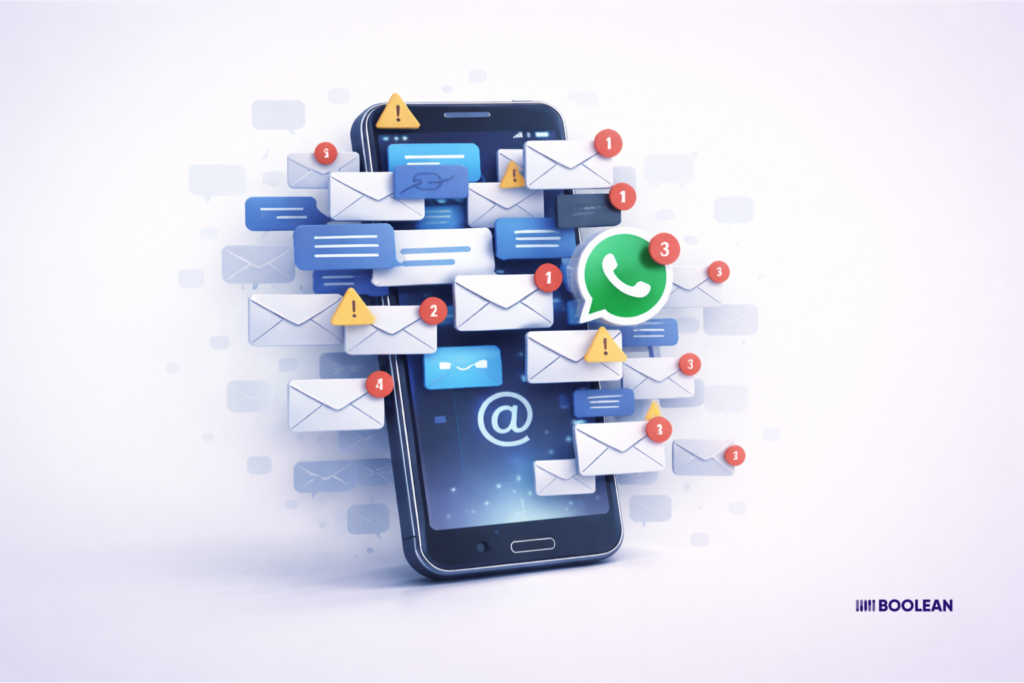
WhatsApp and email work great for casual conversations. But using them as your main business tools? That’s where problems begin.
Let’s break down the real issues.
The WhatsApp Problem
WhatsApp was built for personal chats, not for running a business. When you rely on it heavily, you start noticing cracks.
Here’s what goes wrong:
- Customer messages pile up in group chats
- No way to track conversation history properly
- Team members miss important queries during busy hours
- Zero analytics to measure response times or customer satisfaction
- Your business looks unprofessional, sharing a platform with family memes
And there’s a bigger concern. You don’t own this platform. WhatsApp can change its policies tomorrow. Your entire customer communication strategy could fall apart overnight.
The Email Struggle
Email has been around forever. Yet it comes with its own headaches.
| Email Limitation | Business Impact |
| Low open rates (around 20%) | Most customers never see your message |
| Spam filters | Important updates land in junk folders |
| Slow response times | Customers expect instant replies now |
| No real-time engagement | You lose impatient buyers quickly |
| Cluttered inboxes | Your message competes with hundreds of others |
Think about your own inbox. How many promotional emails do you actually read? Your customers behave the same way.
The Hidden Costs Add Up
Here’s something most business owners overlook. Sticking with outdated communication methods has real costs.
You lose potential sales when responses are delayed. Customer support becomes chaotic without proper tracking. Your team wastes hours sorting through scattered messages.
These hidden costs of not having a custom mobile app quietly eat into your profits every single month.
No Control Over User Experience
With WhatsApp and email, you play by someone else’s rules. You cannot customize how customers interact with your brand.
There are no push notifications that you control. No personalized dashboards. No seamless buying experience.
Your competitors who invest in mobile app solutions are already one step ahead. They offer smoother customer journeys while you struggle with message threads and email chains.
The truth is simple. These tools helped businesses survive. But they won’t help your business thrive in 2026 and beyond.
What Makes Mobile Apps Better for Customer Communication
WhatsApp and email have helped businesses connect with customers for years. But they were never designed for serious business operations.
A dedicated mobile app changes the game completely.
Let me show you why.
Your Message Actually Gets Seen
This is the biggest difference. And it matters more than anything else.
When you send an email, your message fights for attention. It competes against dozens of other emails sitting in the same inbox.
Most people scroll right past. Open rates hover around 20% on a good day. That means 80% of your customers never even see what you sent.
WhatsApp isn’t much better. Messages get buried under family photos and group chat notifications. Business updates disappear into the noise.
Now consider push notifications from a mobile app. They pop up directly on your customer’s phone screen. No competition. No clutter. Just your message front and center.
The numbers speak for themselves. Push notifications see open rates climbing as high as 90%. Your promotions actually reach people. Your updates get noticed. Your business stays fresh in their minds.
Conversations Happen in Real Time
Nobody wants to wait anymore.
Patience has become a rare thing. Your customers expect answers fast and they will go elsewhere if you keep them waiting.
Mobile apps solve this problem beautifully.
Here’s what becomes possible:
- Live chat connects customers to your team within seconds
- Automated responses handle common questions around the clock
- Order tracking updates appear instantly without customers asking
- Quick feedback options let users share thoughts with one tap
- Support tickets get routed to the right person immediately
This speed builds trust. Customers feel valued when they get quick responses. They remember businesses that respect their time.
Wondering how this transforms support operations? See how smart mobile apps are transforming customer support for businesses just like yours.
Every Customer Gets a Unique Experience
Here’s where things get interesting. A mobile app remembers each customer individually.
Think about your favorite shopping app.
It knows what you bought last month. It suggests products you might actually want. It remembers your size and your preferences and your payment details.
Everything feels effortless because the app understands you.
Email blasts treat everyone the same. WhatsApp broadcasts feel random and impersonal. But a well-built mobile app creates experiences that feel custom-made for each user.
| Personalization Feature | How It Works | Why It Matters |
| User profiles | Saves customer preferences automatically | No need to enter details repeatedly |
| Smart suggestions | Recommendations based on past behavior | Helps customers find what they need faster |
| Location awareness | Sends relevant offers based on geography | Feels timely and useful |
| Order history | Displays previous purchases clearly | Makes reordering simple |
| Saved favorites | Lets users bookmark items they love | Creates a personal space within your app |
This personal touch keeps customers coming back. They feel understood rather than sold to.
Speed That Drives Sales
Slow responses kill deals. This happens every single day. A customer shows interest but gets no reply for hours. By the time you respond, they have already moved on to a competitor.
Mobile apps eliminate this problem almost entirely.
Automation handles routine questions instantly. Smart systems direct complex issues to available team members. Customers get answers in minutes not days. The entire buying process moves faster.
And faster buying means more sales. Businesses using mobile apps consistently notice how mobile apps shorten the customer buying cycle by removing delays at every step.
Content That Grabs Attention
WhatsApp lets you share photos and short videos. Email supports attachments that people rarely download. Neither platform offers anything exciting.
Mobile apps open up a completely different world of possibilities.
Inside your own app, you can offer:
- Product catalogs with stunning visuals and zoom features
- Video demonstrations that play smoothly without redirects
- Interactive guides that walk customers through your services
- Loyalty programs with points, rewards and achievement badges
- Live events streamed directly to engaged users
These features create memorable experiences. Customers don’t just see your products. They interact with your brand in ways that stick with them long after they put down their phones.
Works Even Without Internet
Here’s something most people overlook. Mobile apps can function offline.
Your customer might be traveling through an area with weak signal. They might be underground on a subway. Their wifi might be acting up. With WhatsApp and email they are stuck until connectivity returns.
A mobile app handles this differently. Essential information stays stored on the device.
Customers can browse products, check order details and review their account even without internet. Once the connection returns, everything syncs automatically in the background.
For businesses serving customers in areas with unreliable networks, this feature alone makes a massive difference. You never lose a sale just because the signal dropped.
Relationships That Last
Email newsletters get deleted without a second thought. WhatsApp broadcasts feel intrusive and annoying. But a mobile app becomes something different entirely. It becomes a habit.
Customers check their favorite apps throughout the day. During morning coffee. On lunch breaks. While waiting in line. Before falling asleep at night. Your brand stays present in their daily routine.
This consistent presence builds something valuable over time. Trust grows naturally. Loyalty develops without forcing it. Repeat purchases become the norm rather than the exception.
And unlike WhatsApp or email, you own this relationship completely. No platform can change its algorithm and cut you off from your own customers. The connection belongs to you and your business alone.
How Mobile Apps Help You Control Your Brand Experience
When you use WhatsApp or email, you hand over control to someone else. Their rules. Their design. Their limitations. Your brand gets squeezed into a template that looks exactly like everyone else.
A dedicated mobile app flips this completely. You become the boss.
Your Brand Takes Center Stage
Open WhatsApp right now. Every business conversation looks the same. Same green bubbles. Same plain text. Same boring layout. There is nothing unique about how your brand appears.
Email offers slightly more flexibility. But even there, you work within strict boundaries.
Email clients display your message differently on every device. Your carefully designed newsletter might look beautiful on one phone and completely broken on another.
A mobile app changes this story entirely.
Every pixel belongs to you. Your colors fill the screen. Your logo sits proudly at the top. Your fonts create the exact mood you want.
Customers step into your world the moment they open your app.
Elements you control completely:
- Color schemes that match your brand identity
- Typography that reflects your personality
- Layout designs that guide users exactly where you want them
- Imagery and graphics that tell your story
- Animations and transitions that feel yours uniquely
This visual consistency builds recognition. Customers start associating certain colors and styles with your business. Your brand becomes memorable instead of forgettable.
No Distractions From Competitors
Think about what happens when a customer opens their email inbox. Your message sits surrounded by competitors. Promotional emails from rival businesses appear right above and below yours.
Every scroll brings another distraction.
WhatsApp creates similar problems. Your business chat shares space with personal conversations and other companies trying to grab attention.
Focus gets scattered across dozens of different threads.
Inside your mobile app, there are no competitors. Zero distractions. Just your products and your services and your message.
This focused environment keeps customers engaged longer. They browse without interruption. They explore without getting pulled away. They make purchasing decisions without second-guessing.
Features Built Around Your Business Needs
Generic tools force you to adapt. You twist your processes to fit what WhatsApp allows. You limit your communication to what email supports. Your business bends to match the platform.
Custom mobile apps work the opposite way. The platform bends to match your business.
Need a special booking system?
Build it exactly how you want. Want a unique loyalty program? Design it to fit your customer base perfectly. Require specific payment options? Integrate them seamlessly.
Here’s what customization looks like in practice:
| Business Type | Custom App Feature | Why It Works |
| Restaurant | Table reservation with real-time availability | Customers book instantly without phone calls |
| Retail store | Virtual try-on using phone camera | Reduces returns and increases confidence |
| Service company | Appointment scheduling with staff selection | Customers choose their preferred team member |
| Fitness studio | Class booking with waitlist management | Fills every spot automatically |
| Healthcare clinic | Prescription reminders and refill requests | Improves patient care and retention |
When you choose the right app development company, these custom features become reality. Your app works exactly how your business needs it to work.
Consistent Experience Across Every Interaction
Brand consistency matters more than most businesses realize. When customers encounter different experiences at different touchpoints, they get confused. Confusion creates doubt. Doubt kills sales.
WhatsApp conversations feel informal and scattered. Email communications seem corporate and distant. Your website might have one personality while your social media shows another. Nothing connects smoothly.
A mobile app unifies everything under one roof.
Customers experience the same tone everywhere inside your app. The same visual style appears on every screen.
Navigation works identically whether they browse products, contact support or track orders. Everything feels connected and intentional.
This consistency builds confidence. Customers know what to expect. They trust your brand because it feels reliable and professional at every step.
Data Stays in Your Hands
Here’s something critical that many business owners miss. When you communicate through WhatsApp or email, you lose control over valuable information.
WhatsApp owns the data flowing through its platform. Email providers scan messages for advertising purposes. Third parties have access to conversations between you and your customers.
Your own mobile app keeps data where it belongs, with you.
You gain complete visibility into:
- Which features customers use most frequently
- How long people spend browsing different sections
- Where users drop off before completing purchases
- What times of day see the highest engagement
- Which products generate the most interest
This information helps you make smarter decisions. You spot problems quickly. You identify opportunities clearly. You understand your customers better than ever before.
And competitors never see any of it. Your insights remain your competitive advantage.
Professional Image That Builds Trust
Let’s be honest about perception.
A business running entirely through WhatsApp groups looks small and scrappy. Customers wonder if you are serious. They question whether you can handle their needs professionally.
A dedicated mobile app sends a completely different message.
It shows investment. It demonstrates commitment. It proves that you take your business and your customers seriously enough to build something real.
This professional image attracts better customers.
People who value quality choose businesses that present themselves with quality. Your app becomes a signal that separates you from amateur competitors still relying on chat groups and email blasts.
Evolve Without Platform Restrictions
WhatsApp updates its features when it wants. Email technology moves slowly with changes outside your control. You wait for others to innovate before you can improve.
With your own app, you set the pace.
Want to add new functionality next month? Do it.
Need to redesign the checkout process? Go ahead.
Ready to launch a completely new service? Your app grows with you.
This flexibility becomes especially important for expanding businesses. As you scale, your app scales alongside you. Learn more about building scalable mobile apps for rapidly growing businesses that need room to evolve.
Your brand experience improves continuously. You never wait for permission. You never hope someone else makes the changes you need. Control stays firmly in your hands where it belongs.
Real Benefits: Cost Savings and Efficiency Gains
Investing in a mobile app sounds expensive at first glance. But look closer and the math tells a different story. Businesses switching from WhatsApp and email actually save money over time.
Let me explain how.
Less Time Wasted on Repetitive Tasks
Your team probably spends hours answering the same questions every day. Where is my order? What are your business hours? How do I reset my password?
WhatsApp and email handle these queries one by one. Each response takes time. Each message requires someone to type a reply manually.
Mobile apps automate this completely. AI Chatbots answer common questions instantly. Self-service portals let customers find information themselves. Order tracking updates appear automatically without anyone lifting a finger.
Your team focuses on work that actually matters. Productivity jumps. Costs drop.
Fewer Errors Mean Fewer Losses
Manual processes create mistakes. Someone copies an order detail incorrectly from a WhatsApp message.
An important email gets overlooked during a busy afternoon. Small errors add up to big problems.
Mobile apps reduce human error dramatically. Orders flow directly into your system without manual entry. Nothing gets lost or mistyped. Everything stays organized and trackable.
Businesses using mobile apps consistently report how mobile apps reduce operational errors across daily operations.
Marketing That Costs Less and Works Better
Email marketing requires constant spending. You pay for email platforms, design tools and list management services.
Open rates stay disappointingly low despite all that investment.
Push notifications cost almost nothing to send. And they actually get seen.
| Marketing Channel | Average Cost | Typical Open Rate |
| Email campaigns | Medium to High | Around 20% |
| SMS marketing | High per message | Around 45% |
| Push notifications | Very Low | Up to 90% |
The savings become obvious quickly. You spend less while reaching more customers effectively.
Smarter Decisions Through Better Data
Guessing costs money. Wrong inventory decisions tie up cash. Misguided marketing wastes budget. Poor timing loses sales.
Mobile apps give you clear data on customer behavior. You see what sells and what doesn’t. You understand when customers are most active. You know exactly which promotions drive results.
Better information leads to smarter spending. Every dollar works harder because you know where to invest it.
Understanding the True Investment
Many business owners worry about app development costs without seeing the full picture. Yes, there is an upfront investment.
But that investment pays back through efficiency gains, increased sales and reduced operational expenses.
Before making any decision, it helps to create an app development budget that accounts for both costs and expected returns.
Most businesses find the numbers make perfect sense once everything is calculated properly.
The question isn’t whether you can afford a mobile app. The question is whether you can afford to keep losing money on outdated communication tools.
When Should Your Business Make the Switch?
Not every business needs a mobile app today. But certain signs tell you the time has come. Recognizing these signals helps you make the right move at the right moment.
Signs You’ve Outgrown WhatsApp and Email
Ask yourself these questions honestly:
- Are customer messages getting lost or delayed regularly?
- Does your team struggle to track conversations across platforms?
- Are you losing sales because responses take too long?
- Do customers complain about confusing communication?
- Is your competitor already offering an app experience?
If you answered yes to even two or three, then you’re ready for a change.
Business Stages That Demand an App
Some situations make mobile apps almost essential.
You need an app when:
- Customer base grows beyond what manual systems handle
- You want to build a loyalty program that actually works
- Your services require bookings, appointments or orders
- Local expansion becomes a priority for growth
- You need data insights that WhatsApp simply cannot provide
Businesses focused on local growth especially benefit from this shift. Learn how mobile apps help grow your local business faster than traditional methods ever could.
Start Before You Fall Behind
Waiting too long creates problems.
Competitors capture your customers with better experiences. Market expectations shift while you stand still. Catching up becomes harder and more expensive.
The best time to start was yesterday. The second best time is now.
Even if you begin with a simple app, you establish presence. You build customer habits. You collect valuable data from day one. Growth happens step by step.
Conclusion
WhatsApp and email served their purpose. They helped businesses communicate when options were limited.
But the world has moved forward and customer expectations have changed dramatically.
Today, people want speed. They want personalization. They want seamless experiences that fit into their busy lives. Generic messaging tools simply cannot deliver what modern customers demand.
The Choice Is Clear
A dedicated mobile app puts you in control. Your brand shines without distractions. Your customers get faster responses. Your team works more efficiently. Your data stays protected and useful.
The businesses thriving right now understand this shift. They stopped relying on platforms they don’t own. They invested in solutions built specifically for their needs.
What Comes Next
Making this transition feels overwhelming at first. Where do you start? What features matter most? How do you avoid costly mistakes?
Start by understanding what top mobile app features every business should have before building anything. Focus on essentials first. Add complexity later as your needs grow.
The gap between businesses using mobile apps and those stuck on old tools widens every day. Customers notice the difference. They choose convenience over frustration every single time.
Your competitors are already making this move. The only question remaining is whether you will lead or follow.
At Boolean Inc. we turn these ideas into powerful mobile apps tailored for your business goals. Your journey starts with a simple conversation.
FAQs
1. Why should I switch from WhatsApp to a mobile app for my business?
WhatsApp works for casual chats but not for serious business operations. A mobile app keeps everything organized and makes your brand look professional.
2. Is a mobile app better than email for reaching customers?
Push notifications get seen instantly. Emails sit unread in overflowing inboxes. The difference in response rates speaks for itself.
3. Will a mobile app work for my small business?
Size doesn’t matter here. Small businesses often benefit the most because apps help them compete with larger competitors on customer experience.
4. How do I know my business is ready for an app?
If you struggle with lost messages, slow responses or scattered customer data, then you have outgrown basic tools. Time to upgrade.
5. What happens to my existing customers during the switch?
Nothing gets lost. You gradually introduce the app while keeping current channels active. Customers transition at their own pace without disruption.