
Introduction
Most customers do not wake up ready to buy. They browse a little. They compare options. They get distracted. Then they forget.
That slow journey from “I might need this” to “I just bought it” is the customer buying cycle. When it drags on, businesses lose sales in quiet ways.
A shopper leaves your site to “think about it” and never returns. Someone asks a question and does not get an answer fast enough. A good deal feels complicated, so the customer chooses the easier option.
Mobile apps can change that pace.
A well-planned app puts the right next step in front of the customer at the right time. It also keeps everything in one place, which makes buying feel simple and safe.
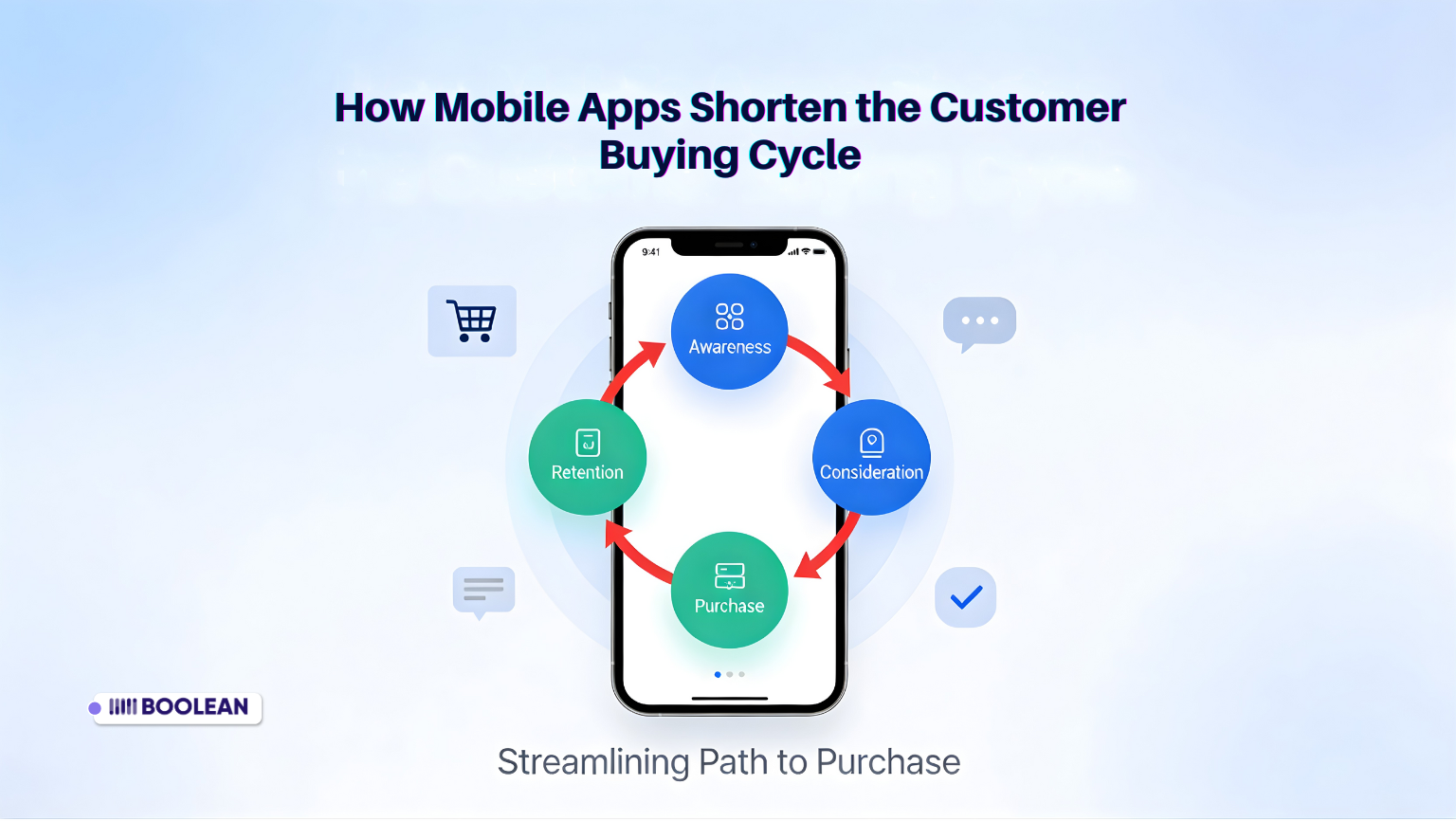
In this blog, you will learn:
- What slows customers down during a purchase
- How mobile apps remove those delays
- Which app tools help people decide faster without feeling pushed
Let’s break it down in plain terms.
What the Customer Buying Cycle Looks Like Today (In Simple Terms)
The customer buying cycle is the path people follow before they spend money. It can take minutes. It can take weeks. It depends on the price, the risk, and how confident they feel.
You can think of it as a few simple steps.
The common stages
- They notice a need
- “I need new shoes.”
- “I should find a better dentist.”
- “My team needs an easier way to place orders.”
This stage is fast. The problem is clear. The solution is not.
- They explore options
They search. They scroll. They ask friends. They read reviews.
This is where people get overwhelmed. Too many choices can slow everything down.
- They compare and narrow down
Now they focus on a small list. They look at:
- Price
- Trust signals like reviews and ratings
- What is included
- How easy it is to buy or book
Small doubts show up here. Doubts create delays.
- They decide
This is the “almost there” moment. It is also the moment when many people drop off.
Why? Because the next step feels annoying.
- A long form
- Confusing steps
- Hidden fees
- No clear answer to a simple question
- They buy
Payment happens. Booking happens. Order is placed.
If it is smooth, they feel good. If it is messy, they may cancel or never return.
- They judge the experience
This part is often ignored. It should not be.
A happy customer buys again. They also tell others. An unhappy customer leaves a review and disappears.
A quick view you can use
| Stage | What the customer is thinking | What often slows them down |
| Notice a need | “Do I really need this now?” | Distractions and uncertainty |
| Explore | “What are my options?” | Too many choices and unclear info |
| Compare | “Which one feels safest?” | Weak reviews and mixed messaging |
| Decide | “Should I do it today?” | Friction, like long steps or missing answers |
| Buy | “I hope this works.” | Complicated checkout or limited payment options |
| After purchase | “Was that worth it?” | No follow-up and no support |
Why are buying cycles getting longer than they should
Most customers are not saying “no.” They are saying “not now.”
Here are the common reasons:
- They get distracted. One call or one message can break their focus.
- They do not trust the details yet. They want proof, not promises.
- They hit a small roadblock. One confusing screen can stop the whole purchase.
- They want a faster answer. If they cannot get it quickly, they move on.
- They feel the risk. This is big for first-time buyers.
It is often something tiny. Tiny things cause big drop-offs.
Real-life examples of the same cycle
Sometimes it helps to see it in everyday situations.
Example 1: A local service booking
- Need: “I need a haircut this week.”
- Explore: Search for nearby salons.
- Compare: Look at ratings and prices.
- Decide: Check availability.
- Buy: Book a time.
- After: Leave a review or rebook.
The delay usually happens with availability or booking.
Example 2: A product purchase
- Need: “My blender broke.”
- Explore: Browse brands.
- Compare: Read reviews and watch short videos.
- Decide: Choose a model.
- Buy: Pay and select delivery.
- After: Track the order and ask questions if needed.
The delay usually happens at comparison or checkout.
Example 3: Food ordering
- Need: “I want dinner fast.”
- Explore: Pick a place.
- Compare: Check the menu and delivery time.
- Decide: Build the cart.
- Buy: Pay.
- After: Track delivery.
The delay usually happens during menu browsing or cart building.
Next, we will look at how mobile apps remove the most common delays and help people move forward faster.
How Mobile Apps Remove Friction and Speed Up Decisions
Friction is anything that makes a customer pause. It can be small. It can be silly. It still costs you the sale.
A mobile app helps because it keeps the buying journey tight. Everything sits in one place. Customers do not have to start over every time they get interrupted. They can pick up where they left off.
Here is how apps usually shorten the path from interest to purchase.
1) Apps reduce “start-from-scratch” moments
On a website, customers often repeat steps. They search again. They fill out forms again. They re-enter the details again.
A good app can remember the basics, such as:
- Saved delivery addresses
- Saved payment options (when customers choose to store them)
- Past orders and favorites
- Size preferences or service choices
That one change can remove minutes. Minutes matter.
2) Apps make the next step obvious
Many buying cycles slow down because people do not know what to do next.
An app can guide the customer with clear actions, like:
- Book now
- Add to cart
- Reserve a slot
- Get a quick quote
- Reorder
No guessing. No hunting around. Just progress.
If you want a bigger picture on why apps often win here, read Mobile Apps vs Websites: Why Businesses Should Choose Apps.
3) Apps help customers decide faster with better product clarity
People delay purchases when they feel unsure. They want to see more. They want proof.
Apps can put helpful details front and center:
- Clear photos and short videos
- Easy-to-read pricing with no surprises
- Reviews and ratings that feel real
- Simple comparisons between options
When customers feel informed, they move. When they feel confused, they wait.
4) Apps turn “I’ll do it later” into “I’ll do it now”
A customer might love what you offer. Then life happens.
Apps can bring them back with gentle reminders, such as:
- An alert that a cart is still waiting
- A price drop notice
- A reminder for an upcoming appointment
- A restock message for a popular item
These small nudges shorten the gap between interest and action.
5) Apps remove checkout pain
Checkout is where many customers drop off. Not because they changed their mind. Because the process felt annoying.
Apps can make buying feel simple by offering:
- Fewer screens to complete the purchase
- Fast payment choices
- Order confirmation right away
- Easy access to receipts and order tracking
Less effort creates more completed purchases. It is that direct.
6) Apps build trust quickly
Trust is speed.
When customers trust you, they do not need days to think. They feel safe choosing you.
Apps help build that confidence with:
- Visible support options
- Clear return or cancellation steps
- Order tracking that reduces anxiety
- Quick answers inside the app
This is one reason many brands look for a top mobile app development company USA when they want to improve results fast without making the experience complicated.
A simple “friction to fix” guide
| What slows customers down | What a mobile app can do instead |
| Too many steps to buy | Shorten the path with fewer taps |
| Re-entering details | Save key info for next time |
| Unclear pricing or options | Show totals and choices clearly |
| Doubts about quality | Highlight reviews, photos, and FAQs |
| Distractions and delays | Use gentle app alerts to bring them back |
If you are planning an app, it helps to work with a team that understands buying behavior, not just screens.
Boolean Inc. often starts by mapping where customers hesitate, then designing the app flow around those moments. That is how you get a faster cycle that still feels natural.
Mobile App Features That Move Customers From “Maybe” to “Yes” Faster
People rarely wake up ready to buy. Most start with a small need, a quick search, or a simple curiosity. The winning apps know this. They guide customers through a few key moments that build trust, remove doubt, and make buying feel easy.
Below are the app moments that move customers faster from “I’m just looking” to “Done. Ordered.”
1) The first open: a calm welcome that gets to the point
Your first impression happens in seconds. If the first screen feels confusing, people leave. If it feels clear, they keep going.
What helps most:
- A short welcome message that explains the main benefit
- A simple sign-in option (email, phone number, or “continue as guest” if it fits your business)
- One clear next step, like “Browse,” “Book,” or “Shop”
Keep it light. Do not ask for ten details up front. Let people explore first.
2) Browsing that feels effortless
Customers move faster when they can find what they want without thinking too hard. Great browsing reduces friction.
Helpful touches include:
- Clear categories that match real customer language
- Smart search that shows results as they type
- Filters that actually matter (price range, size, location, availability)
- Recently viewed items, so they can pick up where they left off
When browsing is smooth, the purchase decision comes sooner.
3) Product or service pages that answer doubts before they grow
This is a big “maybe” moment. Customers are asking, “Is this right for me?” Your app should answer that question quickly.
Strong pages often include:
- Clean photos that show the details
- Simple benefits in bullet points
- Transparent pricing with no surprises
- Delivery times or appointment availability right there
- Easy-to-find return or refund info
Trust grows when details are clear. Confusion slows everything down.
4) Social proof that feels real, not forced
People trust people. Reviews and ratings shorten the buying cycle because they replace guessing with reassurance.
Make social proof useful:
- Show recent reviews, not only the best ones
- Add photos from real buyers when possible
- Let users filter reviews by “most recent” or “most helpful”
- Highlight common themes like “fast delivery” or “true to size”
Even a few honest reviews can be more persuasive than perfect marketing lines.
5) The “help me now” moment: fast support inside the app
When someone has a question, they are close to buying. If they cannot get an answer quickly, they leave and they might not return.
Easy options that keep the momentum:
- A short FAQ under each product or service
- In-app chat or simple message support
- A call button for urgent needs
- Quick replies for common questions
This is where many businesses win or lose the sale.
6) A cart that gently reduces second thoughts
Adding to the cart is not the finish line. It is a test. Customers often pause here, compare options, or get distracted.
Small details that help:
- Show the total cost early
- Show delivery fees clearly
- Offer saved carts, so they can return later
- Add a “buy now” option for fast movers
If you want ideas that increase order size without feeling pushy, you can also explore How Mobile Apps Improve Upselling and Cross-Selling.
7) Checkout that feels like a smooth path, not a paperwork form
Checkout is where buying cycles often break. Too many steps create doubt. Too many fields create frustration.
A faster checkout usually has:
- Fewer screens
- Autofill for address and contact details
- Multiple payment options (cards, wallets, pay later if it fits)
- Clear confirmation at the end
A simple checkout can lift your conversion rate quickly, even if your traffic stays the same.
8) Smart reminders that bring people back at the right time
Not every customer buys in one visit. Some need a nudge. Reminders can shorten the cycle when they feel helpful, not annoying.
Good reminder examples:
- “Your cart is still saved” after a few hours or a day
- “Price dropped,” if that is true
- “Back in stock” alerts
- “Your appointment slots are filling” if time is limited
Keep messages short. Make them relevant. Give a clear action button.
9) The moment after purchase: reassurance that they made the right choice
This part matters more than most beginners think. A confident buyer becomes a repeat buyer. A worried buyer cancels or returns.
Helpful post-purchase moments include:
- A clear order confirmation
- Live order tracking or status updates
- Easy access to receipts
- A simple way to get help if something goes wrong
This is also where many brands add loyalty points or a small “thank you” offer.
Quick table: moments that shorten the buying cycle
| Key moment in the app | What it does for the customer | Why does it speed up buying |
| First open | Sets expectations fast | Reduces early drop-offs |
| Search and filters | Helps them find the right option | Cuts “endless scrolling” |
| Product details | Answers doubts | Builds trust quickly |
| Reviews | Adds real proof | Reduces hesitation |
| In-app support | Solves last-minute questions | Prevents abandonment |
| Checkout | Removes effort | Turns intent into action |
| Reminders | Brings them back | Recovers lost sales |
| Order updates | Reduces anxiety | Lowers cancellations |
If you are planning these moments for your own app, it helps to map them out before you build anything.
Teams like Boolean Inc. often start by focusing on these exact customer touchpoints, so the app feels simple while still driving real results.
For a practical checklist of what to include, you can also read Top Mobile App Features Every Business Should Have in 2026.
Real Business Benefits of a Shorter Buying Cycle
When customers decide faster, your business feels the difference almost immediately. Not just in sales. In day-to-day operations, too. Fewer stalled orders. Fewer abandoned carts. More predictable revenue.
Here are the biggest wins you can expect when a mobile app helps shorten the buying cycle.
1) More sales from the same audience
A shorter buying cycle means fewer people drop off halfway.
What changes in real life:
- More visitors turn into buyers
- More “I’ll come back later” turns into “I bought it”
- More first-time buyers finish the process without help
You are not chasing extra attention. You are getting more value from the attention you already have.
2) Lower marketing waste
Marketing can be expensive. It gets even more expensive when people click but do not buy.
When the app helps customers decide faster:
- Fewer paid clicks are wasted
- Promotions work better because people act quickly
- Your cost per sale often drops over time
It is a quiet win. It adds up.
3) Better cash flow and steadier revenue
Long buying cycles create “maybe money.” It looks promising, but it is not in your account yet.
Shorter cycles help because:
- Orders come in sooner
- Payment happens sooner
- Forecasting becomes easier
That stability matters for staffing, inventory, and planning.
4) Fewer support requests that drain time
When the app answers common questions upfront, customers do not need to call or message as much.
That means:
- Less time spent repeating the same answers
- Fewer “Where is my order?” messages if tracking is clear
- More time for higher-value customer help
Many businesses are surprised by this benefit. It feels small until it is not.
5) Higher trust in your brand
Speed alone is not the point. Clarity is. When customers can understand the offer quickly, trust rises.
A shorter buying cycle often signals:
- The customer feels safe buying from you
- The pricing and steps feel transparent
- The brand experience feels professional
This is one reason some companies work with teams like Boolean Inc. to focus on the customer journey before anything else. The goal is a buying path that feels natural, not pushy.
6) Stronger repeat sales over time
A fast first purchase makes the second purchase even faster. People already know what to expect. They remember the smooth experience.
This can lead to:
- More repeat orders
- More referrals
- Higher lifetime value from the same customer
If you want to go deeper on the repeat side of things, you can also read How Mobile Apps Improve Customer Retention for Businesses.
Quick snapshot: what a shorter buying cycle improves
| Business result | What you may notice | Why it matters |
| Higher conversion | More completed purchases | More revenue without more traffic |
| Lower marketing cost | Better results from ads and promos | More profit per sale |
| Faster cash flow | Money arrives sooner | Easier planning and growth |
| Less support pressure | Fewer basic questions | More time for real customer care |
| Better repeat business | Customers come back sooner | More long-term value |
A shorter buying cycle is not just about speed. It is about removing doubt at the right moments, so buying feels easy.
Planning Your App: What to Focus on Before You Build
A great app is not born in the build stage. It starts with clear choices. If you plan the right things first, your app feels simple for customers and it feels manageable for you.
Here is what to lock in before anyone starts creating screens.
1) Pick one main goal for the first version
Many apps fail because they try to do everything on day one. Start with one clear win.
Common goals:
- Get more orders
- Get more bookings
- Get more quote requests
- Get more repeat purchases
Keep it focused. You can always add more later.
2) Write down the exact action you want customers to take
Be specific. “Grow sales” is not an action. “Buy a product in three steps” is an action.
Ask yourself:
- What is the one thing the customer should be able to do in under two minutes?
- What should happen right after they do it?
This becomes your app’s core flow.
3) Map the buying journey in plain steps
You do not need fancy diagrams. A simple list works.
Example journey:
- Open the app
- Find a product or service
- Check price and details
- Feel confident
- Pay or book
- Get confirmation
- Track progress or manage the order
When you see it laid out, weak spots become obvious.
4) Choose “must-have” features, not “nice-to-have” extras
This is where planning saves money and time.
Must-have features often include:
- Clear categories and search
- Simple product or service pages
- Cart or booking screen
- Easy payment options
- Order confirmation
- Support options like chat or a help page
Nice-to-have features can wait:
- Loyalty points
- Referral programs
- Advanced personalization
- Big social features
Start small. Start strong.
5) Prepare your content before the app is created
Apps feel slow when the business is not ready with the basics.
Have these ready early:
- Photos that look real and clear
- Pricing that is up to date
- Delivery areas, service areas, or appointment hours
- Return policy, cancellation policy, and refund rules
- Short FAQs based on real customer questions
Clarity shortens decisions.
6) Decide how you will build trust inside the app
Trust is a feature. People buy faster when they feel safe.
Trust builders to plan:
- Customer reviews and ratings
- Clear contact details
- Simple “how it works” explanation
- Secure payment methods that customers recognize
If you sell services, show availability and what is included. No guessing.
7) Plan your reminders so they help, not annoy
Reminders can bring customers back, but only when they feel relevant.
Good reminder ideas:
- Cart saved reminder
- Back-in-stock alerts
- Appointment reminders
- Delivery updates
Set a limit. Too many messages push people away.
8) Decide what success looks like, then track it
You cannot improve what you never check.
Simple numbers to watch:
- How many people open the app each day
- How many people search or browse
- How many people add to the cart or start booking
- How many people finish checkout
- How many people come back and buy again
Pick a few. Keep it simple.
9) Choose the right team to support your plan
The right partner will ask you questions that sharpen your goals. They should not rush you into decisions.
If you want help picking a partner, see How to Choose the Right App Development Company for Your Business.
Teams like Boolean Inc. often start with planning sessions that clarify your customer journey first, then they shape the app around it. That approach keeps the experience clean for beginners and buyers.
Quick planning checklist
| Planning item | What to decide | Why it matters |
| Main goal | Sales, bookings, or leads | Keeps the app focused |
| Core customer action | The one key task | Builds a simple flow |
| Must-have features | Search, cart, checkout, support | Prevents feature overload |
| Content readiness | Photos, pricing, policies | Removes buyer doubt |
| Trust signals | Reviews, clear contact, secure payment | Speeds up decisions |
| Reminders | Few helpful messages | Brings customers back |
| Success tracking | 3–6 key numbers | Shows what to improve |
Planning does not slow you down. It protects your time and your budget. It also helps your app do what it is meant to do: turn interest into action.
Conclusion
A shorter buying cycle is not about pushing people. It is about removing the small doubts that slow them down. When your app feels clear and quick, customers stop hesitating. They choose. They buy.
Keep your next steps simple:
- Spot the slow points: Search, product details, pricing, trust, checkout
- Fix the top two first: Fewer steps, clearer answers, better support
- Track what improves: Completed orders, saved carts that return, repeat buyers
If you are looking for a top mobile app development company USA, choose a team that cares about customer decisions, not just how the app looks.
Boolean Inc. can help you plan that kind of smooth experience, especially if you want guidance that stays practical and business-focused. That is what you should expect from a leading mobile app development company.
FAQs
- What is the customer buying cycle?
It is the steps a customer goes through from first interest to final purchase.
- How do mobile apps help customers buy faster?
They make it easier to browse, compare, trust the brand, and check out quickly.
- Do mobile apps increase sales for small businesses?
Yes, many small businesses see more completed purchases and more repeat orders when the app is simple and fast.
- What app features shorten the buying process the most?
Fast search, clear product details, reviews, saved carts, quick payments, and order tracking.
- Is a mobile app better than a website for selling?
Often yes for repeat customers, because apps can be faster and more convenient for frequent buying.