
TL;DR: Cost to Build an App Like Uber, Airbnb, or DoorDash (2026)
- Uber-style ride-hailing: $80,000 – $250,000. An honest MVP starts around $60,000.
- Airbnb-style rental marketplace: $60,000 – $200,000. Cheapest of the three because nothing moves in real time.
- DoorDash-style food delivery: $90,000 – $280,000. Most expensive because it’s four apps, not three.
- Why the range is so wide: you’re never building one app. You’re building a customer app, a provider app, and an admin platform, and the backend that holds them together is where half the money goes.
- The “$15,000 Uber clone” ads are real. So is the $60,000 rebuild that follows them 8 months later.
Cost to Build an App Like Uber, Airbnb, or DoorDash: The Straight Answer
You want the number first. Fair.
After building 100+, including a good number of on-demand and marketplace platforms, here’s where the cost to build an app like Uber, Airbnb, or DoorDash actually lands:
| App type | MVP (one city, core flows) | Market-ready | Full-featured platform | Timeline |
| Uber-style (ride-hailing / on-demand service) | $60,000 – $90,000 | $120,000 – $180,000 | $200,000 – $350,000+ | 4–9 months |
| Airbnb-style (rental / booking marketplace) | $45,000 – $75,000 | $90,000 – $150,000 | $160,000 – $300,000+ | 3–8 months |
| DoorDash-style (food / grocery delivery) | $70,000 – $110,000 | $140,000 – $200,000 | $220,000 – $400,000+ | 5–10 months |
Two things before we go deeper.
First, these numbers assume a hybrid team (US-based leadership, distributed engineering) at a blended $55–$85/hour.
A pure US agency at $150+/hour roughly doubles them. A pure offshore freelancer at $25/hour can roughly halve them, with the risks that come with that. We covered rates by region in our mobile app development cost guide, so I won’t rehash it here.
Second, and more important: nobody actually builds “Uber”. Uber is 15 years and several billion dollars in engineering. What people mean is “an app where a customer requests something, a provider accepts it, and money changes hands.” That’s very buildable. Let’s talk about what it costs.
The thing nobody tells you: you’re building three apps

This is the single biggest reason founders get sticker shock on these projects.
When you say an app like Uber, you picture the rider app. The map, the car icon, and the “Request” button.
But that’s a third of the product. At minimum, you need:
1. The customer app. Rider, guest, or hungry person. Browse, request, pay, track, and rate.
2. The provider app. Driver, host, or courier. Go online, accept jobs, navigate, mark complete, and get paid.
3. The admin platform. You. Approve providers, handle disputes, adjust pricing, see what’s happening, refund the angry customer, and pull the numbers your investors want.
And DoorDash-style apps have a fourth: the merchant app or dashboard for the restaurant to accept orders and manage menus.
Each of these has its own screens, its own logic, and its own testing. They share a backend, but that backend is more complex because it’s serving three or four different clients at once.
Here’s how the effort typically splits:
| Component | Share of total effort | Why |
| Customer app | 25–30% | Most screens, most design polish |
| Provider app | 20–25% | Fewer screens, but real-time and navigation-heavy |
| Admin platform (web) | 10–15% | Functional, not pretty, but lots of tables and controls |
| Backend & APIs | 30–40% | Matching, payments, notifications, real-time state, scaling |
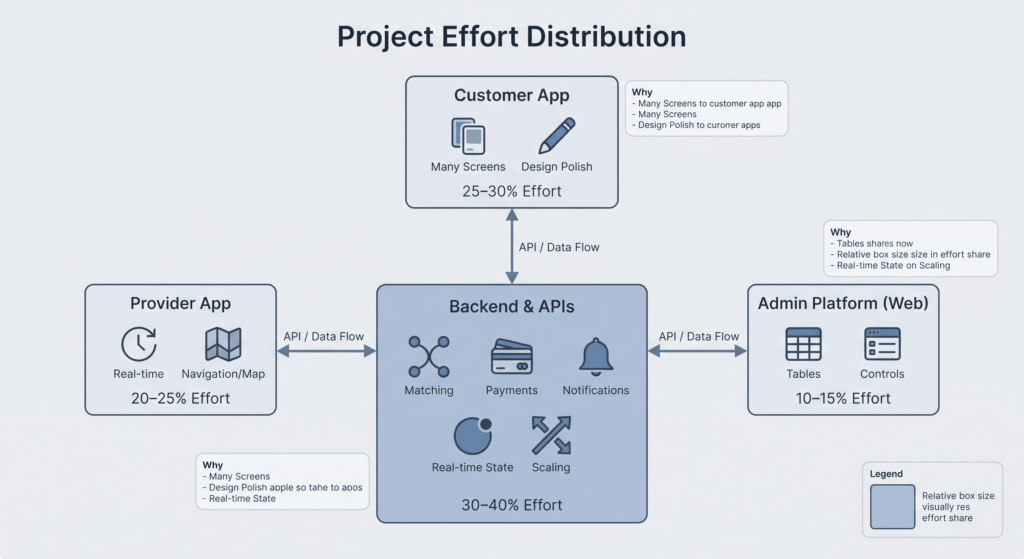
Once you see it this way, a $120,000 quote stops looking outrageous. It’s three apps and a serious backend for $30,000–$40,000 each. Compare that to the $40K–$150K range for one medium-complexity app, and it’s actually efficient.
Cost to build an app like Uber
Uber, Lyft, or any request a person to come do a thing app: rides, tow trucks, mobile mechanics, dog walkers, home cleaners, or on-demand nurses. Same architecture.
Core features and what each one costs
Rider app
| Feature | Hours | Cost (at $70/hr blended) |
| Sign-up, login, profile, phone verification | 40–60 | $2,800 – $4,200 |
| Map with live provider locations | 60–90 | $4,200 – $6,300 |
| Set pickup / destination, address autocomplete | 40–60 | $2,800 – $4,200 |
| Fare estimate before booking | 30–50 | $2,100 – $3,500 |
| Request → matching → confirmation flow | 60–100 | $4,200 – $7,000 |
| Live trip tracking (provider en route, in progress) | 60–90 | $4,200 – $6,300 |
| Payments (cards, Apple/Google Pay, tips) | 50–80 | $3,500 – $5,600 |
| Ride history, receipts | 25–40 | $1,750 – $2,800 |
| Ratings and reviews | 25–40 | $1,750 – $2,800 |
| In-app chat / call masking | 40–70 | $2,800 – $4,900 |
| Push notifications | 20–30 | $1,400 – $2,100 |
| Promo codes | 25–40 | $1,750 – $2,800 |
| Rider app subtotal | 475–750 | $33,000 – $52,500 |
Driver app
| Feature | Hours | Cost |
| Onboarding with document upload (license, insurance) | 50–80 | $3,500 – $5,600 |
| Online / offline toggle, availability | 20–30 | $1,400 – $2,100 |
| Incoming request with accept/decline timer | 40–60 | $2,800 – $4,200 |
| Turn-by-turn navigation handoff | 30–50 | $2,100 – $3,500 |
| Trip status flow (arrived, started, completed) | 40–60 | $2,800 – $4,200 |
| Earnings dashboard, payout history | 40–60 | $2,800 – $4,200 |
| Background location tracking (battery-aware) | 50–80 | $3,500 – $5,600 |
| Driver app subtotal | 270–420 | $18,900 – $29,400 |
Admin panel (web)
| Feature | Hours | Cost |
| Dashboard (live trips, daily numbers) | 40–60 | $2,800 – $4,200 |
| Driver approval and document review | 40–60 | $2,800 – $4,200 |
| User management, bans, support notes | 30–50 | $2,100 – $3,500 |
| Pricing configuration (base, per-mile, per-minute, surge) | 40–70 | $2,800 – $4,900 |
| Dispute and refund handling | 30–50 | $2,100 – $3,500 |
| Reports and exports | 30–50 | $2,100 – $3,500 |
| Admin subtotal | 210–340 | $14,700 – $23,800 |
Backend
| Component | Hours | Cost |
| Auth, user/driver models, APIs | 80–120 | $5,600 – $8,400 |
| Real-time location pipeline (WebSockets, geo-indexing) | 100–160 | $7,000 – $11,200 |
| Matching / dispatch logic (nearest available, timeouts, re-dispatch) | 80–140 | $5,600 – $9,800 |
| Fare calculation engine | 40–70 | $2,800 – $4,900 |
| Payments (Stripe Connect: charge rider, pay out driver, hold tips) | 80–120 | $5,600 – $8,400 |
| Notifications service (push, SMS, email) | 40–60 | $2,800 – $4,200 |
| Cloud infrastructure, CI/CD, monitoring | 60–100 | $4,200 – $7,000 |
| Backend subtotal | 480–770 | $33,600 – $53,900 |
Plus: discovery (40–80 hrs), UX/UI design across all three (150–250 hrs), QA (12–15% of dev), and PM (8–10%).
Total for an Uber style app
| Version | Hours | Cost |
| MVP (one city, one vehicle type, no surge, no chat, basic admin) | 900 – 1,300 | $60,000 – $90,000 |
| Market-ready (everything above) | 1,700 – 2,500 | $120,000 – $180,000 |
| Full platform (+ scheduled rides, multiple service tiers, surge, corporate accounts, multi-city, referral system, advanced analytics) | 3,000 – 5,000 | $200,000 – $350,000+ |
The expensive bits, specifically real-time location and dispatch. That’s where an Uber style app stops being a CRUD app and becomes a distributed systems problem. Budget for a senior backend engineer on those two pieces or you’ll pay for them twice.
If you’re studying the market before you build, our roundup of the top 20 apps like Uber is a useful look at how differently the same model gets executed around the world.
Cost to build an app like Airbnb
Airbnb, Vrbo, or any “list a thing, book a thing” marketplace: vacation rentals, event venues, parking spots, boats, coworking desks, and equipment.
Why is it the cheapest of the three?
Nothing moves. There’s no live tracking, no dispatch, and no “find me the nearest available host in 30 seconds”. A booking is a calendar entry and a payment. That removes the two most expensive backend components from the Uber list entirely.
What Airbnb has instead is a lot of screens. Listings are content-heavy: photos, descriptions, amenities, house rules, cancellation policies, availability calendars, and pricing rules. And search is more sophisticated: filters, map view, and date-based availability.
Core features and costs
Guest app
| Feature | Hours | Cost (at $70/hr) |
| Sign-up, login, profile, ID verification | 40–60 | $2,800 – $4,200 |
| Search with filters (location, dates, guests, price, amenities) | 70–110 | $4,900 – $7,700 |
| Map view of results | 40–60 | $2,800 – $4,200 |
| Listing detail (gallery, amenities, reviews, calendar, rules) | 60–90 | $4,200 – $6,300 |
| Booking flow with date selection and price breakdown | 60–90 | $4,200 – $6,300 |
| Payments (incl. deposits, split payouts, refunds by policy) | 60–90 | $4,200 – $6,300 |
| Wishlists / favorites | 20–30 | $1,400 – $2,100 |
| Messaging with host | 50–80 | $3,500 – $5,600 |
| Trips (upcoming, past), cancellations | 30–50 | $2,100 – $3,500 |
| Reviews (two-way, delayed reveal) | 30–50 | $2,100 – $3,500 |
| Guest app subtotal | 460–710 | $32,200 – $49,700 |
Host app
| Feature | Hours | Cost |
| Listing creation wizard (photos, details, pricing, rules) | 80–120 | $5,600 – $8,400 |
| Availability calendar with blocking, seasonal pricing | 60–90 | $4,200 – $6,300 |
| Booking requests: accept / decline / instant book | 40–60 | $2,800 – $4,200 |
| Host messaging | (shared) | – |
| Earnings, payouts, tax summaries | 40–60 | $2,800 – $4,200 |
| Host app subtotal | 220–330 | $15,400 – $23,100 |
Admin panel: 180–300 hrs ($12,600 – $21,000). Listing moderation, user verification, dispute resolution, payout management, and content flags.
Backend: 350–550 hrs ($24,500 – $38,500). Search indexing (Algolia or Elasticsearch), availability engine (the hard part: no double bookings, ever), pricing rules, Stripe Connect with delayed payouts, messaging, notifications, and image processing.
Total for an Airbnb-style app
| Version | Hours | Cost |
| MVP (one category, request-to-book only, basic search, simple calendar) | 700 – 1,100 | $45,000 – $75,000 |
| Market-ready (everything above) | 1,300 – 2,100 | $90,000 – $150,000 |
| Full platform (+ instant book, dynamic pricing, experiences, multi-currency, host insurance flows, iCal sync, superhost tiers) | 2,300 – 4,200 | $160,000 – $300,000+ |
The expensive bits: the availability engine and search. Getting “this listing is available for these dates at this price” right, under concurrent bookings, with seasonal rules and minimum stays, is fussier than it sounds. Search with map bounds, date availability, and filters that stay fast at 10,000 listings needs a proper search index.
If travel or booking is your vertical specifically, our travel booking app solutions page covers the patterns we reuse.
Cost to build an app like DoorDash
DoorDash, Uber Eats, Instacart, or any “order from a business, delivered by a third party” app: restaurants, groceries, pharmacies, alcohol, and flowers.
Why it’s the most expensive
It’s Uber plus Airbnb. You have:
- The real-time dispatch and tracking of a ride app (couriers moving around a map)
- The content-heavy catalog of a marketplace (menus, items, modifiers, photos)
- A fourth party: the merchant, who needs their own interface to accept orders and manage menus
And the logistics are genuinely harder than ride-hailing. A ride has one pickup and one drop-off. A delivery has a prep-time estimate, a courier who needs to arrive when the food is ready (not 15 minutes early, not 15 minutes late), and often batching (one courier, two orders).
Core features and costs
Customer app: 500–780 hrs ($35,000 – $54,600)
Restaurant discovery and search, menus with modifiers (“no onions,” “extra sauce”), cart, checkout with delivery/pickup options, scheduling, live order tracking with courier location, payments and tips, order history and reorder, ratings, promos, and support chat.
Courier app: 280–430 hrs ($19,600 – $30,100)
Onboarding and documents, going online, batched order offers with earnings shown, navigation to merchant then customer, pickup confirmation (order number, photo), delivery confirmation (photo, PIN, contactless), earnings and payouts.
Merchant app / tablet dashboard: 220–350 hrs ($15,400 – $24,500)
Incoming order alerts (loud), accept with prep time, mark ready, menu management (items, modifiers, availability, 86’ing an item), hours, pause orders, daily sales report, payouts.
Admin panel: 200–320 hrs ($14,000 – $22,400)
Everything from the Uber list, plus merchant onboarding, commission tiers, zone management, delivery fee rules, and courier batching settings.
Backend: 550–850 hrs ($38,500 – $59,500)
Everything from Uber’s backend, plus catalog and menu models with modifiers, order state machine (placed → accepted → preparing → ready → picked up → delivered, with every failure branch), prep-time estimation, courier assignment timed to prep, batching logic, three-way payment split (platform, merchant, courier), and commission and fee engine.
Total for a DoorDash-style app
| Version | Hours | Cost |
| MVP (one zone, restaurants only, no batching, single delivery fee, simple merchant web page) | 1,000 – 1,550 | $70,000 – $110,000 |
| Market-ready (everything above) | 2,000 – 2,900 | $140,000 – $200,000 |
| Full platform (+ batching, scheduled orders, subscriptions like DashPass, grocery with substitutions, multi-vertical, promotions engine, merchant analytics) | 3,200 – 5,700 | $220,000 – $400,000+ |
The expensive bits: the order state machine and the timing logic. Every order passes through 8–12 states and can fail at each one (the merchant doesn’t respond, the courier cancels, or the customer isn’t home). Handling every branch gracefully, with the right notifications and refunds, is easily 200+ hours on its own.
Side-by-side: where the three differ
| Uber-style | Airbnb-style | DoorDash-style | |
| Number of apps | 3 | 3 | 4 |
| Real-time tracking | Critical | None | Critical |
| Matching / dispatch | Complex, time-sensitive | None (guest chooses) | Most complex (timed to prep) |
| Catalog / content | Minimal | Heavy | Heavy |
| Payment split | 2-way | 2-way, delayed payout | 3-way |
| Search complexity | Low | High | Medium-high |
| Hardest backend piece | Live dispatch | Availability engine | Order state machine + timing |
| MVP cost | $60K – $90K | $45K – $75K | $70K – $110K |
| Market-ready cost | $120K – $180K | $90K – $150K | $140K – $200K |
| Typical MVP timeline | 4–6 months | 3–5 months | 5–7 months |
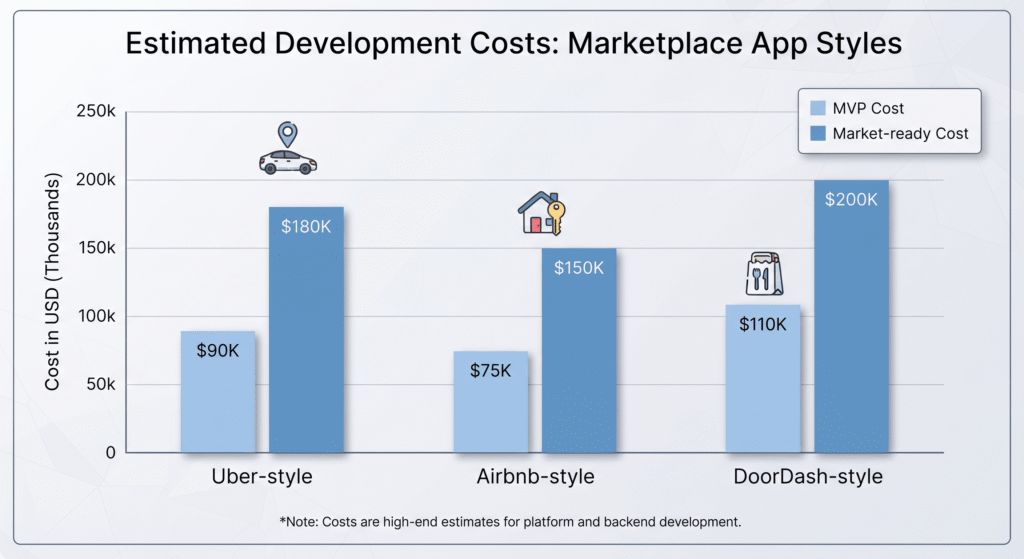
A pattern worth noticing: the price tracks the number of moving parts, not the number of screens. Airbnb has the most screens and costs the least. DoorDash has the most parties and timing dependencies and costs the most.
So when you’re scoping your own idea, ask: how many sides does my marketplace have, and does anything need to happen in real time? Those two answers predict your budget better than your feature list does.
Feature-by-feature pricing (the menu)
Mixing and matching for your own concept? Here’s a menu of the components that show up across all three, priced at a $70/hour blended rate. Your app is roughly the sum of what you pick, plus 25–30% for design, QA, and PM.
| Feature | Hours | Cost | Notes |
| Auth + profiles (both sides) | 60–90 | $4,200 – $6,300 | Social login adds ~10 hrs each |
| Phone / ID verification | 20–40 | $1,400 – $2,800 | Twilio Verify, Persona, or Onfido |
| Provider onboarding w/ document upload | 50–80 | $3,500 – $5,600 | Background check API adds 20–30 hrs |
| Live map with moving markers | 60–100 | $4,200 – $7,000 | Google Maps or Mapbox |
| Address search / autocomplete | 20–35 | $1,400 – $2,450 | Google Places |
| Real-time location pipeline (backend) | 100–160 | $7,000 – $11,200 | The big one |
| Matching / dispatch engine | 80–140 | $5,600 – $9,800 | Radius, timeout, re-dispatch |
| Search with filters + map bounds | 70–120 | $4,900 – $8,400 | Algolia / Elasticsearch |
| Availability calendar (no double booking) | 60–100 | $4,200 – $7,000 | Harder than it looks |
| Catalog with modifiers | 60–100 | $4,200 – $7,000 | Menus, variants, add-ons |
| Cart + checkout | 50–80 | $3,500 – $5,600 | |
| Price / fare estimation engine | 40–80 | $2,800 – $5,600 | Distance, time, surge, fees |
| Payments: Stripe Connect 2-way split | 80–120 | $5,600 – $8,400 | Charge, hold, payout, refund |
| Payments: 3-way split | 100–150 | $7,000 – $10,500 | Platform + merchant + courier |
| Tips | 15–25 | $1,050 – $1,750 | |
| In-app chat | 50–80 | $3,500 – $5,600 | Stream / Sendbird / custom |
| Masked calling | 20–35 | $1,400 – $2,450 | Twilio Proxy |
| Push + SMS + email notifications | 40–70 | $2,800 – $4,900 | Every state change |
| Ratings and reviews (two-way) | 30–50 | $2,100 – $3,500 | |
| Promo codes / referrals | 30–60 | $2,100 – $4,200 | |
| Scheduled bookings | 40–60 | $2,800 – $4,200 | |
| Surge / dynamic pricing | 40–80 | $2,800 – $5,600 | |
| Multi-language | 30–60 | $2,100 – $4,200 | Per language after first: ~10 hrs |
| Admin dashboard (core) | 150–250 | $10,500 – $17,500 | |
| Analytics and reporting | 40–80 | $2,800 – $5,600 | |
| Cloud infra, CI/CD, monitoring | 60–100 | $4,200 – $7,000 |
Pick your rows, sum the hours, multiply by 1.3, and multiply by your rate. You’ll be within 20% of a real quote.
The backend: where half your budget actually goes
Founders consistently underestimate this, so it gets its own section.
In a simple app, the backend is a database and some API endpoints. In an on-demand or marketplace app, the backend is the business. It’s:
Holding state for hundreds of simultaneous transactions. Every active ride, booking, or order is a little state machine that multiple people are watching in real time.
Moving location data constantly. A courier’s phone sends coordinates every 3–5 seconds. With 200 active couriers, that’s 40–70 location updates per second hitting your servers, being stored, and being pushed out to customers watching the map. That’s a real engineering problem, not a Firebase tutorial.
Making decisions. Which driver gets this request? What’s the fare? Is this listing actually free on those dates? When should the courier be dispatched so they arrive as the food comes out? These are algorithms, and they need to be right, fast, and fair.
Moving money in multiple directions. Charging the customer, holding funds, paying out providers on a schedule, handling refunds and disputes, and issuing 1099s. Stripe Connect handles the plumbing; you still have to build the logic around it.
Not falling over on Friday night. Demand for these apps is spiky. Your architecture has to handle 10× normal load without manual intervention.
Practical implications for your budget
- Don’t skimp on the backend engineer. This is where a senior person earns their rate. A mid-level developer can build the rider app screens; the dispatch logic wants someone who’s done it before.
- Managed services are your friend, to a point. Firebase or Supabase are fine for auth, storage, and notifications. For real-time location at scale, you’ll likely want a proper WebSocket layer and a geo-indexed database (PostGIS or Redis with geo commands). We compared the BaaS options in our BaaS platforms guide; in short, they get you to launch, not necessarily to scale.
- Budget 30–40% of total effort here. If a quote shows the backend at 15%, either the scope is missing something or it’s being built in a way you’ll regret.
Clone scripts vs custom: the $15,000 question
Search “Uber clone script” and you’ll find dozens of vendors offering a “complete Uber clone” for $5,000–$25,000.
Let’s be fair to them first. Clone scripts are real. They exist. Some of them run.
Here’s what you’re actually buying and what it costs you later.
What a clone script gives you
- Pre-built rider app, driver app, and admin panel
- A generic design you can re-skin (logo, colors)
- A backend that works for demos and low volume
- Delivery in 2–6 weeks
What it costs you after
| Issue | What happens | Typical cost to fix |
| Generic code you don’t understand | Every change needs the vendor at their pace and price | $100–$200/hr for changes, forever |
| Shared codebase | Bugs and security holes are shared across every clone they’ve sold | Security audit: $5K–$15K; fixes: unknown |
| No real scaling | Works for 50 concurrent users; degrades at 500 | Backend rebuild: $30K–$60K |
| Licensing surprises | Some scripts are “licensed per domain” or have hidden recurring fees | $1K–$10K/yr |
| App store rejections | Apple flags template apps (Guideline 4.3, spam) | Redesign: $10K–$25K |
| Features that don’t quite fit | You’re a mobile mechanic app, but the script assumes point-to-point rides. | Custom work: $15K–$40K |
Our experience: At Boolean Inc., a meaningful share of our on-demand projects started as “can you fix our clone app?” and became “let’s rebuild it.” The rebuild usually costs $60,000–$90,000, the same as building an honest MVP would have in the first place, except now the founder has also spent $15,000 on the clone and 8 months of runway.
When a clone script does make sense
- You’re testing whether demand exists in a specific niche and you’ll throw it away either way
- You have a technical team who can read, own, and modify the code
- The script’s model matches yours almost exactly (you really are just “Uber for a different city”)
The middle path
Reuse components, not whole scripts. A good agency doesn’t write chat, maps, or payments from scratch every time; those are libraries and services. What gets built custom is the part that’s yours: your matching logic, your pricing, your flows, your design. That’s how you land at $60K–$90K for an MVP instead of $150K, without inheriting someone else’s technical debt.
Real example: a $78,000 on-demand MVP
Client: A Houston-based founder launching an on-demand mobile car detailing service. Uber-style architecture: customer requests, detailer accepts, comes to your driveway. Anonymized with permission.
Starting brief: “Uber for car detailing. Everything Uber has.”
Where we landed after discovery:
The hypothesis: “Will Houston suburbanites book a $120 driveway detail through an app instead of driving to a shop, and can we keep 6 detailers busy enough to stay?”
What that meant was cutting from the Uber feature list:
- No live map of available detailers (customers book a time slot instead; detailers aren’t circling neighborhoods)
- No real-time dispatch (jobs offered to detailers in a queue; 10 minutes to accept)
- No surge pricing (flat menu by vehicle size)
- No in-app chat (masked calling via Twilio)
- Live tracking only on the day of service, when the detailer taps “on my way”
That last decision alone cut the backend by roughly 200 hours. The real-time pipeline only had to handle a handful of active jobs at a time, not hundreds.
Final scope
| Component | Hours | Cost |
| Discovery and scoping (2 workshops, prototype tested with 8 customers) | 48 | $3,360 |
| UX/UI design, all three interfaces | 140 | $9,800 |
| Customer app (Flutter, iOS + Android): 16 screens | 310 | $21,700 |
| Detailer app (Flutter): 11 screens | 190 | $13,300 |
| Admin panel (web): 9 views | 120 | $8,400 |
| Backend: booking engine, queue dispatch, day of tracking, Stripe Connect, notifications | 240 | $16,800 |
| QA (3 rounds across 8 devices) | 52 | $3,640 |
| PM and launch | 30 | $2,100 |
| Total | 1,130 hrs | $79,100 |
Rounded to $78,000 on a fixed-price agreement after a small scope trade in week 6.
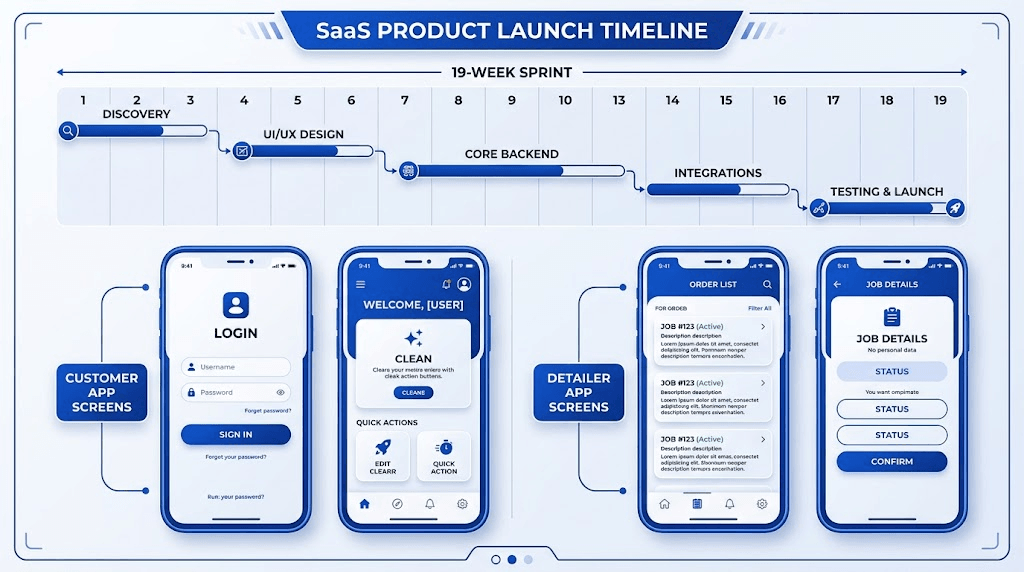
Timeline: 19 weeks, kickoff to both stores.
What happened after launch
- Month 1: 84 bookings, 4 detailers
- Month 3: 310 bookings, 9 detailers, 41% repeat rate
- The “no live map” decision turned out to be preferred by customers, who liked scheduling ahead
- First post-MVP feature request: recurring bookings (“every other Saturday”). Built for $6,200.
- Second: a fleet/B2B option for dealerships. That one’s on the roadmap; it’s a different product.
Ongoing costs at month 6: ~$1,400/month (maintenance retainer, AWS, Twilio, and Stripe fees excluded).
The founder’s original “everything Uber has” version was estimated at $165,000–$190,000 and 8+ months. They’d have launched with features nobody used and no money left for the detailers’ first-month guarantees, which turned out to be the thing that actually made supply work.
Running costs that scale with every ride, stay, or order
Build cost is the entry fee. On-demand apps have a running cost profile that’s different from a normal app because a lot of the third-party services charge per transaction.
| Cost | How it scales | Typical monthly at 1,000 transactions/month | At 10,000/month |
| Google Maps Platform | Per map load, per geocode, per route | $200 – $600 | $1,500 – $5,000 |
| Stripe | 2.9% + 30¢ per charge, plus Connect fees | ~$1,000 on $30K GMV | ~$10,000 on $300K GMV |
| Twilio (SMS, masked calls) | Per message / minute | $100 – $300 | $800 – $2,500 |
| Push notifications | Mostly free (FCM/APNs) | $0 | $0 – $100 |
| Cloud hosting (AWS/GCP) | With users and real-time load | $300 – $800 | $2,000 – $6,000 |
| Search (Algolia) | Per record + per search | $0 – $100 | $300 – $1,000 |
| Background checks (Checkr) | Per provider onboarded | $25 – $50 each | same |
| Maintenance retainer | 15–20% of build / year | $1,000 – $2,500 | $2,500 – $5,000 |
The takeaway: your platform’s take rate has to cover these. For context, Uber’s overall take rate sits around 25%, Airbnb’s is roughly 14–17% combined across host and guest fees, and DoorDash’s delivery commissions run 15–30% depending on the merchant plan. Those aren’t arbitrary; they’re what it costs to run the machine plus a margin.
If your model assumes a 10% take rate on a $20 average order, that’s $2 per order. After Stripe ($0.90) and Maps/Twilio ($0.30), you’ve got 80 cents to cover hosting, support, and maintenance. Do that math before you build.
We’ll cover maintenance costs in full detail in a dedicated post later in this series.
How to build one of these without $250,000
Everything above says expensive. Here’s how founders actually get these built on realistic budgets.
1. Pick one side to make easy, and make the other side manual
Airbnb famously photographed hosts’ apartments themselves. DoorDash founders delivered the food. For your MVP, build a great customer app and run the provider side through a simple web form plus a group chat. You’ll cut 25–35% of the build and learn what providers actually need before you build them an app.
2. Schedule instead of dispatch
Real-time dispatch is the most expensive thing on the menu. If your service can be booked 2+ hours ahead (cleaning, detailing, tutoring, most B2B), you don’t need it. The detailing example above saved ~$14,000 this way.
3. One city. One category. One vehicle type.
Every dimension you add multiplies edge cases. Launch in one zip code with one thing. Expansion is a settings change if the architecture is right; it’s a rewrite if you tried to build for everywhere on day one.
4. Go cross-platform
Three apps × two platforms natively is six codebases. With Flutter or React Native, it’s three. That’s a 30–40% saving on the frontend before you’ve cut a single feature. Our comparison of Flutter vs React Native vs Xamarin is worth a read if you’re unsure which; both are fine for this category, and DoorDash and Uber Eats have both used React Native in production.
5. Buy the commodity pieces
- Chat: Stream or Sendbird.
- Maps: Google or Mapbox.
- Payments: Stripe Connect.
- Identity: Persona or Onfido.
- Background checks: Checkr.
Each one replaces 40–120 hours of custom development with a few hours of integration and a monthly bill. Build only the parts that make your business different.
6. Web admin, not admin app
Nobody needs to approve drivers from their phone. A responsive web dashboard is a third the cost of a native admin app and works better anyway.
7. Phase it honestly
- Phase 1 ($60K–$90K): Core loop only. Prove people book, providers show up, money flows.
- Phase 2 ($30K–$60K): The features your first 500 users actually asked for. Not the ones you guessed.
- Phase 3 ($40K–$80K): Scale features: batching, surge, multi-city, advanced analytics.
Spread over 12–18 months, that’s a market-ready platform for $130K–$230K, funded partly by revenue and by the traction numbers Phase 1 gives you to raise on.
We wrote about the mindset behind this in our MVP development cost breakdown; the principles apply doubly to marketplace apps because there’s twice as much to be tempted by.
So, what’s it going to cost you?
The honest summary:
- An app like Uber: $60K–$90K to prove the concept, $120K–$180K to compete in a city, $200K+ to build something that feels like Uber.
- An app like Airbnb: $45K–$75K to prove it, $90K–$150K to compete, and $160K+ for the full experience.
- An app like DoorDash: $70K–$110K to prove it, $140K–$200K to compete, $220K+ for the whole thing.
And the meta-lesson: you’re not building an app. You’re building a small logistics company that happens to have apps. The apps are 60% of the cost; the backend and the operations tooling are the rest. Founders who understand that go in and build the right thing. Founders who don’t spend $15,000 on a clone, then $70,000 on a rebuild, and then finally start.
If you’re still deciding which marketplace idea to pursue, our list of 40 billion-dollar app ideas has a few on-demand concepts with real gaps in the market. And if you already know what you’re building, keep reading.
FAQs
How much does it cost to build an app like Uber?
An Uber-style app costs $60,000–$90,000 for an MVP (one city, one vehicle type, core request-accept-pay-track flow), $120,000–$180,000 for a market-ready version, and $200,000–$350,000+ for a full-featured platform with surge pricing, scheduled rides, multiple service tiers, and multi-city support. The cost covers three apps (rider, driver, and admin) plus a real-time backend.
How much does it cost to build an app like Airbnb?
An Airbnb-style rental marketplace costs $45,000–$75,000 for an MVP, $90,000–$150,000 for a market-ready version, and $160,000–$300,000+ for a full platform. It’s typically the cheapest of the three because it doesn’t need real-time tracking or dispatch; the main complexity is search, the availability calendar, and split payments with delayed payouts.
How much does it cost to build an app like DoorDash?
A DoorDash-style delivery app costs $70,000–$110,000 for an MVP, $140,000–$200,000 for a market-ready version, and $220,000–$400,000+ for a fully featured. It’s the most expensive because it requires four interfaces (customer, courier, merchant, and admin), real-time tracking, a complex order state machine, and three-way payment splits.
Why are on-demand apps so expensive to build?
Because they’re not one app. Every on-demand or marketplace product needs a customer app, a provider app, and an admin platform, all sharing a backend that handles real-time location, matching, multi-party payments, and notifications. The backend alone is typically 30–40% of the total effort.
How long does it take to build an app like Uber?
An Uber-style MVP takes 4–6 months; a market-ready version takes 6–9 months. Airbnb-style apps are faster (3–5 months for an MVP) and DoorDash-style apps are slower (5–7 months) because of the added merchant side and order timing logic.
Can I use an Uber clone script to save money?
You can buy an Uber clone script for $5,000–$25,000, and it’s an option if you have a technical team and your model matches the script exactly. But clone scripts commonly hit scaling limits, App Store rejections for template apps, and expensive vendor lock-in. Many end up being rebuilt for $60,000–$90,000, which is what a custom MVP would have cost initially.
What are the ongoing costs of running an on-demand app?
Expect $1,500–$5,000/month at low volume and $10,000–$25,000/month at 10,000+ transactions, covering Google Maps API, Stripe fees (2.9% + 30¢ plus Connect fees), Twilio, cloud hosting, and a maintenance retainer of 15–20% of build cost per year. Most of these scale per transaction, so your take rate has to cover them.
Should I build the driver app or customer app first?
Build the customer app properly and run the provider side manually or with a lightweight web tool first. This cuts 25–35% from the MVP budget and lets you learn what providers actually need before investing in a full provider app.
Is Flutter or React Native better for an Uber-like app?
Both work well for on-demand apps; Uber Eats and DoorDash have both used React Native in production, and Flutter’s performance with maps and animations is excellent. Choose based on your team’s expertise and long-term plans rather than the category; either one saves 30–40% over building separate native iOS and Android apps.