
WordPress is suitable for 80% of cases for American small businesses, such as a marketing site, a blog, a services page, or a simple store. For such developments, 3-15 thousand dollars are spent, and your employees can independently take care of changes to the site.
A custom site is needed when WordPress is not suitable for the product: for example, complex logic for booking services, a portal for users, interaction with information from your own software, or a high load which one plugin will not handle. Such a site is more expensive ($15,000-$75,000+) and requires a developer for subsequent modifications.

| WordPress | Custom | |
| Typical cost (small business) | $3,000 – $15,000 | $15,000 – $75,000+ |
| Time to launch | 2-6 weeks | 8-20 weeks |
| Who edits content | Your team | Your team, if a CMS is built in; otherwise a developer |
| Yearly upkeep | $500 – $3,000 | $2,000 – $10,000 |
| Best for | Marketing sites, blogs, brochures, simple stores | Web apps, portals, custom workflows, high-scale |
Key Takeaways
- WordPress powers roughly 42% of all websites. For a marketing site, that’s not a compromise; it’s the default for a reason.
- Custom isn’t “better.” It’s specific. You pay for it when WordPress’s plugin model gets in the way.
- The deciding question: does your website need to do something, or say something? Saying → WordPress. Doing → probably custom.
- Most “we need custom” requests we hear are really “our WordPress site is slow and ugly.” That’s a build-quality problem, not a platform problem.
- Headless WordPress is the middle path: WordPress for content, a custom front end for speed and design. Worth it for a minority of businesses.
What Each Option Actually Means
WordPress
An open-source content management system. You pick a theme (or have one designed), add plugins for features (forms, SEO, booking, e-commerce via WooCommerce), and your staff edit pages without touching code.
It’s free to install. You pay for hosting, premium plugins, and someone to set it up properly.
Custom Website
Constructed from scratch in code (usually React or Next.js, for the front end and whatever back end is appropriate), and every single component is written explicitly for you, not pulled from a plugin directory.
(You can do CMS things if you need to, by mounting a CMS in or onto the product, often a headless CMS like Sanity or Contentful, or, in some cases, WordPress running unassumingly in the background.)
When WordPress Makes Sense
Your Site’s Job Is to Explain and Convert
Who you are, what you do, why someone should call. Services pages, about page, testimonials, blog, contact form, maybe a booking widget. That describes most dental offices, law firms, contractors, restaurants, consultants, and local retailers.
WordPress does this well and cheaply, and it’s been doing it for twenty years.
You Want to Edit It Yourself
Add a blog post Tuesday. Change the hours for the holiday. Swap a team photo. WordPress’s editor is the most familiar in the world, and your office manager can learn it in an afternoon.
Budget Is Under $15,000
A well-built WordPress site, custom-designed theme, properly configured, fast, secure, runs $5,000-$15,000 from a good agency. That’s a fraction of custom.
You Need to Launch Fast
Two to six weeks is normal. Custom projects rarely finish under two months.
What a good WordPress build looks like: a custom or lightly customized theme, under ten plugins, managed hosting, a caching layer, and someone updating it monthly. That’s what Boolean Inc.’s WordPress development service delivers, and it’s why most of the “WordPress is slow” complaints we hear are about sites built with forty plugins on $4/month hosting.
When Custom Makes Sense
The Website Is the Product
A SaaS dashboard. A marketplace. A customer portal where clients log in, see their orders, upload documents, pay invoices. WordPress can be bent into this with plugins. It will fight you every step, and it’ll break on the next plugin update.
You Have Complex, Specific Logic
Multi-step quoting with pricing rules. Scheduling across staff, rooms, and equipment. Membership tiers with custom permissions. Any time you find yourself saying “the plugin almost does it, but…”, you’re describing custom.
Deep Integration With Your Own Systems
Your inventory system, your CRM, your ERP, your field-service software. Plugins exist for the big names (Salesforce, HubSpot). For anything proprietary or mid-market, custom integration is cleaner, faster, and doesn’t depend on a third-party developer keeping a plugin alive.
Performance at Scale
If you’re expecting serious traffic, running paid campaigns where every 100ms of load time costs conversions, or need sub-second pages on mobile for Core Web Vitals, a custom Next.js front end will beat a plugin-heavy WordPress site. Not always by much, if the WordPress site is well built, but consistently.
Security or Compliance Requirements
Healthcare, finance, legal. WordPress can be secured, but its popularity makes it the most-targeted platform on the web, and every plugin is an attack surface. A custom site has fewer moving parts to audit.
Boolean Inc.’s rule of thumb: if more than a third of the site’s pages require logged-in users or custom logic, we quote it custom. If it’s mostly content with a feature or two, we quote WordPress. Our web development team builds both, so we don’t have a reason to push either.
Cost: Build and Five Years of Ownership
Build Cost (2026, US Small Business)
| Scope | WordPress | Custom |
| 5-10 page brochure site, custom design | $4,000 – $10,000 | $15,000 – $30,000 |
| Services site + blog + booking + CRM integration | $8,000 – $18,000 | $25,000 – $50,000 |
| Small store (under 100 products) | $8,000 – $20,000 (WooCommerce) | $30,000 – $70,000 |
| Customer portal / web app | Not recommended | $40,000 – $120,000+ |
Ongoing Cost (Per Year)
| Item | WordPress | Custom |
| Hosting | $300 – $1,200 (managed) | $600 – $3,000 (cloud) |
| Premium plugins / licenses | $200 – $1,000 | $0 – $500 |
| Updates, security, backups | $600 – $2,400 (monthly care plan) | $1,500 – $6,000 (developer retainer) |
| Content changes | $0 (you do it) | $0 if CMS included; $100-$200/hr otherwise |
| Typical annual total | $1,100 – $4,600 | $2,100 – $9,500 |
Five-Year Total
Services site with booking and CRM integration:
- WordPress: ~$12,000 build + ~$2,500/yr × 5 = ~$24,500
- Custom: ~$35,000 build + ~$5,000/yr × 5 = ~$60,000
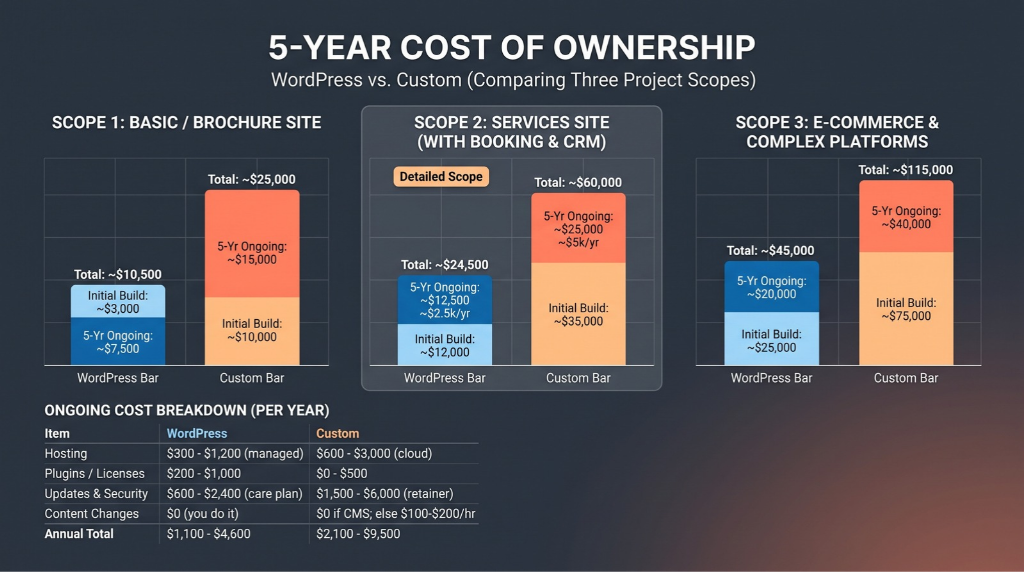
That $35,000 gap is real money for a small business. It’s worth paying when the custom site generates it back through capabilities WordPress couldn’t deliver. It’s wasted when the custom site does the same job a WordPress site would have.
We’ll break down website maintenance costs in detail later in this series.
The Myths That Push People the Wrong Way
“WordPress is slow.”
Badly built WordPress is slow. A custom theme, lean plugins, managed hosting, and caching routinely score 90+ on PageSpeed. The platform isn’t the problem. The $800 build with a bloated multipurpose theme is.
“WordPress isn’t secure.”
WordPress core is patched fast and often. Breaches almost always trace to outdated plugins, weak passwords, or cheap shared hosting. Maintained properly, it’s as safe as a small business needs.
“Custom means we own it.”
You own your WordPress site too. It’s open source. The content, design, and domain are yours. “Ownership” concerns belong to hosted builders like Wix, not to WordPress.
“Custom is future-proof.”
Custom code needs maintenance like anything else. Frameworks update, dependencies deprecate, and the developer who built it moves on. A custom site with no retainer is more fragile than a WordPress site on a care plan.
The Middle Path: Headless WordPress
WordPress runs in the back as the content editor. A custom React or Next.js front end serves the pages.
You get: the editing experience your team knows, plus custom-site speed and design freedom.
You pay: custom-site build costs ($20,000-$60,000) and you need a developer for front-end changes. Content edits stay easy; layout edits don’t.
Who it’s for: content-heavy businesses with real performance needs. Media sites, large multi-location service companies, businesses running heavy paid traffic to landing pages. It’s overkill for a ten-page site.
A One-Minute Decision Test
Count your yeses.
| # | Question | Yes → |
| 1 | Will users log in to see personalized information? | Custom |
| 2 | Does the site need pricing, scheduling, or workflow logic you can’t describe in one sentence? | Custom |
| 3 | Does it need to talk to internal systems that aren’t Salesforce, HubSpot, or QuickBooks? | Custom |
| 4 | Are you handling regulated data (health, financial) directly on the site? | Custom |
| 5 | Is the site primarily pages that explain what you do? | WordPress |
| 6 | Will non-technical staff update it weekly? | WordPress |
| 7 | Is the budget under $15,000? | WordPress |
| 8 | Do you need it live within six weeks? | WordPress |
Two or more “Custom”: get a custom quote; it’ll pay for itself.
Otherwise: WordPress, built properly.
Deciding who should build it? Our freelancer vs agency vs in-house guide applies to websites as much as apps. And if you’re wondering whether you need an app alongside the site, start with when to shift from website to mobile app.
The Bottom Line
WordPress for sites that say things. Custom for sites that do things. Headless when you need both and can afford it.
Most small businesses need the first one, built well. The ones that need custom usually know it, because they’ve already hit the wall with plugins.
FAQs
Is a custom website better than WordPress?
A custom website is better in cases where your business needs complex logic, user accounts, extensive third-party tool integration, or high-performance clusters. Otherwise, WordPress is often more cost-effective for marketing sites and small business websites with few custom features. Ask yourself: can my WordPress site grow with my business? If yes, then WordPress is for you; it saves 50-70% of the costs associated with a custom site and allows your team to update the site content without a developer’s help.
How much does a WordPress website cost?
The entry-level small business WordPress site costs between $4000 and $18000 in 2026, depending on its scope, design complexity, and additional features. The annual maintenance cost for such a project is between $1100 and $4600, covering managed WordPress hosting, plugins, and a developer’s hourly support.
How much does a custom website cost?
A custom-coded small business website project costs between $15K and $50K for a marketing site or services page and can go up to $120K+ for a customer portal or web application, depending on the complexity of third-party API integrations and tools needed. The maintenance cost for such a project is between $2100 and $9500 per year, covering hosting and a developer’s hourly support.
Is WordPress good for SEO?
WordPress is excellent for SEO due to its clean URL structure, built-in SEO-friendly plugins, schema markup, and ease of content creation. A WordPress site will rank just as high as a custom site, given the same quality of content, CTR, and speed optimization. Otherwise, consult our WordPress SEO guide.
What is headless WordPress?
A headless WordPress website is a WordPress instance with a custom frontend, decoupled from default WordPress themes. It is easier to customize and build an accessible, performant marketing site with headless WordPress, while retaining some WordPress editing and publishing tools for content creators. The cost of a headless WordPress project equals a custom website’s cost ($20K-$60K+), but its technical complexity is closer to a WordPress theme customization.